- 1 Overview of the Old Testament
BIBLE BASICS
Old Testament High Level Overview
Creation & Pre-Flood
The Bible commences with the narrative of Creation, a profound account of the divine act that brought forth the universe, our planet, and the myriad forms of life that inhabit it. At the heart of this narrative is the creation of humanity, crafted in the image of God and entrusted with the stewardship of the world. However, the harmonious relationship between humanity and the Creator was soon disrupted by the Fall of Man. This pivotal event, often symbolized by the story of Adam and Eve's forbidden fruit, marked a turning point in the human journey.
Through the Fall, sin entered the world, initially manifesting as a seemingly innocuous act of disobedience. However, sin's insidious nature led to its exponential growth, corrupting humanity's hearts and minds and leading to acts of violence and depravity. By the time of Noah, sin had become so pervasive that no righteous person remained, leaving God with the agonizing decision of whether to preserve or destroy His creation.
Yet, in His infinite wisdom and mercy, God chose a path that would ultimately redeem and restore humanity. He called upon Noah, a righteous man, to build an ark that would serve as a sanctuary during a cataclysmic flood that would cleanse the earth of its wickedness. The flood symbolized God's judgment upon sin but also His desire to preserve His creation.
In Noah and his family, God saw a glimmer of hope. Through the waters of the flood, they underwent a transformative experience, a baptism of righteousness. This symbolic cleansing represented the potential for humanity to be renewed and restored to its original purpose. Noah's ark became a vessel of salvation, a reminder that even in the midst of judgment, God's grace and mercy endure.
The Patriarchs
After the great flood, time progressed, and the era of the Great Patriarchs commenced. Abraham, Isaac, and Jacob, the forefathers from whom the nation of Israel (the church) originated, emerged during this period.
Sarah, Abraham's wife, harbored doubts about God's promise of a child. Consequently, she encouraged Abraham to conceive a child, Ishmael, with their maid, Hagar. However, God's promise prevailed, and Sarah eventually gave birth to Isaac. Abraham, at Sarah's request, sent Hagar and Ishmael away. However, God lovingly cared for both of them.
In a profound test of faith and obedience, God instructed Abraham to sacrifice Isaac, his beloved son. Abraham's unwavering trust in God led him to comply. Miraculously, an Angel intervened, providing an alternative sacrifice in Isaac's place. God then revealed his purpose for Sodom to Abraham, who interceded on its behalf.
Seeking a suitable wife for Isaac, Abraham dispatched his servant to find her. The servant journeyed to Mesopotamia and found Rebecca, the daughter of Abraham's nephew Bethuel. Isaac and Rebecca were married, but it took twenty years for her to conceive. When she finally did, she gave birth to twins, Esau and Jacob. Esau was the elder of the two. A prophecy foretold their destinies: "Two nations are in your womb; and two peoples shall be separated from your body; and one people shall be stronger than the other. And the older shall serve the younger" (Genesis 25:23).
Jacob, driven by his desire for his father Isaac's blessing, resorted to deception. He tricked Isaac into believing he was Esau, his older twin brother, and received the blessing intended for Esau. Esau, upon discovering the betrayal, was filled with rage and vowed to kill Jacob. Fearful for his life, Jacob fled to Haran, where he sought refuge with his uncle Laban.
In Haran, Jacob found himself caught in another web of deception. Laban, taking advantage of Jacob's vulnerability, deceived him into working for him for seven years in exchange for the hand of his younger daughter, Rachel. However, on the wedding night, Laban substituted Leah, Rachel's older sister, for Rachel. Disappointed but determined, Jacob agreed to work another seven years to marry Rachel, whom he truly loved.
Jacob's time in Haran was not without its blessings. He became the father of twelve sons, 6 from Leah , 2 from Rachel and 4 from their maids. (Genesis 30) These sons would later become the patriarchs of the twelve tribes of Israel. Among them was Joseph, the eldest son of Rachel, who would play a pivotal role in guiding the Israelites to Egypt.
Slavery in Egypt, and conquest of Canaan
The Jews are then enslaved in Egypt. The enslavement and freedom of the Jews is detailed in Exodus, Deuteronomy, Numbers and Leviticus. Israel, God’s people, went into enslavement quickly yet again but protected through baptism and the gift of the laws. Despite their suffering, God's protection and guidance never wavered. Through baptism and the gift of the laws, they were empowered to break free from the chains of slavery, both physical and spiritual. [ends Pentateuch]
The newfound freedom brought about the opportunity to enter the promised land. God promised victory in military campaigns and vowed to remain with the Israelites as long as they adhered to His laws. Surrendering to the Holy Spirit's guidance, just as they once obeyed the laws, they were led by Joshua to the promised land, a representation of Heaven. [ends Joshua]
The journey through the Old Testament is replete with significant periods that shaped the Israelites' history and their relationship with God. From Jacob's deception to Joseph's rise in Egypt, from the enslavement and exodus to the conquest of the promised land, each event serves as a testament to God's faithfulness and His desire for His people to experience freedom and fulfillment.
The story of Israel's journey is not without its challenges. Despite God's promise to Abraham, the Israelites found themselves enslaved in Egypt for 400 years. This period of oppression led to their desire for freedom and ultimately culminated in their miraculous escape through the Red Sea. The Red Sea, symbolically viewed as a "water of baptism," represents the Israelites' liberation from slavery and their entry into a new covenant relationship with God.
Guided by the Law, which served as a moral and ethical compass, the Israelites journeyed through the wilderness for many years. This period of testing and refinement prepared them for their eventual arrival in the Promised Land. Under the leadership of Joshua, they conquered Canaan and established the nation of Israel, fulfilling God's covenant with Abraham and his descendants.
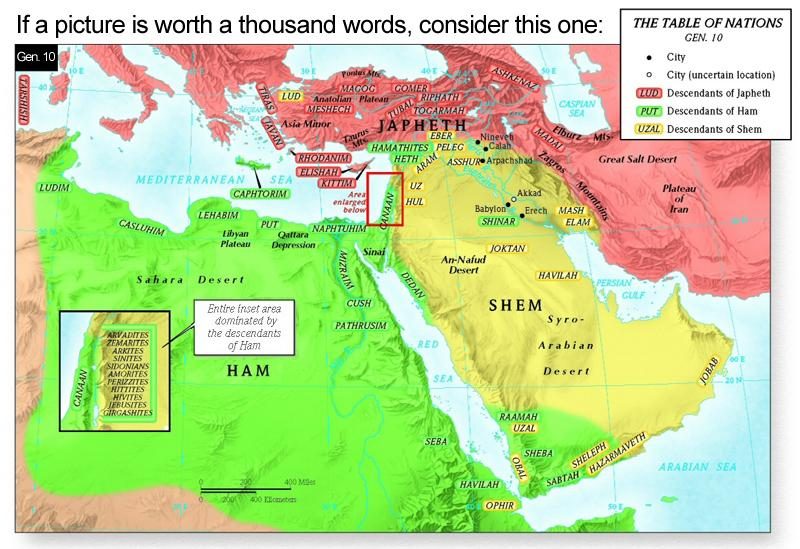
Geographical: The Table of Nations
The lineage of Noah, commonly known as the Table of Nations, provides significant insights into the dispersion of humanity after the Great Flood. According to this genealogical record, Noah's three sons, Ham, Shem, and Japheth, became progenitors of distinct populations that settled in different regions of the world.
Ham, the youngest son, is associated with the land of Egypt. His descendants are believed to have migrated to North Africa and established the ancient Egyptian civilization. This region became renowned for its advanced culture, impressive architecture, and influential religious practices.
Japheth, the second son, is associated with Asia Minor and Europe. His descendants are believed to have spread across these regions, contributing to the diversity of cultures and languages found there. Japheth's lineage includes nations such as the Greeks, Romans, Celts, and Germanic tribes.
Shem, the eldest son, is linked to the Middle East. His descendants populated various areas in the region, including Mesopotamia, Canaan, and Arabia. Notably, Israel, the chosen people of God, descended from Shem through Abraham. God guided Abraham to the land of Canaan, fulfilling His promise of giving this land which He gives to him “and his descendants forever”.
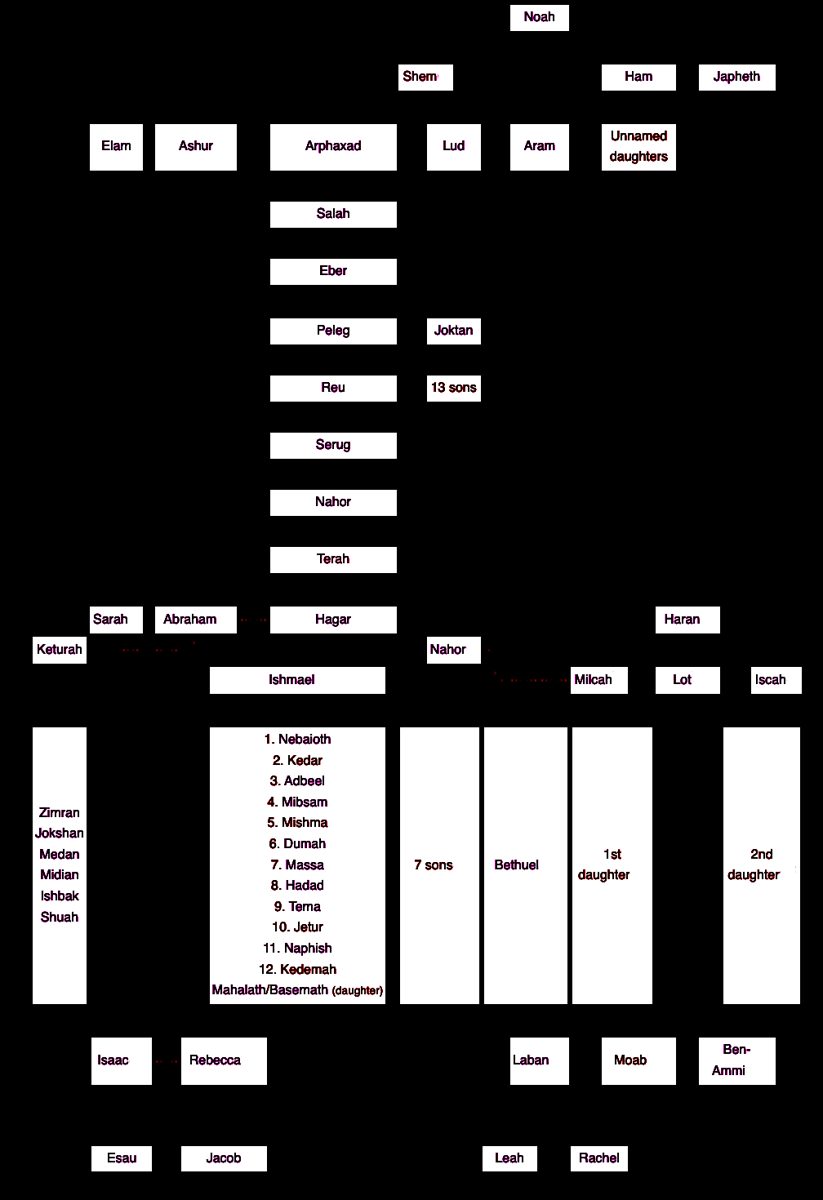
The Descendants of Shem
By looking at the genealogy of Shem, we can more notably notice the inter-relations between characters often referred to in Scripture. For instance, noticing Abraham and Lot’s relationship, uncle to nephew, or seeing Laban, the uncle of Jacob, brother of Rebecca. Visualizing these relationships help simplify the biblical narrative of those events.
Judges to the united Kingdom
After Joshua's death, the tribes of Israel continued their conquest of the southern regions of Canaan. However, they were unable to thoroughly cleanse the land of its native inhabitants. God declared that these remaining people would be an obstacle to Israel's enjoyment of the promised land. Generations passed, and the younger Israelites turned away from God, intermarrying with the Canaanites and worshiping their local deities. God threatened to abandon Israel due to the disobedience of the youth, but he selected a series of judges, or rulers, to act as temporary leaders for the people.
The story of the Judges is a cycle of rebellion, salvation, and renewed rebellion. Israel would follow evil ways, a judge would save them, the judge would die, and then they would return to even worse evil. This cycle repeated itself over and over again.
Some notable parties involved in the story of the Judges include the Midianites (faced by Gideon) and the Philistines (faced by Samson). The judges who led Israel during this time period were Othniel, Ehud, Shamgar, Deborah, Gideon, Abimelech, Tola, Jair, Jephthah, Ibzan, Elon, Abdon, and Samson.
In the end, however, "In those days there was no king in Israel; everyone did what was right in his own eyes" (Joshua 21:25). The Israelites sought their own way, followed their own desires, and were influenced by their pagan surroundings. This led to the point where God said of them, "They have rejected Me from being king over them" (1 Samuel 8:7).
The United Kingdom till Christ: High Level
A United Kingdom
Israelites wants a King
The Israelites, after being led out of Egypt by Moses and wandering in the wilderness for 40 years, eventually settled in the Promised Land. For many years, they were ruled by judges, who were chosen by God to lead and guide the people. However, as the Israelites grew in numbers and strength, they began to desire a king like the other nations around them.
Choice of the People: Saul
Around 1050 BC, the Israelites asked the prophet Samuel to anoint a king over them. Samuel, who had been the last judge of Israel, initially resisted their request, warning them of the dangers of having a king. However, he eventually relented and anointed Saul, a Benjamite, as the first king of Israel.
Saul was a tall and handsome man, and he was also a skilled warrior. A man after the heart of the people. He appeared good, was respected and even feared God at first. However, he was also prone to pride and jealousy. He made several mistakes during his reign, including disobeying God's commands and persecuting David, who was anointed by God to be the next king. As a result of his sins, Saul and his sons were killed in battle, and the kingdom passed to David.
Choice of God: David
David was a shepherd boy from Bethlehem who was chosen by God to be the next king of Israel. He was a man after God’s heart, a man of great faith and courage, and he was also a skilled musician and poet. David's reign lasted for 40 years, and it was a time of great prosperity and power for Israel. He conquered many of Israel's enemies, and he also established Jerusalem as the capital of Israel. David is considered to be one of the greatest kings of Israel, and he is often referred to as "the man after God's own heart."
David's Successor: Solomon
Solomon was David's son and successor. He was known for his wisdom and intelligence, and he is often credited with writing the book of Proverbs. Solomon also built the First Temple in Jerusalem, which was a magnificent building dedicated to the worship of God. Solomon's reign was a time of great peace and prosperity for Israel, but it also marked the beginning of the decline of the kingdom.
Solomon's Successor: Rehoboam
Rehoboam was Solomon's son and successor. He was a harsh and oppressive ruler, and he refused to listen to the advice of his advisors. As a result, the kingdom of Israel was divided into two parts: the northern kingdom of Israel and the southern kingdom of Judah. The northern kingdom was eventually conquered by the Assyrians in 722 BC, and the southern kingdom was conquered by the Babylonians in 586 BC.
A Divided Kingdom
Rooted in the stubbornness of Rehoboam, Jeroboam ignited a revolution that irrevocably divided the once-unified Kingdom of Israel. The northern Kingdom, often referred to as Ephraim or Judah, had its capital in Samaria. The southern Kingdom, commonly known as Jerusalem or Israel, had its capital in Jerusalem.
Each Kingdom witnessed the rise of its own prophets. In the North, prophets emerged as powerful figures, speaking truth to power and challenging the actions of the ruling monarchs. However, the northern Kingdom stubbornly resisted the messages of these prophets, refusing to heed their warnings and guidance. This collective defiance led to their eventual downfall, as the northern Kingdom was swiftly conquered and its people taken into captivity.
In contrast, the southern Kingdom initially displayed a more receptive attitude towards its prophets. These prophets played a vital role in shaping the religious and moral landscape of the Kingdom, offering guidance and counsel to the rulers and people alike. However, over time, the southern Kingdom also began to stray from the righteous path, leading to its eventual downfall at the hands of the Babylonians.
The divided Kingdoms of Israel and Judah served as a cautionary tale, illustrating the consequences of disregarding the wisdom and guidance of prophets. Their stories underscore the importance of humility, obedience, and the need for leaders to listen to the voices of those who speak truth to power.
A Period of Captivity
The Israelites faced a tumultuous period marked by captivity and deportation to Babylon, which unfolded in three distinct waves. During this challenging time, notable prophets emerged as beacons of hope and guidance for their people. Among them stood Daniel, a young man of exceptional character and unwavering faith. His wisdom and ability to interpret dreams gained him favor with the Babylonian king, Nebuchadnezzar. Daniel's prophecies foretold the rise and fall of empires, providing the Israelites with a glimpse of hope amidst their exile.
Alongside Daniel, the prophet Ezekiel played a pivotal role in guiding the Israelites during their time in Babylon. Through visions and symbolic actions, Ezekiel conveyed God's messages of comfort, judgment, and restoration. He encouraged the Israelites to remain steadfast in their faith and to turn away from idolatry. Ezekiel's prophecies also addressed the future restoration of Israel and the rebuilding of the temple in Jerusalem.
The Israelites' captivity in Babylon lasted for approximately 70 years. During this time, they endured hardships, oppression, and cultural assimilation. However, the presence of prophets like Daniel and Ezekiel sustained their hope and reminded them of God's covenant promises. Their prophecies provided a source of comfort and inspiration, helping the Israelites maintain their identity and faith in the midst of adversity.
The deportation of the Israelites to Babylon was a significant event in their history. It marked a period of trial and testing, but also a period of spiritual growth and renewal. Through the teachings of Daniel and Ezekiel, the Israelites learned valuable lessons about humility, repentance, and the importance of trusting in God's sovereignty. The Babylonian captivity ultimately served as a catalyst for the Israelites' spiritual transformation and prepared them for the eventual return to their homeland.