BIBL101 - Overview of the Old Testament
The Prophecy of Ahijah
Prophecy of Ahijah, during the reign of Solomon
Ahijah, a prophet during Solomon's reign, foretold the division of the kingdom. God instructed Ahijah to meet Jeroboam and tear his new garment into twelve pieces, signifying the division of the kingdom. Ten pieces would be given to Jeroboam, representing the ten tribes he would rule over, while one piece would remain with Solomon, symbolizing the tribe of Judah and Benjamin that would stay loyal to him. Solomon, in response to Jeroboam's rebellion, attempted to kill him. However, Jeroboam fled to Egypt and sought refuge under the protection of Pharaoh Shishak. Upon Solomon's death, Jeroboam returned to Israel and ascended to the throne, fulfilling the prophecy of the divided kingdom. God had a plan of prosperity for Jeroboam, promising to make his name as renowned as King David's. “ Then it shall be, if you heed all that I command you, walk in My ways, and do what is right in My sight, to keep My statutes and My commandments, as My servant David did, then I will be with you and build for you an enduring house, as I built for David, and will give Israel to you. ” (1 Kings 11:38)
Have you heard of Jeroboam? Does his name resound like the name of David in the church? God may have plans for each and every one of us, great plans, but it is our choice to live it. Jeroboam, exercising his free will, chose not to adhere to God's plan, leading to his downfall. After forming the Northern Kingdom. Jeroboam established two new centers of worship to replace Jerusalem, one at Dan in the north and the other at Bethel in the southern part of his kingdom. By replacing Jerusalem as the God-appointed place to offer sacrifices, he became known as Jeroboam the son of Nebat, which made Israel to sin.
“Now it happened at that time, when Jeroboam went out of Jerusalem, that the prophet Ahijah the Shilonite met him on the way; and he had clothed himself with a new garment, and the two were alone in the field. Then Ahijah took hold of the new garment that was on him, and tore it into twelve pieces. And he said to Jeroboam, “Take for yourself ten pieces, for thus says the Lord, the God of Israel: ‘Behold, I will tear the kingdom out of the hand of Solomon and will give ten tribes to you (but he shall have one tribe for the sake of My servant David, and for the sake of Jerusalem, the city which I have chosen out of all the tribes of Israel), because they have forsaken Me, and worshiped Ashtoreth the goddess of the Sidonians, Chemosh the god of the Moabites, and Milcom the god of the people of Ammon, and have not walked in My ways to do what is right in My eyes and keep My statutes and My judgments, as did his father David. However I will not take the whole kingdom out of his
hand, because I have made him ruler all the days of his life for the sake of My servant David, whom I chose because he kept My commandments and My statutes. But I will take the kingdom out of his son’s hand and give it to you—ten tribes. And to his son I will give one tribe, that My servant David may always have a lamp before Me in Jerusalem, the city which I have chosen for Myself, to put My name there. So I will take you, and you shall reign over all your heart desires, and you shall be king over Israel. Then it shall be, if you heed all that I command you, walk in My ways, and do what is right in My sight, to keep My statutes and My commandments, as My servant David did, then I will be with you and build for you an enduring house, as I built for David, and will give Israel to you. And I will afflict the descendants of David because of this, but not forever.’ ” Solomon therefore sought to kill Jeroboam. But Jeroboam arose and fled to Egypt, to Shishak king of Egypt, and was in Egypt until the death of Solomon.” 1 Kings 11:29-40
The north is now called Israel, Ephraim. God had a plan of prosperity for Jeroboam, one which would make his name as known as King David. Yet, in his free will, Jeroboam did not fulfill God’s plan.
Separation of northern 10 tribes
Ten tribes of Israel revolted under Jeroboam's leadership, forming the Northern Kingdom. These tribes were Asher, Dan, Ephraim, Gad, Issachar, Manasseh, Naphtali, Reuben, Simeon, and Zebulun. The northern kingdom, often referred to as Israel or Ephraim, separated from the southern kingdom of Judah, which remained loyal to Solomon's descendants. Jeroboam, upon hearing of Solomon's death, returned from Egypt and met with Rehoboam, Solomon's son and successor. The elders of Israel requested Rehoboam to lighten the burden imposed by his father, but Rehoboam's unwise response led to the division of the kingdom.
“And Rehoboam went to Shechem, for all Israel had gone to Shechem to make him king. So it happened, when Jeroboam the son of Nebat heard it (he was still in Egypt, for he had fled from the presence of King Solomon and had been dwelling in Egypt), that they sent and called him. Then Jeroboam and the whole assembly of Israel came and spoke to Rehoboam, saying, “Your father made our yoke heavy; now therefore, lighten the burdensome service of your father, and his heavy yoke which he put on us, and we will serve you.” So he said to them, “Depart for three days, then come back to me.” And the people departed.” 1 Kings 12:1-5
The Divided Kingdom
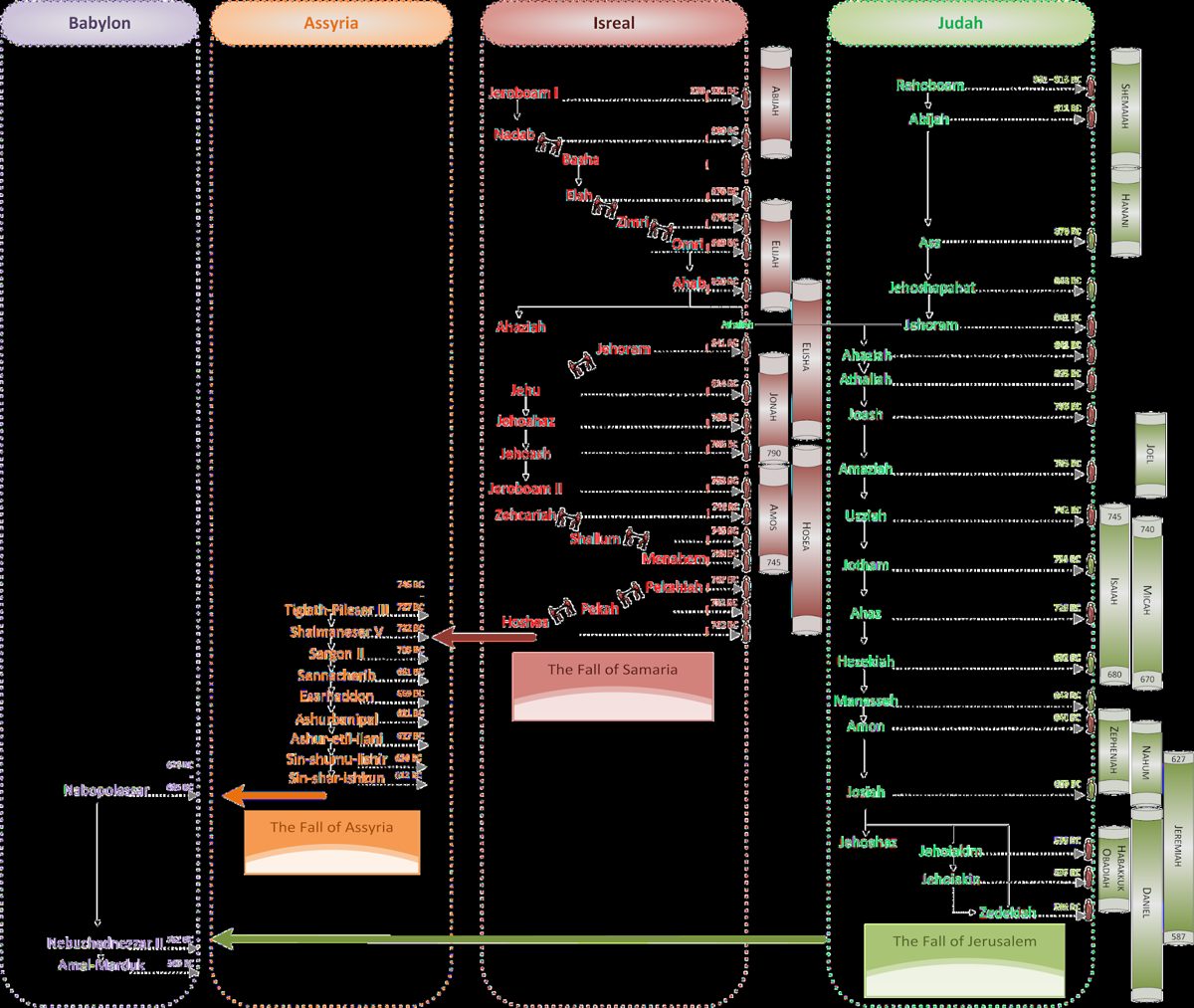
The Divided Kingdom of Israel was a period in ancient Israelite history that began after the death of King Solomon around 931 BC. Jeroboam returned to Israel and was proclaimed king by ten of the twelve tribes. The two tribes that remained loyal to Solomon's son, Rehoboam, were Judah and Benjamin, who formed the southern Kingdom of Judah. The kingdom was split into two separate entities: the northern Kingdom of Israel and the southern Kingdom of Judah.
The northern Kingdom of Israel, which consisted of the tribes of Asher, Dan, Ephraim, Gad, Issachar, Manasseh, Naphtali, Reuben, Simeon, and Zebulun, was often referred to as "Israel," "Ephraim," or "Samaria," with its capital city being Samaria. The southern Kingdom of Judah, consisting of the tribes of Judah and Benjamin, was often referred to as "Judah" or "Jerusalem," with Jerusalem as its capital.
The division of the kingdom had significant political and religious implications. The northern kingdom was known for its idolatry and worship of false gods, while the southern kingdom remained more faithful to the worship of Yahweh in Jerusalem. This religious divide contributed to conflicts and tensions between the two kingdoms.
The divided kingdoms also experienced different political fortunes. The northern Kingdom of Israel was frequently at odds with its neighbors, including the Arameans and Assyrians, and ultimately fell to the Assyrian conquest in 722 BC. The southern Kingdom of Judah survived longer, but was eventually conquered by the Babylonians in 586 BC, leading to the Babylonian exile of the Jewish people.
The Divided Kingdom period was a transformative time in Israelite history, marked by political upheaval, religious division, and significant cultural and social changes. The legacy of the divided kingdoms can still be seen in the modern-day religious and ethnic divisions in the region.
The Kings of the North: Israel, Ephraim
Only Stage 1: No God, quick destruction
The Kings of the north in ancient Israel were known for their wicked deeds and idolatry. Jeroboam, the first of these kings, set up calf idols in his temples, leading the people astray from the worship of the one true God. His reign lasted for 22 years.
After Jeroboam, his son Nadab ascended to the throne. However, his reign was short-lived, lasting only two years (1 Kings 15:25-26). Nadab's captain, Baasha, plotted against him and killed him along with the entire House of Jeroboam. Baasha then became king and reigned for 24 years. During his reign, he engaged in a war with Asa, the king of Judah. (1 Kings 15:27- 16:7)
Baasha was succeeded by Elah, who reigned for only two years. He was assassinated by Zimri, the commander of his chariots (1 Kings 16:8-10). Zimri's reign was even shorter, lasting only seven days. The army elected Omri as king, and he laid siege to Tirzah, the capital city, forcing Zimri to commit suicide. (1 Kings 16:15-18)
Omri became king after Zimri's death and reigned for 12 years.(1 Kings 16:23-28) Omri's son, Ahab, surpassed his father in wickedness. He married Jezebel, a pagan priestess, and introduced Baal worship into Israel. Ahab also had his son, Ahaziah, marry one of the daughters of Judah, further solidifying his political alliances. Ahab's reign lasted for 21 years.(1 Kings 16:28 - 22:40) Murders, plots and deception were at the center of the Kingdoms of Judah.
Ahaziah succeeded his father, Ahab, but his reign was cut short after only one year. He was fatally injured in a battle and died. (1 Kings 22:40 , 2 Kings 1:18)
Jehoram, Ahab's son by Jezebel, became king after Ahaziah's death. He reigned for 12 years and continued the wicked ways of his father. Jehoram faced several challenges during his reign, including conflicts with neighboring kingdoms and a rebellion led by Elisha's student, Jehu.(2 Kings 3:1, 9:25)
Jehu, a military commander, was anointed king by Elisha's student. He rose up against Jehoram, killing him along with Ahaziah, the king of Judah, and Jezebel, Ahab's mother. Jehu's reign lasted for 28 years, and he implemented religious reforms to eradicate Baal worship from Israel.(2 Kings: 9 - 10:36)
The Kings of the South: Judah, Jerusalem
Stage 1: Upholding a godly environment
Abijah took fourteen wives and had a large family with 22 sons and 16 daughters. However, Abijah's efforts to reunite the ten tribes of the northern Kingdom of Israel with Judah were unsuccessful. While he initially conquered Bethel and seized the golden calves worshiped there, instead of destroying them as required by the law, Abijah kept them. This decision demonstrated that he was not fully devoted to upholding God's commands.
Asa, who succeeded Abijah, was a dedicated follower of Yahweh. He was committed to preserving the traditional worship practices and eradicating idolatry and its associated immoralities. After a successful battle against Zerah of Ethiopia in his tenth year of rule, Judah experienced peace for fifteen years until the 25th year of Asa's reign. However, in his 26th year, Asa faced a challenge from Baasha, the king of Israel. To counter this threat, Asa formed an alliance with Ben-Hadad I, the king of Aram Damascus, persuading him to break his peace treaty with Baasha and invade the Northern Kingdom in exchange for monetary compensation. Asa reigned for many years and was highly revered by his people. He was generally regarded as a righteous king, known for his devotion to God and his leadership.
Jehoshaphat, the king of Judah, displayed great zeal in suppressing the idolatrous worship prevalent at the "high places" throughout the kingdom. This commendable action is recorded in 2 Chronicles 17:6, showcasing his commitment to promoting the worship of God. Additionally, Jehoshaphat sought to strengthen his kingdom by pursuing alliances with the northern kingdom of Israel. Notably, he arranged the marriage of his son, Jehoram, to Ahab's daughter, Athaliah. However, this alliance drew the criticism of the prophet Jehu, son of Hanani, who reproached Jehoshaphat for associating with the wicked house of Ahab. Recognizing his mistake, Jehoshaphat repented and returned to his previous stance of opposing all forms of idolatry. He dedicated himself to promoting the worship of God and ensuring just and righteous governance for his people, as described in 2 Chronicles 19:4–11.
Upon hearing the tragic news of Ahaziah's untimely death, Athaliah, driven by ambition and a desire for power, seized the throne of Judah. In a ruthless move, she ordered the execution of all potential claimants to the throne, including members of her own Omri dynasty. However, Jehosheba, Ahaziah's sister, defied Athaliah's murderous rampage and managed to rescue one of her grandsons, Jehoash, who was only a year old at the time. Jehoash was the son of Ahaziah and Athaliah's daughter, making him a direct descendant of both the Omri and Davidic dynasties.
Joash, the son-in-law of the prophet Zechariah, faced a challenging situation when the priests and officials of the kingdom turned away from worshipping God. Zechariah courageously confronted them, urging them to return to the path of righteousness. However, Joash, influenced by the wicked counsel of his advisors, reacted by ordering the execution of Zechariah by stoning. This tragic act demonstrated Joash's departure from the principles of faith and justice that had once guided his kingdom.
Stage 2: Guidance vs. Pride
Uzziah, a young monarch, ascended the throne at the tender age of 16 and reigned for approximately 52 years. During his rule, Uzziah oversaw a period of immense prosperity, surpassing all reigns since Solomon's except for Jehoshaphat's. The reigns of both, Uzziah and Jeroboam II in the north, marked prosperous times for both the kingdoms of Israel and Judah. The weakening of Egypt's economic power provided opportunities for growth and expansion. As a result, Israel and Judah experienced significant growth in stature and wealth. However, this era of prosperity led to overconfidence and a misplaced reliance on their own strength and resources.
Driven by pride, Uzziah committed a grave act. He ventured into the temple of Jehovah, intending to burn incense on the altar of incense, a privilege reserved solely for the priests. Azariah, the High Priest, recognized this as an attempt by Uzziah to usurp the prerogatives of the priests, and confronted him with a band of eighty priests. In a stern voice, Azariah declared, "It is not for you, Uzziah, to burn incense to the Lord, but for the priests, the sons of Aaron, who are consecrated to burn incense." (2 Chronicles 26:18).
At that very moment, the ground beneath them shook violently, and an earthquake erupted. Uzziah, stricken with terror, felt a burning sensation on his skin. It was leprosy, a dreaded disease that marked him as unclean. Compelled to reside in "a separate house" until his death, Uzziah's leprosy served as a constant reminder of his transgression (2 Kings 15:5, 27; 2 Chronicles 26:3). The Book of Isaiah uses "the year that king Uzziah died" as a reference point for describing the vision in which Isaiah sees his vision of the Lord of Hosts.
The government was entrusted to his son Jotham, who ably took the reins, guided by the advice of the prophets Isaiah, Hosea, Amos, and Micah. Jotham, a wise and righteous ruler, benefited greatly from the counsel of these prophets. Through their guidance, he implemented reforms, strengthened the nation, and promoted justice and righteousness. The reign of Jotham marked a significant period in Israel's history, characterized by spiritual revival, social justice, and economic prosperity. The prophets' influence on Jotham's rule left a lasting impact, shaping the destiny of his kingdom and leaving a legacy that would be remembered for generations to come.
Stage 3: Seeking the signs of God
Upon his accession to the throne of Judah, King Ahaz encountered a formidable challenge in the form of a coalition led by Pekah, the king of northern Israel, and Rezin, the king of Damascus (Syria). These monarchs sought to compel Ahaz to join them in opposing the growing threat of the Assyrians, who were preparing to invade the Northern Kingdom under their powerful leader, Tiglath-Pileser III (Pul). Faced with this pressing situation, the prophet Isaiah counselled Ahaz to place his trust in God rather than seek alliances with foreign powers. Isaiah urged Ahaz to ask for a sign as confirmation of God's promise of deliverance. However, Ahaz refused, stating that he would not put God to the test (Isaiah 7:12). In response, Isaiah declared that whether Ahaz asked for a sign or not, he would receive one. The sign would be the birth of a child, and the child's mother would name him Immanuel, which means "God-with-us" (Isaiah 7:13-14). This prophecy symbolized the enduring presence of God with His people, even in times of great distress.
Unfortunately, Ahaz did not heed Isaiah's counsel and instead chose to align himself with the Assyrians. In 732 BCE, he travelled to Damascus to pay homage to Tiglath-Pileser and his gods. Ahaz was captivated by the splendour and prestige of the Assyrian religion and politics, and he adopted some of their practices in Jerusalem. He had an altar built in the Temple, modelled after one he had seen in Damascus, and implemented changes to the ritual and furnishings of the Temple, all "because of the king of Assyria" (2 Kings 16:18).
In sharp contrast to Ahaz's actions, his son Hezekiah, who succeeded him to the throne, demonstrated unwavering trust in God. When the Assyrian king Sennacherib turned his attention towards the cities of the west in 701 BCE, Hezekiah refused to rely on Egypt for support. Instead, he placed his faith in
God and fervently prayed for deliverance. The Assyrians did not launch an attack on Jerusalem, and God miraculously intervened by sending an angel who struck down 185,000 Assyrian soldiers in one night, forcing Sennacherib to return to his own land in disgrace.
Later in his life, Hezekiah fell ill with a severe boil or inflammation that Isaiah initially believed would be fatal. However, after Hezekiah prayed to God, Isaiah delivered a message that he would live for another 15 years (Isaiah 38:5). During this extended period, Hezekiah's son and successor, Manasseh, was born. Manasseh was 12 years old when he ascended to the throne after Hezekiah's passing.
Thus, the reigns of Ahaz and Hezekiah provide contrasting examples of kings who made different choices in the face of adversity. Ahaz turned to foreign alliances and adopted foreign religious practices, while Hezekiah relied solely on God and experienced miraculous deliverance. Their stories serve as reminders of the importance of faith, trust, and seeking God's guidance in times of trial.
Life of Repentance
During his reign, Manasseh reversed the centralizing religious reforms instituted by his father, King Hezekiah. Instead, he re-established local shrines, possibly driven by economic motives. These shrines served as places of worship for polytheistic deities such as Baal and Asherah. Manasseh even went so far as to restore the worship of these deities within the Temple itself, defying the strict monotheism promoted by his father. Furthermore, he sponsored the Assyrian astral cult throughout Judah, further solidifying his commitment to polytheism.
In a significant event, Manasseh was captured and brought in chains before the Assyrian king, believed to be Esarhaddon. This capture likely occurred due to suspicions of disloyalty on Manasseh's part. However, the biblical account indicates that he was later treated well and reinstated on his throne. Notably, neither the biblical book of Kings nor Assyrian records provide any further details about this incident.
Manasseh's wickedness reached such extreme levels that he is even said to have committed the heinous act of martyring the prophet Isaiah by cutting him in half. The severity of his imprisonment, however, brought about a transformation in Manasseh. He experienced deep remorse and repentance, turning away from his evil ways.
After Manasseh's reign, his son Amon succeeded to the throne. Unfortunately, Amon reverted to the idolatrous practices of his father, undoing much of the spiritual progress made during Hezekiah's time. Much can be said about unhealthy upbringing, even though the repentance of Manasseh was accepted by God, the consequences of his decisions impacted Israel past his departure.
From the tender age of eight, Josiah was placed as King of Judah. Guided by an unwavering faith, he sought the Lord's presence and guidance, yearning to establish a righteous and God-centered nation. With unwavering determination, Josiah embarked on a mission to restore the worship of God throughout his kingdom. He recognized that the people had strayed from the path of righteousness, and he believed it was his duty to lead them back to the Lord. He commanded the people to cleanse the Temple and remove all the idols and pagan symbols that had crept in over the years.
Josiah also encouraged the life of repentance among his subjects. He understood that true worship involved not only external rituals but also a genuine transformation of the heart. He preached the importance of turning away from sin and living a life that was pleasing to God. Through his words and actions, Josiah inspired many to seek forgiveness and to walk in the ways of the Lord.
His reforms had a profound impact on the nation. The people began to turn away from idolatry and embrace the worship of the one true God. The Temple once again became a place of reverence and devotion, and the nation experienced a spiritual revival. Josiah's reign became a model of faithful leadership and a testament to the power of God's grace at work in a ruler's heart.
The Prophetic Messages
North Jonah, Amos, Hosea Northern Israel
Jonah the prophet, precedes Amos and Hosea, and lived in the northern Israel but prophesied to the Ninevites who are in Assyria. Some say that as a prophet, he knew what would happen to his land, his family 65 years later (his mission was ~65 years prior to the Assyrian crisis). So as such, this is why he didn’t want to go to Nineveh. He went the complete opposite way, he wanted nothing to do with them. Jonah learned later to rely on God. He prayed and repented and God answered his prayers.
Jonah’s Message: their city would be destroyed in forty days if they did not repent for their wickedness.
Amos was a man of fearless resolution in it, faithful and bold in reproving sin and denouncing the judgments of God for it, and pressing tirelessly to repentance and reformation. He then calls Israel to account, and judges them for their idolatry, their unworthy walking under the favors God had bestowed upon them, and their incorrigibleness under his judgments. He calls them to repentance, rejecting their hypocritical sacrifices unless they did repent. He foretells the desolations that were coming upon them notwithstanding their security, some particular judgments, particularly on Amaziah; and, after other reproofs and threatenings, concludes with a promise of the setting up of the Messiah’s kingdom and the happiness of God’s spiritual Israel therein, just as the prophecy of Joel concluded.
Amos’ Message: Rebuked Social Injustice within the North, called them to repentance, warning them of God's coming punishment, and making them seek the day of the Lord. He was not successful, then Hosea came after him.
Hosea prophesied of the destruction of the kingdom of the ten tribes when it was at a great distance, and lived himself to see and lament it, and to improve it when it was over, for warning to its sister kingdom. The scope of his prophecy is to discover sin, and to denounce the judgments of God against a people that would not be reformed. Thus, God wants to speak harshly to Israel and sent Hosea. God asks him to marry Gomer, the harlot. Due to his marriage he ends up having the ability to relate to them – telling them that he understands why they don’t love God, because you don’t know Him – if Gomer knew how much I committed to her, how much I love her and was loyal to her, she would not leave me. The beginning of transformation is not to love God, it is to know Him! This is the beginning of transformation.
Hosea’s Message: Lack of knowledge of love of God. During the reign of king Hoshea, Israel fell captive to the Assyrians, 722 BC.
Other notable prophets at the time are Elijah and Elisha.
South Isaiah, Micah Judah
At the time of Isaiah, Pekah, king of Israel, tells Syria (small country) let’s unite and fight Assyria – knowing they are too small, they go to Ahaz, king of Judah, but he rejects them, at the recommendation of Isaiah! When they refused, Israel and Syria wanted to take over his army, so they went to war. Ahaz was trembling in fear. He started doubting and began thinking of requesting help from Egypt. But Isaiah stopped him – don’t shake! Trust and he will deliver you - and promised God would deliver them as a sign. Surely, Assyrians ended up helping them and eventually conquered Israel all together.
Isaiah’s Message: Israelites spread throughout the nations. The priests became bad, so they spread. So how does God save the Israelites? He sends His Son, to teach the apostles to spread the world. The Israelites are now everywhere. How does God save Israel? It’s crazy, we got to save everyone! This is the message. The world is now Israel. “In returning and rest you shall be saved, in quietness and confidence shall be your strength” Isaiah 30:15
Micah was to convince sinners of their sins, by setting them in order before them, charging both Israel and Judah with idolatry, materialism, oppression, contempt of the word of God, and their rulers especially, both in church and state, with the abuse of their power; and also by showing them the judgments of God ready to break in upon them for their sins. And to comfort God’s people with promises of mercy and deliverance, especially with an assurance of the coming of the Messiah and of the grace of the gospel through him. It is remarkable concerning this prophecy, and confirms its authority, that we find two quotations out of it made publicly upon very solemn occasions, and both referring to very great events. One is a prediction of the destruction of Jerusalem (3:12). Another is a prediction of the birth of Christ (5:2)
Micah’s Message: God judgment of evil, and goodness to the faithful, as well as addressing social injustice that was also going on in the south. “What does Yahweh require of you but to do justice, to love kindness, and to walk humbly with your God? (Micah 6:8)