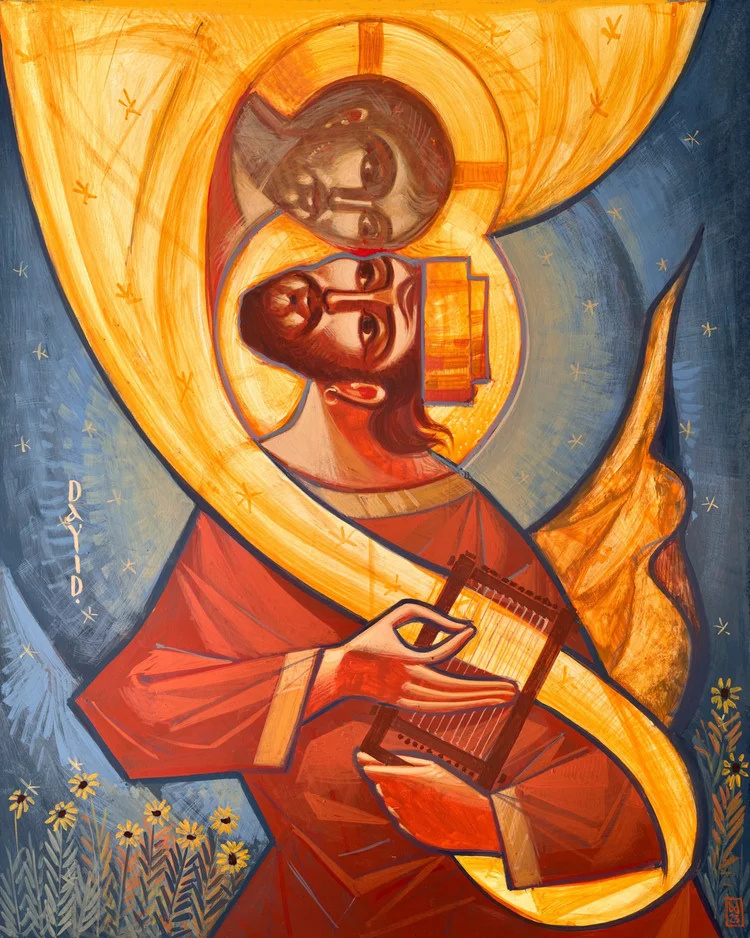
- 4 Kings & Leaders
Typology: Recognizing the Blueprint
Throughout Scripture, God reveals Himself not only through direct words and commandments but also through the lives of His people. The stories of the Old Testament are more than ancient records of faith and failure; they are the unfolding revelation of God in Christ. Within the Old Testament, we discover shadows and symbols, figures whose experiences and roles anticipate something far greater than themselves.
This way of reading the Bible is known as typology. In typology, an Old Testament person, office, or event is a type: a prophetic image that foreshadows a deeper spiritual truth. The fulfillment of that image in the New Testament is called the antitype, found perfectly in Jesus Christ. Typology is not imaginative storytelling imposed on the text; it is a reverent recognition that the same God who acted in Israel’s history also brought salvation to completion in the Incarnate Word. Thus, the gospel is not a new idea appearing suddenly in the New Testament, but the promised fulfillment of what God had been speaking “from the very beginning.”
Among all Old Testament figures, few reflect the person and mission of Christ as vividly as King David. Anointed as shepherd and king, David stands at the intersection of humanity’s weakness and God’s redemptive power. His courage before Goliath, his deep repentance after sin, his anointing by the Spirit, and his role as a ruler who brings unity and peace, all these moments echo in the life and ministry of Christ, who embodies them in their fullness.
By contemplating the parallels between David’s story and the life of Jesus, we gain a richer and more complete understanding of the gospel: Christ is the true King, the true Shepherd, the true Champion, and the true Forgiver is revealed in the Old Covenant in shadow, and in the New Covenant in truth.
The Royal Lineage: Son of David
In ancient times, genealogy played a crucial role in establishing a person's lineage and religious importance. For this reason, the Holy Gospels of St. Matthew and St. Luke preserve two genealogies of the Lord Jesus Christ. Though the genealogies are not identical in every detail, their theological purpose is clear: they proclaim that Jesus is truly of the house of David, fulfilling the necessary lineage for the Messiah.
The Gospel of Matthew opens by calling Jesus Christ the “Son of David, the Son of Abraham”. The genealogy highlights David as “David the king”. This emphasis is because the Messiah was prophesied to come as a king from a king, specifically from the house of David.
The repeated emphasis on “the king” is not incidental. The Messiah was prophesied to come as a king from a king, specifically from the lineage of David. This royal expectation is voiced in the Scriptures:
- “And has raised up a horn of salvation for us, In the house of His servant David” – Luke 1:69
- “There I will make the horn of David grow; I will prepare a lamp for My Anointed.” – Psalm 132:17
This expectation was also alive among the people during Jesus’ earthly ministry. They saw His works, and they searched the Scriptures with their hearts, asking whether the promised King had come:
- The blind men cried out to Him, saying, “Son of David, have mercy on us!” (Matthew 9:27).
- The multitudes, amazed by His works, questioned, “Could this be the Son of David?” (Matthew 12:23).
- As Jesus entered Jerusalem, the crowds proclaimed, “Hosanna to the Son of David!” (Matthew 21:9).
However, Jesus revealed a deeper truth about His identity to the Pharisees.When they answered that the Christ is “the Son of David,” Jesus confronted them with David’s own Spirit-inspired confession:
“While the Pharisees were gathered together, Jesus asked them, saying, ‘What do you think about Christ? Whose Son is He?’ They said to Him, ‘The Son of David.’ He said to them, ‘How then does David in the Spirit call Him ‘Lord,’ saying: ‘The Lord said to my Lord, ‘Sit at My right hand, Till I make Your enemies Your footstool’ ’? [Psalm 110] If David then calls Him ‘Lord,’ how is He his Son’ And no one was able to answer Him a word, nor from that day on did anyone dare question Him anymore, (Matthew 22:41-45).
This paradoxical question exposed the Pharisees' limited understanding, challenging them to recognize that Jesus was not merely a descendant of David but also possessed a higher, divine status. In this moment, the Lord opens the door into the mystery: the Messiah is David’s Son according to the flesh, yet David calls Him “Lord” by the Spirit. In other words, Christ is not merely descended from David, He is greater than David, the eternal King whom David serves and prefigures.
This deepens the beauty of the cry of the blind men proclaiming “Son of David”. This confession from the lips of the needy, especially the blind, those who cannot rely on outward sight, and their petition, “have mercy on us,” is therefore both theological and liturgical: they identify the King by His divine mercy. This is consistent with God’s character as revealed throughout Scripture: His power is never divorced from compassion, and His kingship is not expressed as domination, but as healing, restoration, and deliverance.
The Suffering King Foretold
Typology does not only point to Christ’s kingship; it also points to the scandal and glory of His suffering. The Old Testament prepares the Church to recognize the crucified Messiah, not as an unexpected tragedy, but as the promised path of redemption. The Servant’s rejection in Isaiah and the righteous sufferer’s agony in the Psalms form a prophetic horizon in which the Cross is revealed as God’s wisdom.
“And when we see Him, There is no beauty that we should desire Him. He is despised and rejected by men” – Isaiah 53:2-3
Psalm 22 likewise bears witness with a startling vividness:
“My God, My God, why have You forsaken Me?” “A reproach of men, and despised by the people. All those who see Me ridicule Me; They shoot out the lip, they shake the head, saying, “He trusted in the Lord, let Him rescue Him; Let Him deliver Him, since He delights in Him!”” “I am poured out like water, And all My bones are out of joint” “They pierced My hands and My feet; I can count all My bones. They look and stare at Me. They divide My garments among them, And for My clothing they cast lots.” (Psalm 22)
These are not accidental parallels. Rather, we confess that the Spirit who inspired the Scriptures also prepared the people of God to recognize Christ, especially when His glory is veiled beneath suffering.
The Anointing and the Coming of the Spirit
The moment David transitions from shepherd to king is a powerful type of Christ’s initiation into His ministry: the anointing. In Israel, anointing is not merely a human appointment, it is the sign of divine selection, divine mission, and divine empowerment. The king receives oil outwardly and the Spirit inwardly.
Divine Selection in Bethlehem
God commands Samuel:
“Fill your horn with oil, and go; I am sending you to Jesse the Bethlehemite. For I have provided Myself a king among his sons.” And Samuel said, “How can I go? If Saul hears it, he will kill me.” But the Lord said, “Take a heifer with you, and say, ‘I have come to sacrifice to the Lord.’ Then invite Jesse to the sacrifice, and I will show you what you shall do; you shall anoint for Me the one I name to you.” So Samuel did what the Lord said, and went to Bethlehem. And the elders of the town trembled at his coming, and said, “Do you come peaceably?” And he said, “Peaceably; I have come to sacrifice to the Lord. Sanctify yourselves, and come with me to the sacrifice.” Then he consecrated Jesse and his sons, and invited them to the sacrifice.” – 1 Samuel 16:1-5
Samuel’s mission is clear. He comes to Bethlehem with oil, yet he does not know who the chosen king is. This, too, bears a typological weight: the prophets spoke truly, yet they did not grasp the full horizon of what they proclaimed.
“Of this salvation the prophets have inquired and searched carefully, who prophesied of the grace that would come to you, searching what, or what manner of time, the Spirit of Christ who was in them was indicating when He testified beforehand the sufferings of Christ and the glories that would follow. To them it was revealed that, not to themselves, but to us
they were ministering the things which now have been reported to you through those who have preached the gospel to you by the Holy Spirit sent from heaven—things which angels desire to look into.” – 1 Peter 1:10-12
The Rejected Shepherd Chosen
David is not presented as a naturally obvious candidate. He is the youngest, overlooked even by his own household:
And Samuel said to Jesse, “Are all the young men here?” Then he said, “There remains yet the youngest, and there he is, keeping the sheep.”- 1 Samuel 16:11
Here the pattern of God’s election appears: the Lord often chooses what is hidden, small, and despised in order to reveal His power and overturn human pride. David’s initial status as a young, rejected shepherd mirrors the prophetic portrait of Christ’s rejection:
“There is no beauty that we should desire Him. He is despised and rejected by men” – Isaiah 53:2-3
The Anointing at the Sacrifice
Kingship in Scripture is inseparable from consecration. A king is not simply a strong figure who rises above others; he is one set apart by God, appointed for God’s purposes, and empowered by God’s Spirit. David’s transition from shepherd to king is therefore presented not as a career advancement but as an anointing.
“Then Samuel took the horn of oil and anointed him in the midst of his brothers; and the Spirit of the Lord came upon David from that day forward.” – 1 Samuel 16:13
This is why the Church reads the anointing of David as a luminous type of Christ’s own public inauguration, and also as a pattern that echoes into the sacramental life of believers.
This pairing, anointing and Spirit, is central to the typology. The anointing happens at the sacrifice (verses 2-3), just as Christ was enthroned on the Cross at the ultimate sacrifice. The Cross is not a defeat forced upon Christ; it is the royal enthronement of the true King, who reigns by self-offering love. And at Christ’s Baptism, the Holy Spirit descends, revealing that His ministry is the Spirit-bearing, Spirit-filled work of salvation.
When Christ is Baptized, the Holy Spirit also comes down just as the Spirit enters David when he is anointed. Similarly, the Holy Spirit comes upon believers when they are baptized and anointed with myron. In this way, David’s anointing does not merely point to an ancient political transition; it points forward to the mystery of Christ’s consecration and to our own sacramental incorporation into His life.
The Contrast in Kingship: Saul vs. David
The relationship between King Saul and David sets up a powerful typology regarding the temporal versus the eternal kingdom. In the Old Testament, Saul is not merely “a bad king” in a moralistic sense; he becomes a sign of a kingdom grounded in insecurity, self-preservation, and disobedience. David, for all his human weakness, becomes the standard by which the kings are measured, because his kingship is rooted in God’s choosing and God’s Spirit.
| Characteristic | Saul (Type of AntiChrist) | David (Type of Christ) |
|---|---|---|
| Status | Rejected and becomes a sign of evil. Temporary. | Becomes the standard by which all OT kings are compared. The King of Kings. |
| The Spirit | When a distressing spirit was upon Saul, David would play the harp, and Saul would become refreshed and the spirit would depart. | Afetr Christ’s baptism, He casts out demons, overcomes temptations, and heals the people. |
| Recognition | The anointing was known only to the Prophet, not the King (Saul). | Christ the King was known to the people of God, not King Herod or the nobles. |
| Destiny | Will be replaced. | Christ will come again and replace all earthly kings. |
Furthermore, the attempts by Saul to kill David parallel the attempts to seize Jesus. When Saul sent messengers to capture David, the Spirit of God fell upon them, and they prophesied (praised God) instead. When Saul went himself, he was similarly overcome by the Spirit and prophesied, thus failing to kill David. Similarly, officers sent to take Jesus were unable to, reporting: “No man ever spoke like this Man!” (John 7:44-49).
The Good Shepherd and the King
David’s role as a shepherd is not a mere biographical detail; it is part of God’s theological preparation of the king. In the Scriptures, shepherding is a royal vocation: the true ruler is one who guards, feeds, gathers, and is willing to suffer for the flock. Thus David’s shepherdhood becomes a living prophecy of the Messiah, who will rule not by domination but by sacrificial care.
David’s Stewardship
God chose David from the sheepfolds, taking him from following the ewes, “To shepherd Jacob His people, And Israel His inheritance.” David’s kingship is therefore shaped first by hidden faithfulness. Before he stands before armies and courts, he stands before beasts and loneliness, learning courage, vigilance, patience, and self-offering love.
“He also chose David His servant, And took him from the sheepfolds; From following the ewes that had young He brought him, To shepherd Jacob His people, And Israel His inheritance. So he shepherded them according to the integrity of his heart, And guided them by the skillfulness of his hands.” – Psalm 78:70-72
David was protective, risking his life to deliver lambs from the mouth of a lion or a bear. His care is not sentimental; it is costly, active, and courageous.
“But David said to Saul, ‘Your servant used to keep his father’s sheep, and when a lion or a bear came and took a lamb out of the flock, I went out after it and struck it, and delivered the lamb from its mouth; and when it arose against me, I caught it by its beard, and struck and killed it. Your servant has killed both lion and bear;”’ – 1 Samuel 17:34-36
This shepherding reveals the interior logic of David’s later leadership: the king is not above the people, he is for the people, accountable to God for their protection and peace.
Prophetic Role
The prophets do not speak of shepherding just as an image, they speak of it as the form of God’s source of salvation. Ezekiel prophesied that the Lord would establish “one shepherd over them, and he shall feed them, My servant David”.
“I will establish one shepherd over them, and he shall feed them—My servant David. He shall feed them and be their shepherd. And I, the Lord, will be their God, and My servant David a prince among them; I, the Lord, have spoken.” – Ezekiel 34:23-24
Through this prophecy, even after David’s historical life, “David” becomes a messianic title, a shorthand for the coming Shepherd-King. The Old Testament prepares us to expect a ruler whose authority is expressed as pastoral care.
Christ, the Fulfillment
Just like David, Christ comes as a Shepherd and a King for Israel. Yet Christ fulfills the shepherd-image in a manner beyond David’s reach: He does not merely risk His life; He freely gives it. He does not merely save sheep from beasts; He saves humanity from sin and death.
“I am the good shepherd; and I know My sheep... and I lay down My life for the sheep” (John 10:14-16).
David laid down his life for his sheep by fighting the lion and bear; Christ laid His life on the cross to save us from our sins. In Orthodox life, this is not only a doctrine to be admired but a pattern to be received: every true servant-leader is called to shepherd with “integrity of heart” and to accept the cost of love.
The Champion: David and Goliath
The confrontation with Goliath is not just a lesson about courage. Israel is afraid, paralyzed, and unable to deliver itself. Salvation comes through a chosen champion who fights on behalf of the people of God.
Goliath as the Champion
Goliath was identified as a “champion” (Hebrew: one man to represent all the people). He defied the armies of the living God.
“And a champion went out from the camp of the Philistines, named Goliath, from Gath, whose height was six cubits and a span.” 1 Samuel 17:4
David, approaching the conflict as a shepherd and not a warrior, came against Goliath with a staff, a sling, and five smooth stones (1 Samuel 17:40). He comes seeking to deliver his people yet is rejected:
“Now Eliab his oldest brother heard when he spoke to the men; and Eliab’s anger was aroused against David, and he said, ‘Why did you come down here? And with whom have you left those few sheep in the wilderness? I know your pride and the insolence of your heart, for you have come down to see the battle.’ ” – 1 Samuel 17:28
Rejected by his brothers, mocked by his opponent (1 Samuel 17:43), David’s reply is one of the clearest confessions of faith in Scripture:
“Then David said to the Philistine, ‘You come to me with a sword, with a spear, and with a javelin. But I come to you in the name of the Lord of hosts, the God of the armies of Israel, whom you have defied.’” – 1 Samuel 17:45
David declared that he came in the “name of the Lord of hosts”. The victory that follows is decisive and unmistakably God’s.
“So David prevailed over the Philistine with a sling and a stone, and struck the Philistine and killed him. Therefore David ran and stood over the Philistine, took his sword and drew it out of its sheath and killed him, and cut off his head with it.” – 1 Samuel 17:50-51
Christ as the Champion
David’s victory is not an end in itself; it points forward to Christ, the true Champion, who stands in place of all humanity.
Christ is our champion, who represents and saves us all from our enemies:
“in the body of His flesh through death, to present you holy, and blameless, and above reproach in His sight” – Colossians 1:22
Like David, Christ approaches His decisive conflict not as a worldly warrior, but as a shepherd. He enters Jerusalem meekly. He confronts death armed not with steel, but with obedience, humility, and love. The Cross itself becomes the paradoxical weapon. Christ also defeats the devil with a stick in His arms: the Cross.
The ridicule Christ receives mirrors David’s rejection and mocking:
“For even His brothers did not believe in Him.” – John 7:5
“And when they had mocked Him, they took the purple off Him, put His own clothes on Him, and led Him out to crucify Him.” - Mark 15:20
"For the message of the cross is foolishness to those who are perishing" - 1 Corinthians 1:18
And yet, St. Paul proclaims:
“has in these last days spoken to us by His Son, whom He has appointed heir of all things, through whom also He made the worlds;” – Hebrews 1:2
Christ is not only a descendant of David or a heroic champion within history, but the eternal Son of God Himself. David’s victory over Goliath was real, yet temporary and limited; Christ’s victory is universal and everlasting. The One who stands before His enemies as a humble Shepherd is the same One through whom God created all things and to whom all things belong. When Christ goes to the Cross, He does so not as a powerless victim, but as the rightful Heir of all creation, freely entering human weakness in order to redeem it. In this way, the story of David prepares us to recognize that the true Champion is not merely chosen by God, but is God’s own Son, through whom salvation is finally and fully accomplished.
The Rewards of Victory
The rewards promised to the man who killed Goliath were immense: great riches, the king’s daughter, and exemption from taxes. In fulfillment, after the Cross, Christ espouses us, the church, as His bride, and He grants us forgiveness of sins (exemption from taxes). Christ defeats the devil using the Cross, symbolically described as a “stick in his arms”. His victory becomes our peace; His righteousness becomes our covering; His life becomes our life.
As St. Jerome reflects on Christ’s drawing power after the Cross: “For wherever the carcass is, there the eagles will be gathered together.” – Matthew 24:28
“We are taught about the sacrament of Christ by the use of a natural example taken from daily life… how much more ought we and the whole multitude of believers hasten to him whose splendor comes from the east and shines as far as the west!” – St. Jerome
St. Jerome’s reflection helps us understand that the Cross, though it appears as weakness and death, becomes the place of irresistible attraction. Just as eagles are drawn instinctively to what sustains them, so the faithful are drawn to Christ crucified, recognizing in Him the true source of life. The Lord’s sacrifice is not hidden or powerless; it shines forth, calling people from every place and nation to gather around Him. In this way, the Cross becomes the center of unity for the Church, drawing together all who hunger for salvation and revealing that what the world sees as defeat is, in truth, the triumph of divine love.
The Two-Tone Victory
David’s victory involved two distinct actions: killing Goliath with the stone/sling, and then using the enemy’s sword to finish the task. This foreshadows Christ's "2 tone victory":
- First Victory: Christ defeated Satan once on the Cross.
- Final Victory: He will come again for the final victory at the Second Coming, wielding a sharp sword out of His mouth to strike the nations (Revelation 19:15).
“Now out of His mouth goes a sharp sword, that with it He should strike the nations. And He Himself will rule them with a rod of iron. He Himself treads the winepress of the fierceness and wrath of Almighty God.” – Revelation 19:15
The Church therefore lives between Cross and Kingdom—redeemed, yet awaiting the full manifestation of victory.
Acceptance and Forgiveness: From Rejection to Rest
David experienced profound rejection by the establishment (Saul) and even by his elder brother, Eliab. When fleeing Saul, David escaped to the cave of Adullam, where everyone who was in distress, in debt, or discontented gathered to him.
After David flees, being rejected by his own people, and goes among the Gentiles, he eventually gathers a community of the broken:
“Everyone who was in distress, everyone who was in debt, and everyone who was discontented gathered to him.” – 1 Samuel 22:1–2
Similarly, Christ invites the heavy laden to Himself, promising rest: “Come to Me, all you who labor and are heavy laden, and I will give you rest” (Matthew 11:28).
Christ, like David, is rejected by the leaders, feared by the authorities, and yet irresistibly followed by the people:
“No man ever spoke like this Man!” – John 7:46
Even Caiaphas unwittingly prophesies the scope of Christ’s salvation, “that Jesus would die for the nation, and not for that nation only, but also that He would gather together in one the children of God who were scattered abroad.” – John 11:51–52
Forgiveness as the Final Mark of the King
Throughout David’s life, victory and mercy are repeatedly held together. Though anointed king, David refuses to seize the throne by violence. Again and again, he spares Saul, even when Saul relentlessly seeks his life. David’s restraint is not weakness, nor political calculation; it is reverence for God and trust in God’s judgment. He will not establish his kingdom through bloodshed or personal vengeance, but through obedience and humility before the Lord.
Like David, Christ is rejected by those in power, pursued unjustly, and surrounded by hostility. Yet He does not answer violence with violence, nor hatred with hatred. Instead, at the very moment when injustice reaches its peak, Christ reveals the deepest truth about the Kingdom He brings:
“Father, forgive them, for they do not know what they do.” – Luke 23:34
Here the typology reaches its summit. The true King is revealed not merely in victory, but in mercy. Christ forgives those who crucified Him, revealing the heart of the Kingdom of God.