- 1 Patriarchs
The Four Stages of Abraham's Spiritual Journey
Abraham, revered as one of God's most devoted servants and the father of many nations, embarked on a profound spiritual journey marked by distinct stages. Each stage played a pivotal role in shaping his unwavering faith and solidifying his covenant with the Lord.
| Stage | Key Events | Significance |
|---|---|---|
| Call to Work and Mission (Gen. 12-14) | Abraham's divine encounter and call to leave his homeland | Sets the stage for Abraham's unwavering faith and obedience |
| The Covenant of God (Gen. 15-16) | God's promise of an heir through Sarah and the establishment of a covenant | Tests Abraham's faith and solidifies his role as the father of many nations |
| The Sealed Covenant (Gen. 17-21) | Circumcision as a physical reminder of the covenant between God and Abraham | Symbolizes Abraham's willingness to obey God's commands and demonstrates his unwavering trust in divine promises |
| The Perfection of Faith (Gen. 22-25) | God's command for Abraham to ofefr Isaac as a sacrifice | Ultimate test of Abraham's faith, demonstrating his profound love for God and His promises |
Through these four stages, Abraham's faith was tried, proven, and perfected. His unwavering trust in God and his commitment to the covenant laid the foundation for the nation of Israel and became a testament of faith for generations to come. Abraham's spiritual journey serves as a reminder of the transformative power of faith and the importance of surrendering our hearts and lives to the divine will.
The Call to Work & Mission: His Family
Abram, later known as Abraham, was born into a family that worshiped other gods. His father, Terah, and his ancestors had lived on the other side of the River Euphrates in the ancient city of Ur, located in the Fertile Crescent of Mesopotamia (present-day Iraq). Ur was a prosperous and advanced city, known for its ziggurats, temples, and trade. However, the spiritual atmosphere in Ur was characterized by polytheism and idolatry. According to Joshua 24:2, God spoke to Joshua, the leader of the Israelites, about the origins of Abraham's family. God reminded the Israelites that Terah, the father of Abraham and Nahor, had served false gods in Ur before being called by God to follow Him. “Thus says the Lord God of Israel: ‘Your fathers, including Terah, the father of Abraham and the father of Nahor, dwelt on the other side of the River in old times; and they served other gods.” (Joshua 24:2)
From Ur, Abram and his family migrated to Haran, a city in ancient northern Mesopotamia, located about 600 miles (975 kilometers) northwest of Ur. Haran was also a significant city and a center of trade and culture. It is believed that Abram spent a significant part of his life in Haran, where he continued to worship the God of his ancestors. However, God had a special plan and calling for Abram. He revealed Himself to Abram and instructed him to leave his country, his family, and his father's house and go to a land that God would show him. This marked the beginning of Abram's journey of faith and his transformation into the father of the nation of Israel.
The Call to Work & Mission: His Country, Ur of the Chaldees
Ur of the Chaldees was the land where Abraham was born. It was an idolatrous country, where even the children of Eber, who was a descendant of Noah, had fallen into idolatry. This should serve as a reminder to those who have received the grace of God and become heirs of the promised land of Canaan not to forget their humble beginnings and the sinful state in which they were born.
Abraham's departure from Ur of the Chaldees, accompanied by his father Terah, his nephew Lot, and the rest of his family, was an act of obedience to the call of God. The details of this call are recorded in Genesis 12:1-3. In this chapter, however, we find Abraham and his family in Haran, a place located about halfway between Ur and Canaan. They remained in Haran until Terah's death, possibly because the old man's age and infirmities prevented him from continuing the journey.
It is important to note that reaching Haran does not necessarily mean reaching Canaan. One may be on the way to the promised land, but simply fall short. Many people come close to the kingdom of God but never fully enter it. They may make some progress in their spiritual journey, but they fall short of the ultimate destination.
The Call to Work & Mission: Fourfold Command; Fourfold Promise
In Genesis 12:1-3, God's covenant with Abraham begins with a profound calling that unfolds a magnificent destiny for him and his descendants. It's a fourfold command accompanied by a fourfold promise that sets the stage for the unfolding of God's redemptive plan.
"Get out of your country, from your family and from your father’s house, to a land that I will show you. I will make you a great nation; I will bless you and make your name great; and you shall be a blessing. I will bless those who bless you, and I will curse him who curses you; and in you all the families of the earth shall be blessed.” God commanded Abraham; “Get out of your country”. This command was a radical departure from everything familiar to Abraham. He had to leave behind his homeland, his extended family, the comforts of his father's house and go to an unknown land.
But embedded in this command was a set of glorious promises: "I will make you a great nation; I will bless you and make your name great; and you shall be a blessing." God's promise of making Abraham a great nation spoke of the formation of a people who would carry His blessing to the world. The promise of blessing was further amplified with the declaration, "I will bless those who bless you, and I will curse him who curses you." God's protection and favor would be extended to those who honored Abraham and his descendants, while those who opposed them would face consequences. Finally, the grandest promise resonated through the words, "and in you all the families of the earth shall be blessed." This promise hinted at the coming of a Savior from Abraham's lineage who would bring blessing to all nations, fulfilling God's redemptive purpose for humanity.
Abraham's faith determined his obedience. Hebrews 11:8 testifies that "By faith, Abraham obeyed when he was called to go out to the place which he would receive as an inheritance. And he went out, not knowing where he was going." God reaffirmed His covenant with Abraham at the age of 75, reiterating the fourfold command and promise (Genesis 12:1-3). Abraham, alongside his wife Sarai (later renamed Sarah) and his nephew Lot, obediently set out for Canaan, known as Israel today.
During their journey, God appeared to Abraham and declared, "to your offspring I will give this land" (Genesis 12:7). This promise highlighted the fact that the life of asceticism, a willingness to leave everything behind for a higher purpose, is not confined to monasticism but can encompass the lives of ordinary people like Abraham, who was married and had a family. Abraham's life and decisions exemplifies how faith and obedience go hand in hand. His journey reminds us that when God calls us to a path that may seem uncertain or challenging, we can trust in His promises and step out in faith, knowing that He will guide and bless us.
The Call to Work & Mission: The Call of Abram
Obedient to the call, Abram gathered his family and set out on a transformative journey towards the land of Canaan. Accompanied by his father Terah, his grandson Lot, and his daughter-in-law Sarai, Abram embarked on a pilgrimage that would shape the course of history. Yet, their journey encountered an unexpected pause as they arrived in Haran. There, they settled down and remained for an extended period. “And Terah took his son Abram and his grandson Lot, the son of Haran, and his daughter-in-law Sarai, his son Abram’s wife, and they went out with them from Ur of the Chaldeans to go to the land of Canaan; and they came to Haran and dwelt there”. (Genesis 11:31)
According to St. Stephen's in Acts 7:2-3, it was God's word to Abraham that had initiated the family's move. They had set out for Canaan, "but when they came to Haran, they settled there." They stopped and settled. Why? The reasons for their prolonged stay in Haran remain shrouded in mystery. Some believe that Abram waited for his father, Terah, to pass away before continuing the journey. Others suggest that practical considerations, such as the need to gather provisions or organize their belongings, may have influenced their decision. Regardless of the specific reasons, it is clear that Abram and his family spent a significant amount of time in Haran.
Abram, a man of unwavering faith and trust in God, continued to yearn for the fulfillment of the divine promise. Despite the delay, he remained steadfast in his devotion. Notably, during his time in Haran, Abram constructed an altar, demonstrating his reverence for God and his commitment to worship. In contrast, Terah, Abram's father, had spent much of his life entangled in idolatry and sin. As the patriarch of the family, Terah had the opportunity to lead his household towards righteousness. However, he failed to embrace the truth and worship the one true God. Consequently, Terah's journey towards the promised land was cut short. He lived and wasted most of his energetic years to worship idols. At the end of his life, he had no more strength to walk. He was unable to complete the pilgrimage, remaining in Haran until the end of his days.
The story of Terah serves as a cautionary example, highlighting the importance of embracing God's call without hesitation. It reminds us that procrastination and double-mindedness can hinder our progress on the spiritual path. Abram, on the other hand, stands as an exemplar of faith and obedience. His unwavering trust in God and his willingness to follow the divine command, even without knowing the exact destination, exemplify the essence of a life surrendered to the will of the Almighty.
The Call to Work & Mission: The Journey to Canaan
Reviewing the journey to Canaan, the calling begins in Ur of Mesopotamia where Terah and his family, including his sons Abram and Nahor, as well as his grandson Lot, made the decision to leave their homeland. They followed the course of the Euphrates River upstream, traveling to Haran. (Genesis 11:27-32) At Haran, God extended a call to Abram, instructing him to "leave your country... and go to the land that I will show you." He established a covenant agreement with Abram, promising to grant his family the 'promised land' of Canaan. With their tents and flocks, Abram and his nephew Lot set out toward Canaan. (Genesis 12:1-5)
Upon reaching Canaan, Abram erected an altar by the sacred tree of Moreh at Shechem. (Genesis
12:6-7) As explained by Ambrose of Milan, "where there is Bethel, that is, the house of God, there is also the altar. Where there is the altar, there is also the calling on the name of God. It is not by chance that he made such great progress. He hoped with the help of God. The athlete of God exercised and strengthened himself in adversity. He went into the desert."
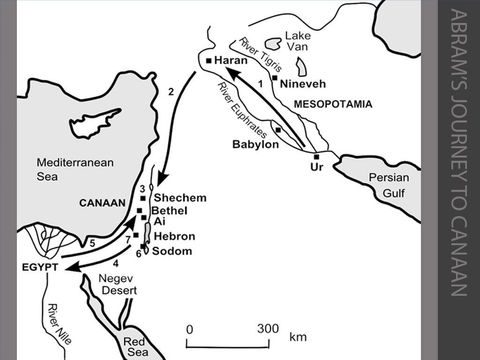
Abram then moved to the hill country situated between Bethel and Ai, followed by a journey southward toward the Negev Desert. Compelled by drought and famine, Abram and Sarai embarked on a journey along the Way of Shur, leading them to the well-watered lands of the Nile Delta in Egypt. (Genesis 12:8-20) However, circumstances
forced Abram and Sarai to flee Egypt, finding refuge in the hill country near Bethel. (Genesis 13:1-9) Subsequently, Abram and Lot decided to separate. Lot chose the fertile and well-watered Jordan Valley, setting up his tent near Sodom. (Genesis 13:10-13) Meanwhile, Abram relocated to the great oaks of Mamre near Hebron, where he built another altar. (Genesis 13:18) Abram's displayed clear willingness to leave his comfort zone and embrace the unknown. Exemplary of the unwavering faith that God desires from His followers.
The Covenant of God: Covenant vs. Contract
To properly contemplate the significance of God’s covenant with Abraam, we first must clearly understand the meaning of a covenant? Is it a contract? How do the two compare? Let us first dive into a contract. A contract is a binding and solemn agreement made by two or more parties and involving mutual responsibilities.
Typically, a contract is an agreement between two or more parties where each party seeks a benefit the other can provide. In other words, contracts are centered on getting something from someone else. Generally, contracts have very specific terms and conditions. Each party agrees to complete certain actions and failure to do so violates the contract and offers the other party or parties the opportunity to escape from their obligations.
Think of a mortgage: when you buy a house, you take out a mortgage to pay for it. If you have ever bought a house with a mortgage, you know how many papers you have to sign as part of the contract! In essence, the bank buys out your house for you and allows you to live in it while you repay them on the schedule set forth in the contract. Each month, you are to pay a certain amount of money and as long as you do so, keep the home insured, pay property taxes, and so forth, you are allowed to live in it. You want a home. The bank wants to make money. That is why both enter into the contract. Both have obligations which make the contract binding, but if any fail to meet those obligations, the other party can void the contract.
Additionally, think of a health club membership: when you join a health club, you generally sign a contract whereby you promise to pay your monthly dues, clean off the equipment after use, and so forth. In turn, the club promises to keep up the facilities and equipment, provide classes, and so forth. You entered the contract so that you can have a place to work out. The health club entered because it wants to make money.
In the same way, the covenant entails similar parameters. However, there are different kinds of covenants in the Holy Bible: there is the unconditional covenant, such as the Noahic covenant, promising to never to flood the earth again. There is also the conditional covenant, which leads to a concession of sorts; an example of this would be the Mosaic covenant, wherein the people promised to obey the Law, and God shared a series of blessings based on their obedience and curses based on their disobedience.
A covenant however has a key difference. When I sign a covenant with God, to marry my spouse and I try go to the court to dissolve the marriage and the judge confirms the marriage is dissolved; there is a major flaw. He has no right to dissolve a covenant that I did not make with him. I did not make a covenant with the judge. I made a covenant with God. I wrote the covenant with God. When does it end? It does not end. Covenants, promises of God, are eternal, whether conditional or not. The covenant is between a greater and a lesser, and should therefore not be broken.
It is humbling, that the greater God, the eternal, the creator, is willing to bind Himself in a non-breakable covenant with His creation. He is showing signs of fidelity, loyalty, and love. I might be 100% committed to the contract obliged, but not 100% confident in the other person. But in God we have full confidence. The question is the commitment on our part. However, covenants are not a legal issue, they are family bonds. For instance, when Adam says: she is flesh of my flesh, bone of my bones, he is uttering the covenant. Or, when Jesus offers us his blood and says: take drink of it all of you for this is the Blood of the New Covenant, this essentially makes us His family.
The Covenant of God: The Promise of an Heir
The Hebrew word 'b-rith,' which translates to "covenantal oath," encapsulates a deep commitment within familial relationships, such as father-son and husband-wife. It originates from the Akkadian term 'biritu,' signifying a fetter or bond. An oath of this magnitude entails three essential requirements.
Firstly, a swearing or an oath is necessary. The Hebrew Bible depicts it as a binding relationship rooted in commitment, involving promises, obligations, and durability.
Secondly, the covenant must be established between a greater and a lesser entity. A prime example is the covenant between God and Israel, emphasizing God's unconditional love and care for Israel, while Israel's obligations to God are conditional. The greater entity promises to unconditionally care for and love the lesser entity, with the lesser entity responding with conditional obligations. Both perspectives emphasize human responsibility, but the conditional interpretation places greater emphasis on Israel's success or failure in fulfilling its obligations.
Additionally, covenants are not limited to divine relationships. They can be formed between friends, families, and socio-political groups. Examples include the covenant between David and Jonathan (1 Samuel 18:3), the covenant between Jacob and Laban (Genesis 31:49-50), the covenant between the Israelites and Gibeonites (Joshua 9:3-27), and the covenant between David and the elders of Israel (2 Samuel 5:3).
The Covenant of God: The Covenant with Abraham
Understanding such a meaning behind the covenant of God was of primordial importance to the testament of Abraham’s life and faith. Abraham must of understood this concept and that the promises of God were never to be broken. And as such, when God promised:
- Land: “To a land that I will show you” (v1)
- People: “I will make you a great nation” (v2)
- Name: “And make your name great” (v3)
God talked with him, nearly 14 years after the first promise, saying: “When Abram was ninety-nine years old, the Lord appeared to Abram and said to him, “I am Almighty God; walk before Me and be blameless. And I will make My covenant between Me and you, and will multiply you exceedingly.” Then Abram fell on his face, and God talked with him, saying: “As for Me, behold, My covenant is with you, and you shall be a father of many nations. No longer shall your name be called Abram, but your name shall be Abraham; for I have made you a father of many nations. I will make you exceedingly fruitful; and I will make nations of you, and kings shall come from you. And I will establish My covenant between Me and you and your descendants after you in their generations, for an everlasting covenant, to be God to you and your descendants after you. Also I give to you and your descendants after you the land in which you are a stranger, all the land of Canaan, as an everlasting possession; and I will be their God.” (Genesis 17:1-8). His promises never changes. A key factor in Abraham’s faith.
The Sealed Covenant
“And God said to Abraham: “As for you, you shall keep My covenant, you and your descendants after you throughout their generations. 10 This is My covenant which you shall keep, between Me and you and your descendants after you: Every male child among you shall be circumcised; 11 and you shall be circumcised in the flesh of your foreskins, and it shall be a sign of the covenant between Me and you. 12 He who is eight days old among you shall be circumcised, every male child in your generations, he who is born in your house or bought with money from any foreigner who is not your descendant. 13 He who is born in your house and he who is bought with your money must be circumcised, and My covenant shall be in your flesh for an everlasting covenant. 14 And the uncircumcised male child, who is not circumcised in the flesh of his foreskin, that person shall be cut off from his people; he has broken My covenant.”” (Genesis 17:9-14)
This passage holds profound significance, as it encapsulates the establishment of a sacred covenant between God and Abraham, a covenant that is both sealed and confirmed through the act of circumcision. According to this passage, accepting God's covenant, which is everlasting in nature, requires an individual to undergo circumcision. The covenant between God and Abraham serves as a testament to the profound relationship between God and humanity. Through circumcision, individuals enter into this covenant, acknowledging their commitment to God and His commandments.
The act of circumcision symbolizes the dedication of one's life to God. It represents the removal of impurities, the purification of the flesh, and the acceptance of God's covenant. By undergoing circumcision, individuals demonstrate their willingness to align themselves with God's will and to live in accordance with His precepts. Moreover, it identifies individuals as members of God's chosen people and establishes a sense of unity and solidarity among those who share this unique spiritual bond. The covenant, symbolized by circumcision, becomes a source of identity, purpose, and direction for those who embrace it.
The Sealed Covenant: A Comparison of Abraham and Lot
Abraham and his nephew, Lot, were very different in a multitude of ways: “please let there be no strife between you and me, and between my herdsmen and your herdsmen, for we are brethren. Is not the whole land before you? Please separate from me. If you take the left, then I will go to the right; or if you go to the right, then I will go to the left’.” (Genesis 13, 19) We shall be comparing how two people live the covenant. Abraham, on one hand, is rooted in mercy and kindness that offers to the other everything.
St. John Chrysostom speaks of qualities of Abram, the prominent in dignity, how he was not disturbed, as his nephew accepted to be given the right to choose, and took for himself the first portion, leaving to his uncle the second best portion, saying, “when it ended up for the older to lose his first portion, he did not get angry, ... but was satisfied with his second-best portion. When his younger nephew did him wrong, he loved him, and gave him help in the time of need.” He also says “Abram, not seeking his own benefit, but that of others, put himself in harm’s way; and interceded on behalf of those, with whom he had no relationship ... His nephew on the other hand, hearing his uncle saying, “If you take the left, I will go to the right,” he accepted the right to choose, and sought his own benefit, to lose eventually all his possessions, as the whole region burnt up (Genesis 19;) while all the surrounding regions came to no harm.”
| Abraham | Lot |
|---|---|
| Abraham is a man of faith. (Hebrews 8:11) | Lot has to see to believe. |
| Abram lifetd his eyes to recall Eden that man was deprived of because of the envy of the devil; so he embraced Lot saying to him: “We are brethren,” (Gensis 13: 8,) Abraham’s heart drew to brotherly love. | Lot, on the other hand, lifetd his eyes “To see all the plains of Jordan that were well watered everywhere.” (Genesis 13: 10) Lot’s heart drew to selfishness. |
| God picked out the land for Abraham. (Genesis 13:14-15) | Lot picked out his land for himself. (Genesis 11:13) |
| The Bible emphasizes that Abraham was a man of prayer. (Genesis 17:20, Genesis 18:22-33) | The Bible does not mention that Lot prayed, as a result he symbolizes a spiritually cold believer. |
| He lived as a stranger in the world (tent). And the altar symbolized his communion and love with God. | Lot had a house in Sodom. (Genesis 19:1-9) |
| Abraham feared the Lord and as a result God revealed to him His plans for Sodom. (Genesis 18:17, Psalms 25:14) | Lot was indifefrent towards God. |
| Abraham could difefrentiate between holy and wicked people. | Lot could not difefrentiate between good and wicked people. He called the people of Sodom his brethren, (Genesis 18:7.) |
| Abraham was a joyful believer and saw the coming of Jesus Christ. (John 8:56) | Lot’s soul was tormented from day to day. (2 Peter 2:8) |
| Abraham's life was a witness to everyone around him, even his servants believed in God and were men of prayer. (Genesis 24) He also wanted Isaac to marry a believing woman. | The life of Lot was not a good example to his daughters and wife. |
| Abraham lived with God so he was called His friend. (Isaiah 41:8) | Lot gave his daughters to wicked people in marriage. |
| Abraham was about to sacrifice his son, believing that God can raise him back up from the dead, (Hebrews 11:17-19,) therefore, he is an example of faith. | Lot lived with wicked people and as a result his family was corrupted. (1 Corinthians 15:33) |
| God ties His name with Abraham. (Genesis 28:13, Exodus 3:6) | God did not associate His name with Lot's name. |
| Abraham was good at speaking with people. He was very respectful with Lot in Genesis 13:8. Isaac learned how to pray from his father. He learned how to dig wells which portrays the life of diligence. He learned how to build altars which portrays a fellowship with God. (Genesis 26:25.) | Lot was not good at speaking, he did not say anything right to the wicked people and he was arguing with the angels who were trying to get him out of Sodom. (Genesis 19:7-8) |
| Abraham lived in Canaan since it was God's will. | Lot lived in Sodom according to his own will. |
The Sealed Covenant: The Promise
Our Lord promised Abhrahm’s wife a child: “and shall Sarah, who is ninety years old, bear a child?”And Abraham said to God, “Oh, that Ishmael might live before You!” Then God said: “No, Sarah your wife shall bear you a son, and you shall call his name Isaac; I will establish My covenant with him for an everlasting covenant, and with his descendants after him.” (Genesis 1:17-19) Abraham certainly understood the meaning and promises of God cannot and will not be broken. This conviction and understand set stage for what came next.
The Perfection of Faith: Faith is Tried in the Offering of Isaac
By faith Abraham, when he was tested, offered up Isaac, and he who had received the promises offered up his only begotten son, of whom it was said, “In Isaac your seed shall be called,” concluding that God was able to raise him up, even from the dead, from which he also received him in a figurative sense.” (Genesis 21:12 )
Let us examine it again. If God comes to you and asks of you the person most valued to you. Your son. Which you spent years trying to get. And he tells you to bring that person to your dining table. Bring the hardest and biggest knife in the kitchen, sacrifice him, let him bleed and after you finish burning him up please. What would you say? Realistically, many of us would say no. But Abraham was a man of great faith.
He had trust beyond measure. God cannot lie. It is through Isaac that He will have many generations. Abraham knew the unbreakable covenant of God. He had this faith in it, that was unquestionable. He knew God. Even if he went through every single step, and actually completely burned him. God will have to take the ashes and reform him. Why? Because God promised. His obedience was proportional to his faith! Do not take things always as they seem. Trust in the promises of our Lord.
This is precisely what St. Paul told the Hebrews: “By faith Abraham, when he was tested, offered up Isaac, and he who had received the promises offered up his only begotten son, 18 of whom it was said, “In Isaac your seed shall be called,” 19 concluding that God was able to raise him up, even from the dead, from which he also received him in a figurative sense.” That Abraham knew the promise of God cannot be broken even to the point that he would rise him up.
The Perfection of Faith: Faith is Perfected in the Offering of Isaac
“Then the Angel of the Lord called to Abraham a second time out of heaven, and said: “By Myself I have sworn, says the Lord, because you have done this thing, and have not withheld your son, your only son— blessing I will bless you, and multiplying I will multiply your descendants as the stars of the heaven and as the sand which is on the seashore; and your descendants shall possess the gate of their enemies. In your seed all the nations of the earth shall be blessed, because you have obeyed My voice.” (Genesis 22:15-18)