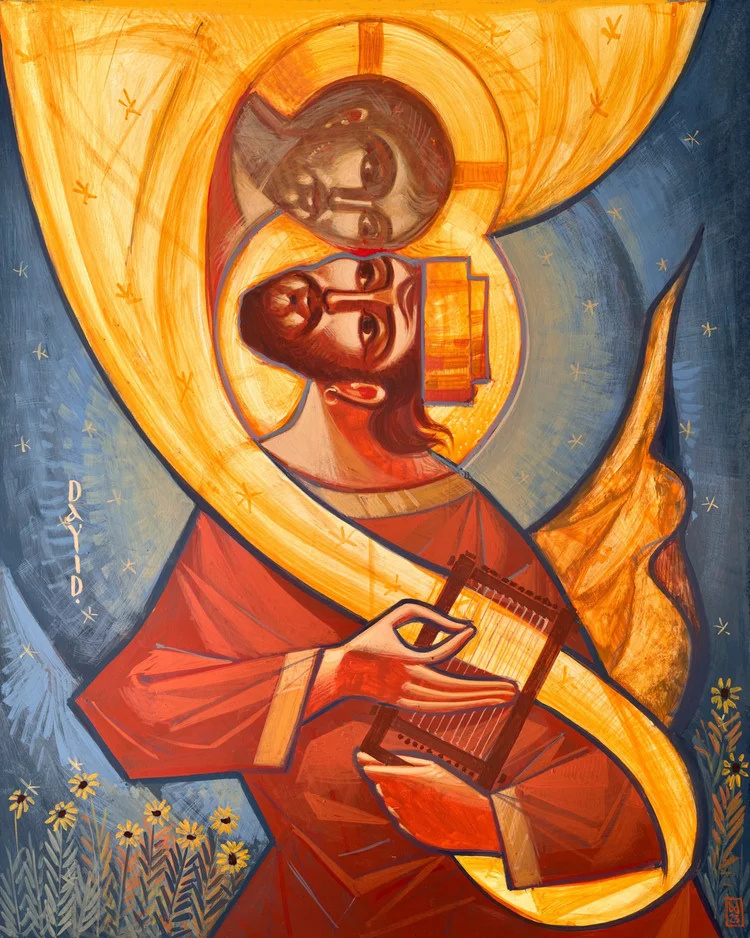
- 3 Prophets
The Fifth Evangelist
The prophet Isaiah occupies a central place among the Major Prophets of the Old Testament. His name means “The LORD is salvation,” a meaning that encapsulates both the content and the purpose of his prophetic ministry. Isaiah lived and prophesied during the eighth century BC, around 700 BC, a period marked by political instability, moral decline, and looming foreign threats.
Isaiah is widely regarded as one of the greatest prophets of Sacred Scripture. The book that bears his name presents the most comprehensive and detailed prophetic portrait of Jesus Christ found anywhere in the Old Testament. For this reason, St. Jerome famously referred to Isaiah as “the Fifth Evangelist,” because his prophecies proclaim Christ with a clarity comparable to that of the four Gospels.
Isaiah was the son of Amoz and that he was married and had children, whose very names functioned as prophetic signs to the people of Judah (Isaiah 1:1; 7:3; 8:3). His prophetic ministry began during the reign of King Uzziah and extended for approximately sixty years, spanning the reigns of Jotham, Ahaz, Hezekiah, and Manasseh. Through these reigns, Isaiah addressed kings, priests, and people alike, calling them to repentance, faith, and trust in the Lord.
Isaiah’s message moves constantly between judgment and hope. He exposes sin with uncompromising clarity, yet he also proclaims comfort, restoration, and future glory. Above all, he reveals God as both holy and merciful, righteous and saving.
Structure of the Book of Isaiah
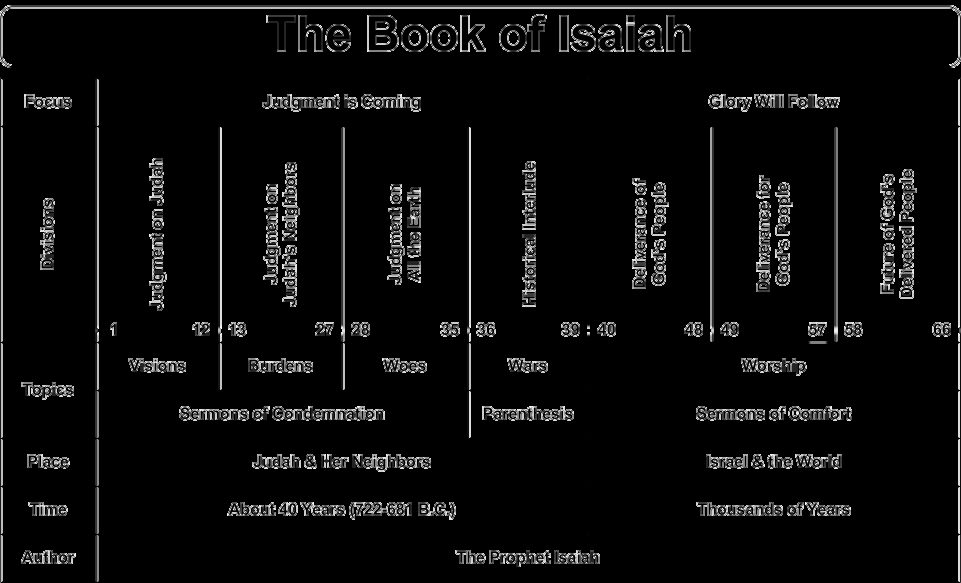
The Book of Isaiah is traditionally understood as having two major divisions, with some scholars recognizing a threefold structure based on theme and emphasis:
Chapters 1–39
Judgment and the Holiness of God
This section focuses primarily on Judah, Jerusalem, and the surrounding nations. Isaiah confronts idolatry, injustice, pride, and misplaced trust in political alliances. These chapters include prophecies against foreign nations, warnings of impending judgment, and historical narratives related to Assyrian aggression.
Within this section appear foundational Messianic prophecies, including the sign of the virgin birth (Isaiah 7:14) and the promise of a righteous Davidic King.
Chapters 40–66
Comfort, Salvation, and Future Glory
This section opens with the words, “Comfort, yes, comfort My people” (Isaiah 40:1). The tone shifts from warning to consolation. God promises deliverance, forgiveness, and renewal. The Servant Songs appear here, culminating in Isaiah 53, which presents the suffering and redemptive mission of the Messiah with remarkable precision.
Chapters 56–66
The New Jerusalem and the Consummation of Salvation
Some recognize these chapters as a distinct subsection emphasizing the restoration of Zion, the inclusion of the nations, and the final establishment of God’s kingdom. These chapters look beyond historical return from exile toward the ultimate fulfillment of God’s saving plan.
This structure reflects not multiple messages, but one unified prophetic vision: judgment leads to purification, and purification leads to salvation.
The Beginning of Isaiah’s Prophetic Ministry
Isaiah’s ministry begins with one of the most profound commissioning visions in all of Scripture. In a moment of divine revelation, Isaiah is granted a vision of the heavenly throne room itself.
“In the year that King Uzziah died, I saw the Lord sitting on a throne, high and lifted up, and the train of His robe filled the temple. Above it stood seraphim; each one had six wings: with two he covered his face, with two he covered his feet, and with two he flew. And one cried to another and said: ‘Holy, holy, holy is the LORD of hosts; The whole earth is full of His glory!’ And the posts of the door were shaken by the voice of him who cried out, and the house was filled with smoke. So I said: ‘Woe is me, for I am undone! Because I am a man of unclean lips, And I dwell in the midst of a people of unclean lips; For my eyes have seen the King, The LORD of hosts.’ Then one of the seraphim flew to me, having in his hand a live coal which he had taken with the tongs from the altar. And he touched my mouth with it, and said: ‘Behold, this has touched your lips; Your iniquity is taken away, And your sin purged.’ Also I heard the voice of the Lord, saying: ‘Whom shall I send, And who will go for Us?’ Then I said, ‘Here I am! Send me.’” (Isaiah 6:1–8, NKJV)
This vision reveals several essential truths. God is enthroned in holiness. Heaven and earth are filled with His glory. Even the seraphim veil themselves in reverence before Him. Confronted with this holiness, Isaiah becomes acutely aware of his own impurity and the impurity of the people he is sent to serve.
Purification precedes mission. Isaiah is not commissioned until his sin is removed. The live coal taken from the altar signifies cleansing through divine initiative, not human effort.
Patristic Interpretation of Isaiah’s Calling
St. Cyril of Alexandria offers a deeply Christological interpretation of Isaiah’s purification:
“One of the seraphim is sent to Isaiah with a burning coal which he took from the altar with tongs. This is clearly a symbol of Christ, who, on our behalf, offered himself up to God the Father as a pure and unblemished spiritual sacrifice with a most pleasing fragrance. In the same way, Christ is received from the altar. We must, however, explain why Christ is like a burning coal. It is customary in Holy Scripture for the divine nature to be likened to fire. God appeared in this way to the people of Israel as they stood before the Lord at Horeb, which is Mount Sinai.”
This interpretation reveals that Isaiah’s cleansing prefigures the sacramental and redemptive work of Christ. The coal signifies divine fire that purifies without destroying—judgment transformed into mercy.
Isaiah’s Mission
Isaiah is sent to proclaim a message that will not immediately be received. God warns him that the people will hear without understanding and see without perceiving. Judgment will come, cities will fall, and the land will be desolate. Yet even in this bleak vision, hope remains.
A remnant—a “holy seed”—will survive, like a stump left after a great tree is cut down (Isaiah 6:13). From that stump, life will spring forth again.
Thus Isaiah’s ministry is marked by a paradox that runs through the entire book: judgment that purifies and suffering that leads to salvation. This paradox finds its ultimate fulfillment in Christ, whom Isaiah foretells more clearly than any other prophet.
The Suffering Servant (Isaiah 42–53)
Among all the Messianic prophecies of the Old Testament, none are as profound, as detailed, or as theologically decisive as Isaiah’s prophecy of the Suffering Servant. In these chapters, Isaiah reveals a Messiah whose mission is not first to conquer by force, but to redeem through obedience, humility, suffering, and self-giving love. Here, the mystery of salvation is unveiled with striking clarity: the Messiah saves by suffering on behalf of others.
These passages form the heart of why Isaiah is called the Fifth Evangelist. They present the Gospel in prophetic form centuries before the birth of Christ.
The Servant Chosen and Anointed by God
The Servant is introduced as one uniquely chosen, upheld, and anointed by God Himself:
“Behold! My Servant whom I uphold, My Elect One in whom My soul delights! I have put My Spirit upon Him; He will bring forth justice to the Gentiles. He will not cry out, nor raise His voice, Nor cause His voice to be heard in the street. A bruised reed He will not break, And smoking flax He will not quench; He will bring forth justice for truth.” (Isaiah 42:1–3, NKJV)
This Servant is not aggressive, loud, or violent. He does not impose justice through domination. Instead, He restores gently. The weak are not crushed; the faint are not extinguished. Salvation comes not by force, but by compassion.
The Gospel explicitly applies this prophecy to Christ:
“A bruised reed He will not break, And smoking flax He will not quench, Till He sends forth justice to victory.” (Matthew 12:20, NKJV)
The Servant as Light and Covenant
Isaiah reveals that the Servant’s mission extends beyond Israel to all nations:
“I, the LORD, have called You in righteousness, And will hold Your hand; I will keep You and give You as a covenant to the people, As a light to the Gentiles, To open blind eyes, To bring out prisoners from the prison, Those who sit in darkness from the prison house.” (Isaiah 42:6–7, NKJV)
The Servant is not merely a messenger of a covenant—He is the covenant itself. He restores sight, frees captives, and brings light to those in darkness. These words are fulfilled directly in Christ’s healing ministry, His forgiveness of sins, and His proclamation of salvation to Jew and Gentile alike.
Rejection and Hidden Glory
As the prophecy unfolds, the Servant is revealed as one who will be rejected rather than celebrated:
“He is despised and rejected by men, A Man of sorrows and acquainted with grief. And we hid, as it were, our faces from Him; He was despised, and we did not esteem Him.” (Isaiah 53:3, NKJV)
This rejection is not accidental. It is part of the salvific plan. The Servant does not suffer because He fails; He suffers because He obeys. His path reveals that God’s victory is accomplished through humility, not human glory.
The Substitutionary Suffering of the Servant
Isaiah now speaks with unmistakable clarity about the redemptive meaning of the Servant’s suffering:
“Surely He has borne our griefs And carried our sorrows; Yet we esteemed Him stricken, Smitten by God, and afflicted. But He was wounded for our transgressions, He was bruised for our iniquities; The chastisement for our peace was upon Him, And by His stripes we are healed.” (Isaiah 53:4–5, NKJV) The Servant suffers in place of others. He bears what does not belong to Him so that others may receive what they do not deserve. Healing, peace, and reconciliation flow directly from His wounds. This passage forms the foundation of the Church’s understanding of Christ’s atoning sacrifice.
Silent Obedience unto Death
Isaiah emphasizes not only the suffering of the Servant, but the manner in which He suffers: “He was oppressed and He was afflicted, Yet He opened not His mouth; He was led as a lamb to the slaughter, And as a sheep before its shearers is silent, So He opened not His mouth.” (Isaiah 53:7, NKJV) The Servant does not resist, protest, or curse. His obedience is voluntary and complete. This prophecy finds direct fulfillment in Christ’s silence before His accusers and His willing acceptance of the Cross.
Death, Burial, and Vindication
Isaiah even foretells the Servant’s death and burial:
“And they made His grave with the wicked— But with the rich at His death, Because He had done no violence, Nor was any deceit in His mouth.” (Isaiah 53:9, NKJV) Despite His innocence, the Servant dies. Yet His death is not the end. God vindicates Him: “Yet it pleased the LORD to bruise Him; He has put Him to grief. When You make His soul an offering for sin, He shall see His seed, He shall prolong His days,
And the pleasure of the LORD shall prosper in His hand.” (Isaiah 53:10, NKJV)
Here resurrection is implied. The Servant dies, yet lives. He offers Himself as a sacrifice, yet continues His work. His suffering results in life for many.
Justification of Many
The prophecy concludes with a declaration of victory:
“By His knowledge My righteous Servant shall justify many, For He shall bear their iniquities.” (Isaiah 53:11, NKJV)
The Servant does not merely inspire; He justifies. He restores humanity’s relationship with God by bearing sin and imparting righteousness.
The Fulfillment in Christ
The New Testament consistently identifies Jesus Christ as the fulfillment of Isaiah’s Suffering Servant. Christ Himself embraces this identity, especially in His passion, death, and resurrection. What Isaiah saw in prophecy, the Church proclaims as fulfilled reality.
The Suffering Servant reveals the deepest truth of the Gospel: God saves the world not by avoiding suffering, but by entering it and transforming it through love.
Isaiah and the Hope of the Resurrection
Isaiah’s prophetic vision does not end with suffering and death. Woven throughout his book is a powerful hope that death itself will be overcome and that God’s saving work will culminate in renewal, restoration, and everlasting life. While the Suffering Servant reveals how salvation is accomplished, Isaiah’s resurrection imagery reveals what that salvation ultimately brings.
Isaiah stands among the clearest Old Testament witnesses to the truth that God’s final victory includes the defeat of death and the restoration of life.
God’s Victory Over Death
Isaiah boldly proclaims that death will not have the final word over God’s people:
“He will swallow up death forever, And the Lord GOD will wipe away tears from all faces; The rebuke of His people He will take away from all the earth; For the LORD has spoken.” (Isaiah 25:8, NKJV)
This is not poetic exaggeration. It is a theological declaration: death itself will be destroyed. The promise that tears will be wiped away reveals not only physical resurrection, but also complete healing of human suffering. The Apostle Paul later cites this very passage to proclaim the victory of Christ’s resurrection (1 Corinthians 15:54).
Resurrection Foretold Explicitly
Isaiah speaks even more directly about the resurrection of the dead:
“Your dead shall live; Together with my dead body they shall arise. Awake and sing, you who dwell in dust; For your dew is like the dew of herbs, And the earth shall cast out the dead.” (Isaiah 26:19, NKJV)
Here Isaiah declares that those who dwell in the dust will rise again. Resurrection is not metaphorical, nor merely national restoration—it is personal, bodily, and real. God’s life-giving power extends even to those who have returned to the earth.
The Servant Lives After Death
Isaiah’s resurrection hope is inseparable from the Suffering Servant. After describing the Servant’s death as a sin offering, Isaiah proclaims that He will live and see the fruit of His sacrifice:
“He shall see the labor of His soul, and be satisfied. By His knowledge My righteous Servant shall justify many, For He shall bear their iniquities.” (Isaiah 53:11, NKJV)
The Servant dies, yet sees and rejoices. He is cut off, yet continues His mission. This paradox prepares the reader to understand the resurrection of Christ—not as an afterthought, but as the divine confirmation of His saving work.
New Creation and Everlasting Joy
Isaiah’s resurrection hope expands into a vision of new creation:
“For behold, I create new heavens and a new earth; And the former shall not be remembered or come to mind. But be glad and rejoice forever in what I create; For behold, I create Jerusalem as a rejoicing, And her people a joy.” (Isaiah 65:17–18, NKJV)
Salvation is not merely escape from death; it is transformation of existence. God renews creation itself. Life after death is not diminished—it is glorified.
Isaiah’s Message Completed in Christ
Isaiah’s prophetic message forms a complete arc:
- Humanity’s sin is exposed
- God’s holiness is revealed
- The Servant suffers and dies
- Death is defeated
- Life is restored
What Isaiah proclaims in promise, Christ fulfills in history. The resurrection of Jesus Christ is the definitive answer to Isaiah’s hope. Because Christ lives, death is no longer the end. Because the Servant was raised, those united to Him will also rise.
Isaiah thus teaches the Church that salvation is not only forgiveness of sins, but the restoration of life itself. Judgment gives way to mercy, suffering gives way to glory, and death gives way to resurrection.
The Victorious Lord: Isaiah, Hezekiah, and the Defeat of Assyria
Rabshakeh’s Blasphemy and the Crisis of Faith
During the reign of Hezekiah, Judah faced one of its gravest threats. Sennacherib, king of Assyria, sent his chief spokesman, Rabshakeh, to Jerusalem. Standing within hearing distance of the people, Rabshakeh mocked Hezekiah, ridiculed trust in Egypt, and openly blasphemed the Lord, insisting that the God of Israel would be no more able to deliver Jerusalem than the gods of the other nations Assyria had already destroyed.
Rabshakeh even boasted of offering two thousand horses—knowing full well Judah had no riders to mount them—using mockery to undermine confidence in God rather than military strength. His message was clear: do not trust Hezekiah; do not trust the Lord.
Hezekiah’s Prayer and God’s Answer
Faced with this humiliation and threat, Hezekiah did not respond with political maneuvering or military posturing. Instead, he humbled himself before God. He tore his clothes, entered the house of the Lord, and sent for the prophet Isaiah. Then he prayed.
Isaiah records both the prayer and God’s decisive response:
“Therefore thus says the LORD concerning the king of Assyria: ‘He shall not come into this city, Nor shoot an arrow there, Nor come before it with shield, Nor build a siege mound against it. By the way that he came, By the same shall he return; And he shall not come into this city,’ Says the LORD. ‘For I will defend this city, to save it For My own sake and for My servant David’s sake.’” (Isaiah 37:33–35, NKJV)
That very night, the angel of the Lord struck the Assyrian camp, and the invincible army collapsed without Judah lifting a sword. The episode reveals a central theme in Isaiah: salvation belongs to the Lord, not to human power.
Historical Interlude: King Hezekiah
Scripture presents Hezekiah as one of Judah’s most faithful kings:
“Now it came to pass in the third year of Hoshea the son of Elah, king of Israel, that Hezekiah the son of Ahaz, king of Judah, began to reign. He was twenty-five years old when he became king, and he reigned twenty-nine years in Jerusalem… And he did what was right in the sight of the LORD, according to all that his father David had done.” (2 Kings 18:1–3, NKJV)
Hezekiah’s reforms were radical and courageous. He removed the high places, destroyed idols, and even broke in pieces the bronze serpent made by Moses when it had become an object of idolatry—calling it Nehushtan, “a mere piece of bronze.”
“He trusted in the LORD God of Israel, so that after him was none like him among all the kings of Judah, nor who were before him. For he held fast to the LORD; he did not depart from following Him, but kept His commandments.” (2 Kings 18:5–6, NKJV)
His faith was not theoretical. It was tested under siege, mockery, and mortal illness—and it endured.
Hezekiah’s Illness and God’s Mercy
Later in his reign, Hezekiah fell gravely ill. Isaiah came to him with a stark message from God:
“Thus says the LORD: ‘Set your house in order, for you shall die and not live.’” (Isaiah 38:1, NKJV)
Hezekiah turned his face to the wall and prayed with tears, placing his entire life before God. The Lord answered immediately:
“I have heard your prayer, I have seen your tears; surely I will add to your days fifteen years. I will deliver you and this city from the hand of the king of Assyria, and I will defend this city.” (Isaiah 38:5–6, NKJV)
As a sign, God caused the shadow on the sundial of Ahaz to move backward ten degrees—an unmistakable sign that the Lord rules not only history, but time itself.
A Verse for Times of Bitterness
Out of this trial comes one of the most personal and consoling verses in Isaiah, often cherished in times of suffering:
“Indeed it was for my own peace That I had great bitterness; But You have lovingly delivered my soul from the pit of corruption, For You have cast all my sins behind Your back.” (Isaiah 38:17, NKJV)
Here suffering is reinterpreted through faith: bitterness becomes a path to peace, and affliction becomes the setting for mercy.
The Martyrdom of Isaiah
Tradition holds that Isaiah himself sealed his prophetic witness with blood. During the reign of the wicked king Manasseh, Isaiah was condemned and sawn in two—a fate alluded to in Hebrews 11:37. He was buried near the Pool of Siloam, having proclaimed throughout his life the holiness of God, the coming of the Messiah, and the certainty that the Lord alone is victorious.
Summary
Isaiah reveals:
- God’s sovereignty over empires
- The power of prayer over intimidation
- Faithfulness rewarded with deliverance
- Suffering transformed by repentance
- The prophet’s life as a testimony unto death
Isaiah does not merely predict salvation—he lives it, suffers for it, and ultimately dies proclaiming that “the Lord is Salvation.”