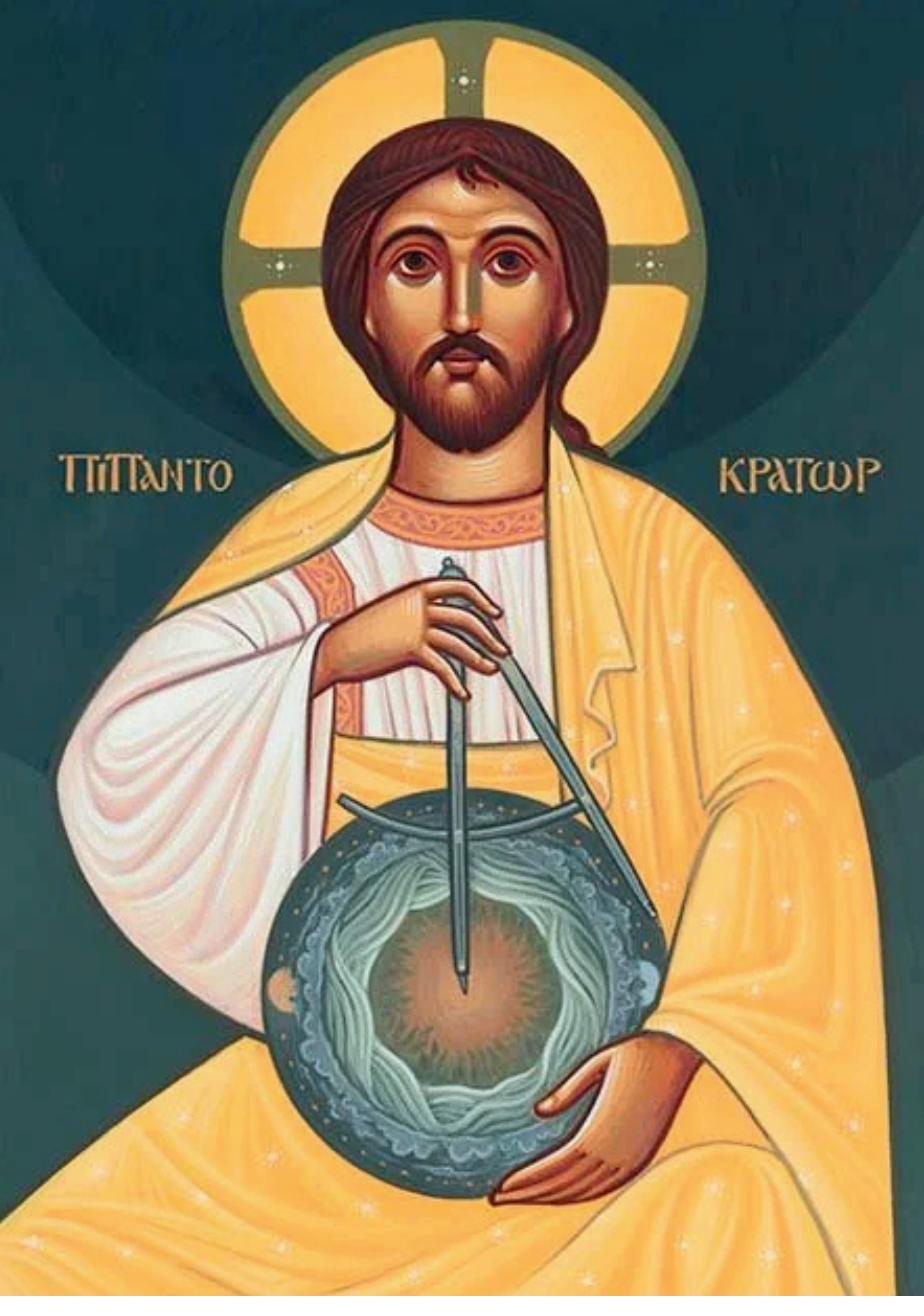
Having confessed the angels, we now turn to our elder brethren in the faith — the saints who, having completed the course and finished the race, now stand before the throne and pray for us who are still on the way. The doctrine of the intercession of the saints is one of the most beloved convictions of the Orthodox Church and one of the most misunderstood by those outside the communion. The servant who has grasped this lesson will have a new confidence in his own prayer, a new affection for his spiritual fathers, a new reverence in the house of God, and a ready answer for the Protestant brother who asks, in all sincerity, why we "pray to the saints." Our purpose in this lesson is not polemic but confession. We are not defending ourselves; we are opening a door into a room that is full of light.
Growing up in a Church where many hymns, icons, church names, and censers invoke the saints; we live in a culture in which the saints have been stripped from the imagination of Western Christianity. Meeting Protestant friends at university, Evangelical co-workers in the office, and perhaps even Coptic brethren who have absorbed the assumptions of a foreign theology, is inevitable.
We are not here to spend pages refuting objections — those will be answered, but briefly and toward the end. We are here first to see, to rejoice, to confess. The communion of saints is an article of the Creed; let us teach it with the joy that an article of the Creed deserves.
The Scriptural Foundation — One Household, Living and Departed
The first word must be Scripture's. The God of the Bible is not the God of abstractions; He is a God with a family. And that family, the Apostle teaches, is not broken by death.
“For this reason I bow my knees to the Father of our Lord Jesus Christ, from whom the whole family in heaven and earth is named.” Ephesians 3:14-15
Heaven and earth. One family. Named from one Father. The Apostle does not say "the family in heaven" and "the family on earth" as though there were two companies; he says "the whole family," passing through heaven and earth as a single, continuous household. This is the grammar of the communion of saints.
“But you have come to Mount Zion and to the city of the living God, the heavenly Jerusalem, to an innumerable company of angels, to the general assembly and church of the firstborn who are registered in heaven, to God the Judge of all, to the spirits of just men made perfect, to Jesus the Mediator of the new covenant.” Hebrews 12:22-24
The Apostle writes in the perfect tense — you have come. It is not something reserved for the hour of death; it is the present condition of every baptized Christian. At this moment, as the Pre-Servant reads this lesson, he has already come to the spirits of just men made perfect. The question is not whether we have access to the saints but whether we will exercise the access that baptism has already opened.
What the Saints Do — Three Kinds of Intercession
The Coptic tradition, following the Fathers and summarized with characteristic clarity by H.H. Pope Shenouda III, distinguishes three kinds of intercession:
- Propitiatory intercession: The intercession that reconciles God and man by the offering of a sufficient ransom. This is proper to the Lord Jesus Christ alone, and no saint can share in it.
- Entreating intercession: The intercession of prayer, the asking of favor on behalf of another. This belongs to every Christian, angel, and saint, and is commanded as an act of love.
- Intercession of the poor: The intercession of those whom we serve, whose gratitude calls down the mercy of God upon the one who has shown them mercy.
When we deny to the saints the first kind of intercession we refuse to insult the Cross. When we confess in them the second and third kinds we receive what Scripture plainly teaches. Every objection falls once the distinction is held clearly in mind.
Propitiatory Intercession: Christ Alone
The Apostle writes without qualification:
“For there is one God and one Mediator between God and men, the Man Christ Jesus, who gave Himself a ransom for all.” 1 Timothy 2:5-6
This verse is often raised as an objection to our teaching. In fact it is its foundation. The Apostle is not speaking of prayer in general — he has just, in verse 1, commanded "supplications, prayers, intercessions, and giving of thanks be made for all men" — he is speaking of the ransom. There is one Mediator because there is one Ransom. No saint paid the price; therefore no saint mediates in this sense. The blood of Christ is unique, sufficient, and unshareable.
The same Apostle John who calls Christ "the propitiation for our sins" in 1 John 2:2 also calls Him in the preceding verse "our Advocate with the Father" — paraclete — and St. John the Baptist calls Him "the Lamb of God who takes away the sin of the world" (John 1:29). The saints in the Apocalypse are those who have "washed their robes and made them white in the blood of the Lamb" (Revelation 7:14) — not in their own blood. The Coptic liturgy sings this night and day: every absolution, every exhortation, every prayer is offered "through Jesus Christ our Lord." No saint, no angel, no Mother of God ever displaces the Mediator. Their intercession is not a rival to His; it is the echo of His.
“If anyone sins, we have an Advocate with the Father, Jesus Christ the righteous. And He Himself is the propitiation for our sins, and not for ours only but also for the whole world.” 1 John 2:1-2
Entreating Intercession: The Common Inheritance of the Faithful
When a Christian asks his brother to pray for him, he is not rivaling the one Mediator; he is obeying the New Testament. The Apostle Paul asks again and again that prayer be made for him.
“Brethren, pray for us.” 1 Thessalonians 5:25
“Therefore I exhort first of all that supplications, prayers, intercessions, and giving of thanks be made for all men” 1 Timothy 2:1
“Now I beg you, brethren, through the Lord Jesus Christ, and through the love of the Spirit, that you strive together with me in prayers to God for me.” Romans 15:30
If it is licit — indeed commanded — to ask for the prayers of a brother standing beside me on earth, how much more licit is it to ask for the prayers of a brother who stands before the throne? The saint is not less a brother because he has passed into the nearer presence of God; he is more a brother, because death, as St. Cyprian teaches, does not dissolve the bonds of the Body of Christ — it strengthens them.
Scripture itself shows us the saints interceding. In the Old Covenant Abraham pleads with God for Sodom (Genesis 18:22-33) and the Lord answers him. Moses stands in the breach for Israel after the golden calf and the Lord relents (Exodus 32:11-14). Job is told to pray for his three friends, "for I will accept him" (Job 42:7-8). Samuel says, "Far be it from me that I should sin against the LORD in ceasing to pray for you" (1 Samuel 12:23). Elisha prays and the dead child is raised (2 Kings 4:32-35). In the New Covenant the Apostles command intercession, the Church prays for Peter in prison (Acts 12:5), the elders are summoned to anoint and pray for the sick (James 5:14-16). "The effective, fervent prayer of a righteous man avails much," writes James — and the most righteous man who prayed, he continues, was Elijah (James 5:17). If the righteous on earth may pray for us with great effect, the righteous who are perfected cannot pray with less.
Do the Departed Saints Know Us? Do They Hear Our Prayers?
This is the point at which the Protestant objection gathers. It is raised as though the Bible knew nothing of it. In fact the Bible is full of it.
“There is joy in the presence of the angels of God over one sinner who repents.” Luke 15:10
The angels, then, know when a sinner on earth repents. If knowledge reaches the angelic host, it reaches the saints also, for the Lord says of the resurrection that "they neither marry nor are given in marriage, but are like angels of God in heaven" (Matthew 22:30). What the angels know, the perfected know — this is the consistent reading of the Fathers.
“They cried with a loud voice, saying, How long, O Lord, holy and true, until You judge and avenge our blood on those who dwell on the earth?” Revelation 6:10
The souls under the altar know what is happening on earth — they know that their blood has not yet been avenged, they know that persecutions continue, and they bring their knowledge to God as prayer. They are not asleep; they are alert, they are conscious, they are praying.
“Now the smoke of the incense, with the prayers of the saints, ascended before God from the angel's hand.” Revelation 8:4
The prayers of the saints are offered in heaven. They are held in golden bowls — the vials of Revelation 5:8 — and they ascend with the smoke of the incense. The whole of the heavenly Liturgy is a great intercession offered on our behalf.
St. Paul writes, "Now we see in a mirror, dimly, but then face to face. Now I know in part, but then I shall know just as I also am known" (1 Corinthians 13:12). Our knowledge grows when we pass into the immediate presence of God; it does not shrink. And in the parable of the Rich Man and Lazarus (Luke 16:19-31) Abraham is shown to remember the earthly condition of both men. The departed saints know, and they remember, and they pray.
God Honors Those Who Honor Him
The doctrine of the intercession of the saints rests, at its deepest, on a principle repeated everywhere in Scripture: God honors those who honor Him. "Those who honor Me I will honor," the Lord says to Eli (1 Samuel 2:30). And this honor does not cease at death; it flowers at death.
Consider the case of the Prophet Elisha. He was a man mighty in God — he did not die a mighty death, he died in his bed — and yet the Scripture records:
“So it was, as they were burying a man, that suddenly they spied a band of raiders; and they put the man in the tomb of Elisha; and when the man was let down and touched the bones of Elisha, he revived and stood on his feet.” 2 Kings 13:21
A dead man, on touching the bones of a dead prophet, was restored to life. The bones of the saint were holy after the saint had passed, and the power of God flowed through them. The Church did not invent the veneration of relics; the Holy Spirit wrote it into the book of Kings. The same pattern returns in the New Covenant — at Ephesus "handkerchiefs or aprons were brought from his [Paul's] body to the sick, and the diseases left them" (Acts 19:12); at Jerusalem "they brought the sick out into the streets and laid them on beds and couches, that at least the shadow of Peter passing by might fall on some of them" (Acts 5:15). The shadow of the saint was medicinal; the very cloth of the saint was healing. God honors those who honor Him, and the honor extends to the saint's body, to the saint's belongings, to the saint's shadow — how much more to the saint's prayer.
“If anyone serves Me, let him follow Me; and where I am, there My servant will be also. If anyone serves Me, him My Father will honor.” John 12:26
The Witness of the Church — Liturgy, Fathers, and Icons
The Church has never separated the doctrine of the intercession of the saints from her worship. In the anaphora of St. Basil, after the consecration of the Holy Mysteries, the priest prays: "Most of all, the pure, full of glory, ever-Virgin Saint Mary,... Saint John the Forerunner, Saint Stephen the Protomartyr, our father St. Mark the Evangelist, … and all the choirs of the Saints." The Church names them; she calls them by name, one by one, because they are a family, and the faithful are drawn into their company. The Coptic hymns "Ari Epresvevin" — "Intercede on our behalf" — addressed to the Theotokos, and "Tobh Emepchoice" — "Ask the Lord on our behalf" — addressed to the saints, are the daily speech of the faithful.
The Fathers speak with one voice. St. Cyril of Jerusalem, explaining the Liturgy to the newly baptized, says that we commemorate the Patriarchs, Prophets, Apostles, and Martyrs, "that God, at their prayers and intercessions, would receive our petition." St. John Chrysostom calls the saints "our unfailing advocates." St. Augustine, writing in the West, says that the martyrs do intercede, but that they intercede through Christ and in Christ. St. Gregory of Nyssa, preaching on St. Theodore the Tyro, says that at the grave of the saint "those who come approach as to the living, alive, and this is no invention of the imagination." The doctrine is catholic — common to all the ancient Churches of both East and West — and it is as old as the second century, when the Acts of the Martyrs began to record the prayers of the persecuted Church at the tombs of her confessors.
The icons of the saints are the visible face of this doctrine. An icon is not an imagination; it is a window. The icon of the saint in the church is the Church's confession that this brother is alive, that he is present, that his face may be turned toward us even now. The kiss given to the icon, the candle lit before it, the prayer offered in its presence — none of these is worship; all of them are the family's greeting of an elder brother who stands in the next room.
The Intercession of the Poor
Pope Shenouda III, following the Fathers, reminds us of the third kind of intercession, often forgotten: the intercession of the poor. When the Christian feeds the hungry, clothes the naked, visits the sick, and welcomes the stranger, the gratitude of those he has served rises to the throne of God as a prayer, and the mercy of God descends upon his head.
“Then the King will say to those on His right hand, Come, you blessed of My Father, inherit the kingdom prepared for you from the foundation of the world... Assuredly, I say to you, inasmuch as you did it to one of the least of these My brethren, you did it to Me.” Matthew 25:34,40
This is an intercession that any Christian may ask for now. The poor whom we serve become, in the economy of grace, our intercessors. St. John Chrysostom, in his preaching at Antioch and Constantinople, makes this point with startling insistence: if you wish to have powerful advocates on the day of judgment, clothe the poor, for the garments you give them will plead for you. The pastoral application for the Sunday school is immediate. Teach the children that the child they help, the elderly neighbor they visit, the orphan they remember in their prayers, is already gathering for them a company of advocates before God.
Why Churches Are Named After Saints
The Orthodox faithful often give the names of saints to their churches, their monasteries, their schools, even their children. This practice has been misunderstood as an importation from paganism; it is in fact a direct inheritance from the Bible itself.
The Temple of Solomon was called "the house which I have built for My name" (1 Kings 8:44) — and yet it was called "the house of Solomon" as well (2 Chronicles 7:11). The Torah is called "the Law of the LORD" and also "the Law of Moses" (Joshua 8:31). The prophetic books are called the word of the Lord and also "the words of Jeremiah" (Jeremiah 1:1). The Holy City is called "the City of God" and also "the City of David." There is no rivalry in this; there is a simple logic. The instrument of the Holy One is honored with the name of the Holy One, and the name of the Holy One is attached to His instrument. So too the Apocalypse: "Now the wall of the city had twelve foundations, and on them were the names of the twelve apostles of the Lamb" (Revelation 21:14). The New Jerusalem itself bears the names of the saints.
When a Coptic village calls its church "the Church of St. Mina" or "the Church of St. Mark," it is doing nothing more than writing into the name of its temple the names that the Holy Spirit wrote into the foundations of the heavenly city.
A Pastoral Answer to the Brother Who Objects
Let the Pre-Servant learn a short and charitable answer to give to the Protestant brother who asks, in good faith, why we "pray to the saints." Three sentences, in a kind voice, will almost always suffice.
- We do not pray TO the saints as we pray to God — we ask them to pray WITH us, as you would ask your friend or your grandmother to pray for you.
- The Bible says that Christians have already come to the spirits of just men made perfect (Hebrews 12:22-24), that the prayers of the saints rise as incense before God (Revelation 5:8; 8:3-4), and that the souls under the altar pray for justice on the earth (Revelation 6:10) — so our practice is a reading of Scripture, not an addition to it.
- There is one Mediator between God and men, the Man Christ Jesus (1 Timothy 2:5) — and for that very reason we can boldly ask the whole family in heaven and earth to pray with us through Him, because it is His one Mediation that binds the whole family into one prayer.
The servant must speak these sentences without heat. The brother asking is not an enemy; he is often a sincere Christian who has inherited a defective catechesis. The best apologetic in such a conversation is not an argument but an invitation — come, visit a Coptic Divine Liturgy, hear the names read, see the icons venerated, watch the censer pass, and ask yourself whether the Christianity of the first four centuries looks more like this or more like a bare auditorium with a single teacher at the front.
How to Teach the Intercession of the Saints
The catechesis for children is simple, joyful, and structured.
- Teach them the names of the saints of our Church — St. Mark, St. Athanasius, St. Antony, St. Pachomius, St. Macarius, St. Mina, St. George, St. Demiana, St. Rebecca, St. Moses the Black — and tell their stories with the zest of family history.
- Teach them the hymns — "Ari Epresvevin" to the Theotokos and "Tobh Emepchoice" to the saints — and explain, line by line, what the words mean.
- Teach them to ask for a saint's prayers in a direct, childlike voice, and to feel no embarrassment in doing so.
- Teach them to venerate the icons without fearing that they are committing idolatry — show them the distinction between proskynesis and latreia in words a child can hold.
- Teach them to serve the poor, and explain that by doing so they are building for themselves a company of intercessors who will pray for them for the rest of their lives and into eternity.
- Teach them, above all, that they belong to a family larger than the one that lives in their neighborhood — a family that is partly visible and partly invisible, partly pilgrim and partly perfected, but wholly one in Christ.
The Warmth of the One Household
The doctrine of the intercession of the saints is not an appendix to the Christian faith; it is the warmth of the house. There is one God; there is one Mediator between God and men; there is one Church; and within that one Church, at any given moment of the Liturgy, the living are joined to the perfected in a single communion of praise and of prayer. The saints are not dead; they are most alive. They are not distant; they have been made near. They do not compete with Christ; they stand only because He stands for them. They pray for us with an undistracted attention that our earthly intercessors cannot yet attain, and their prayer is effective because it is offered in Him who is the effectiveness of every prayer.
The servant of the Pre-Servants class should leave this lesson with a settled warmth in his heart. He has a family. That family is larger than his parish, larger than his diocese, larger than his generation. It is the whole household in heaven and on earth, named from one Father. And when he kneels tonight to pray, he is not alone; his voice is added to a chorus that has been singing since the Apostle Stephen first saw the heavens opened. Let him teach his children this joy, and let him teach it with confidence.
“Therefore, since we are surrounded by so great a cloud of witnesses, let us lay aside every weight, and the sin which so easily ensnares us, and let us run with endurance the race that is set before us.” Hebrews 12:1