- 1 Introduction to Patristics
What is Patristics?
Theology, being a study of God, encompasses many different types of studies. One of which is the study of the early Fathers, Patrology. ‘Patr’ in latin means Father. However, the study of the fathers does not limit itself to studying their life, their stories or their teachings. Rather, patrology enriches us with different kinds of theology, the ability to discern heresies and their impact on our faith as well as finding purpose and role of different individuals in the church. When we study the lives, biographies, and stories of the fathers, we are not studying as scholars, rather we become in touch with their lives. In fact, we are able to recognise their union with the Father and the work of the Holy Spirit within them and the early church. Most importantly, their writings reveal to us, God. Many different writings make us discover God in many different aspects. They help navigate our way through the church. There is no guide on how to apply the bible; they are our ultimate guide.
Examples of Fatherhood
The Patriarchs
Over the course of time, God has always bestowed on us the blessing of fathers leading His people. More than simply being their leader, from the outset, these fathers became a standard, beacons of light, that are examples to us, even today. Abraham, Isaac, Jacob are all referred to as Patriarchs. Marriam Webster defines Patriarchs as: “one of the scriptural fathers of the human race or of the Hebrew people”. Thus, patriarchs are fathers. God was clear in the type of blessing he bestowed through Abraham: “I will make you a great nation; I will bless you And make your name great; And you shall be a blessing.” (Genesis 12:2) Looking at the fathers, their lives, their guidance is a significant blessing, bestowed and granted to us from God.
Criteria’s of Fatherhood
There are two critical criteria for an individual, a saint, to be considered a church father. First, the individual must be orthodox. First and foremost, their doctrines and teachings are orthodox, that being straight and bringing glory to God. Much like an ortho-dontist straightens teeth, the ortho-dox fathers straighten the teachings in a manner that glorifies God.
Secondly, the orthodox father, much like the patriarchs, must maintain a holy life in such a way that we may attain the evangelical spirit of the early church. It must be maintained however, that the writings of the fathers are not infallible. Each separate quotation from the acts of any Father must be consolidated with writings of other fathers while being in harmony with scripture and consider the way each term is used within their contemporary time.
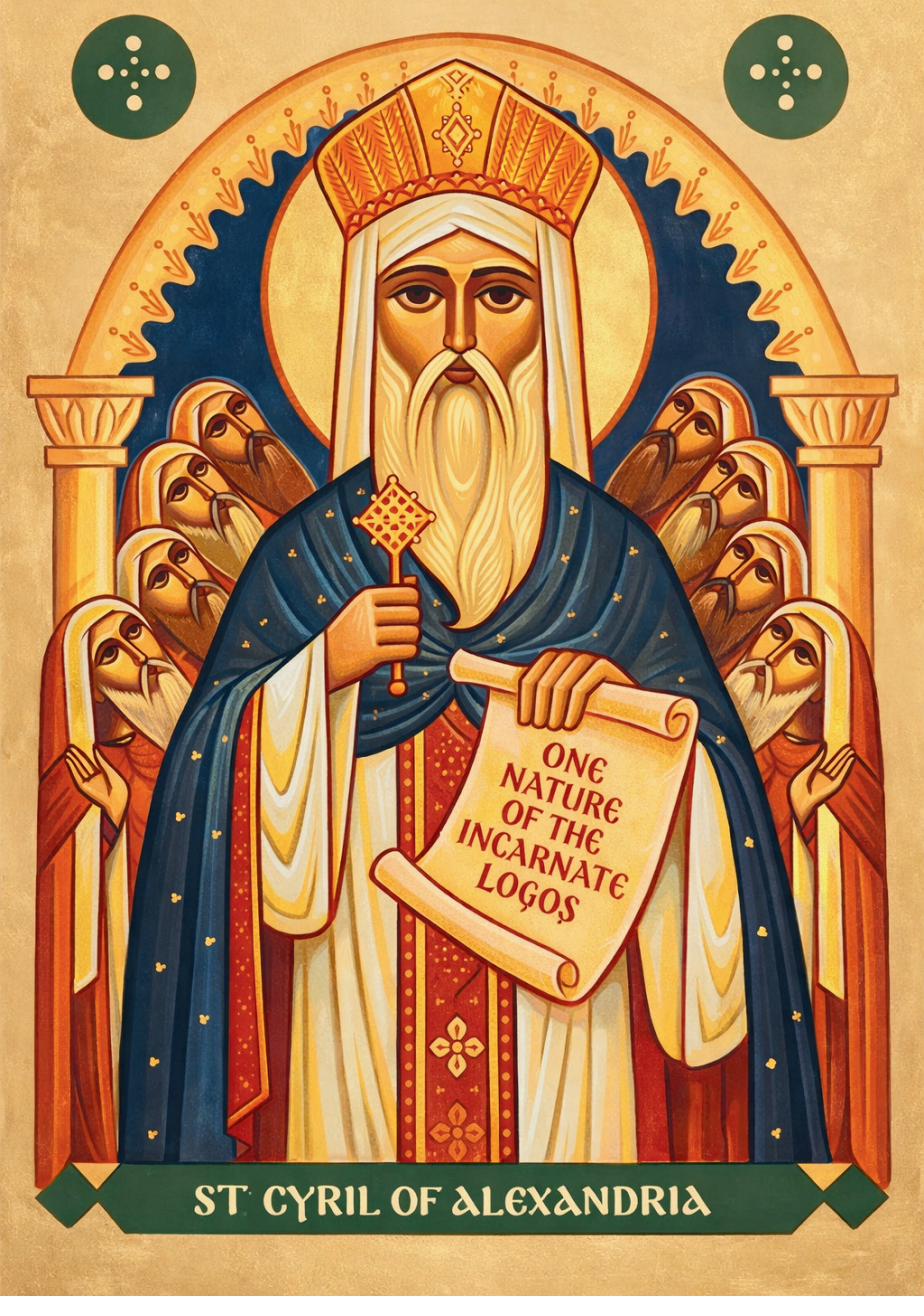
Referring to the fathers as a guide and preserving their orthodox teachings is of great importance. It is also inspirational to see early church fathers such as St. Athanasius and St. Cyril themselves quote their predecessors and fathers. St. Gregory of Nyssa tells us: “It is fit for us to preserve the tradition we have received from our forefathers without change.” Similarly, St. Cyril proclaims that he himself loved the pursuit of the knowledge of his predecessors: “I am a lover of the true teachings, pursuing the spiritual steps of my Fathers.”
Speech as the “Child” of the Soul
In the patristic tradition, a person’s teaching is understood to arise from the depths of the heart. St. Clement of Alexandria expressed: 'The speech is the son of the soul; therefore we call those who teach us our fathers.’ Because teaching flows from this deepest center of the human person, the one who imparts spiritual wisdom assumes a role similar to that of a parent, begetting spiritual life in those who receive the teaching.
For this reason, St. Clement and many fathers from the earliest centuries referred to their instructors in the faith as “Fathers.” They are not merely academic authorities, but spiritual parents whose words shape the soul and form the heart in Christ.
The Tradition of Receiving and Handing On
A defining characteristic of the Holy Fathers is their awareness that authentic Christian teaching is received, not invented. St. John Cassian expresses this succinctly:
“I shall say nothing on my own account, but only what I have received from the holy Fathers.”
Cassian speaks for the entire patristic ethos. A Father does not place himself as an originator of doctrine but as a faithful son of those who came before him. His task is to preserve, embody, and transmit the apostolic faith in its purity.
Thus, the patristic tradition forms a living chain of spiritual parenthood: each generation of Fathers begets the next through the words born from the depths of their souls.
The “Parenthesis Theory”
Modern Orthodox scholars sometimes describe this dynamic using the term “Parenthesis Theory.” The idea is that the Fathers speak within a received framework, the apostolic tradition, rather than outside or beyond it. Their teaching is enclosed, as it were, within parentheses formed by the faith handed down to them.
This means:
- They do not innovate new doctrines.
- They articulate the same faith in the language and circumstances of their time.
- Their authority rests not in originality, but in faithfulness.
In this way, the spiritual fatherhood of the Saints preserves the continuity of the Church’s life, ensuring that the teaching passed from father to son remains the same in every generation.
Classification of the Fathers
The classification of the fathers may be characterized in several fashions. Typically, the patristic writings will be reference based on one of the following:
Classification
Description
| Time | The Ante-Nicene, Nicene and Post Nicene Fathers - the fathers in time with respect to the council of Nicea. |
| Language | Based on the language of writing (Greek or Latin). The Majority of Eastern fathers would write in Greek while the western father in Latin. |
| Location | Based on where they are from. From which we have the Alexandrian Fathers, The Cappodocian Fathers, The Antiochian and Syrian Fathers or the Latin/Western Fathers |
| Material | Many authors wrote extensively addressing different topics and through different methods. Most material of writings would fall in one of the following categories: Apologetics, Exegetical Writings, Homilies, Letters, Liturgical Works, Dialogues, Poetry, Ascetic, Canons, Historical, Dogmatic. |
The Apostolic Fathers
Disciples of the Disciples
The Apostolic Fathers occupy a unique place in the life of the Church. They were the disciples of the disciples, those who learned directly from the Apostles themselves. In the spiritual vocabulary of the early Church, this relationship is often expressed in filial terms:
“When a man learns from the mouth of another, it is said that he is the son of the person who teaches him, and the latter is called father.” - St. Irenaeus, Against Heresies Book IV
Thus, the Apostolic Fathers stand as the first “sons” of the Apostles, receiving from them the living tradition of Christian faith and practice.
The Simplicity and Importance of Their Writings
The writings of the Apostolic Fathers are marked by simplicity, yet they hold profound significance. Many aspects of ecclesial life that are only briefly mentioned in Scripture are more clearly explained by these early witnesses.
For example, the New Testament speaks only in passing about the laying on of hands for episcopal ordination, without detailing its form. Yet in the writings of the Apostolic Fathers we see how the earliest Christians understood and enacted such practices.
St. Ignatius of Antioch, for instance, calls the Eucharist “the medicine of immortality” and strongly affirms the unity of the Church around one bishop in each city, a principle foundational to Orthodox ecclesiology. And after the Book of Acts, which recounts the martyrdom of St. Stephen, the Martyrdom of St. Polycarp is the earliest complete and reliable account of a Christian martyr’s final witness.
Through these writings, we glimpse the lived faith of the earliest post-apostolic communities.
The Fathers Direct Us Toward the Church
Following the Apostolic Fathers is itself the path recommended by the later Fathers. St. Irenaeus, a spiritual grandson of the Apostles through St. Polycarp, teaches:
“One should not seek among others the truth that can be easily found in the Church. For in her, as in a rich treasury, the apostles placed all that pertains to the truth.” (Against Heresies III.4)
And again:
“Those who explain Scripture without the help of the Church’s tradition cut asunder the significance of the truth.”
For Irenaeus, fidelity to the Apostolic Fathers is fidelity to the Apostles themselves.
The Fathers on Tradition and Spiritual Fatherhood
The early Fathers consistently testify that Christian teaching is an inheritance, passed on from teacher to disciple in an unbroken chain.
St. Clement of Alexandria writes:
“Words are the progeny of the soul. Hence we call those who instructed us fathers.” (Stromateis 1.1.2–2.1)
St. Gregory of Nyssa echoes the same truth:
“We have the Tradition set out for us from the Fathers like an inheritance, through apostolic succession and transmitted through the saints.”
And St. Basil the Great summarizes the entire patristic worldview:
“Among the dogmas and the kerygma preserved in the Church, some we possess through written teaching, and others we received from the Apostolic Tradition, handed down in secret. Both have the same authority and force.”
The Unified Witness
Across generations, the Fathers speak with one voice: Christian truth is not self-invented but received. The Apostolic Fathers are thus the first stewards of this inheritance, standing closest to the Apostles and faithfully handing down what they had themselves received.
Their witness forms the first link in the great chain of spiritual fatherhood that continues through the centuries and remains the living heart of Orthodox tradition.
Apologists (Ante-Nicene Fathers)
The Meaning of Apologia
The term apologia in Greek means “a defense”, specifically a reasoned explanation offered on behalf of the truth. From this comes the theological discipline of apologetics, the ordered defense of the Christian faith. For the early Church, such defense was offered not only through rational arguments but also through the living witness of holiness. A life transfigured by grace is itself an irrefutable testimony to the truth of Christ.
The Great Apologists of the Early Church
Among the most prominent Orthodox apologists are Justin Martyr, Theophilus of Antioch, St. Irenaeus of Lyons, and St. Clement of Alexandria. These Fathers wrote at a time when Christianity was misunderstood and often persecuted, and they sought both to correct false accusations and to reveal the inner beauty and coherence of the Christian faith.
St. Justin Martyr
St. Justin, a philosopher who found in Christ the fulfillment of all true wisdom, composed The First Apology, addressed to Emperor Antoninus Pius. In it he defends the moral life of Christians and presents reasoned arguments showing the truth and nobility of the Gospel. He also gives one of the earliest explicit testimonies to the Church’s understanding of the Eucharist:
“Not as common bread or as common drink do we receive these… We have been taught that the food that has been eucharistized by the word of prayer, that food which by assimilation nourishes our flesh and blood, is the flesh and blood of the incarnate Jesus.”
Justin’s witness unites philosophy with martyrdom, as he ultimately sealed his apology with his own blood.
Theophilus of Antioch
Theophilus, writing To Autolycus, addresses a learned pagan friend in order to show the divine authority of the Christian faith and the irrationality of paganism. His arguments expose the inconsistencies of Greek philosophy when it departs from the revealed truth:
“But Plato and those of his school acknowledge indeed that God is uncreated, and the Father and Maker of all things; but then they maintain that matter as well as God is uncreated, and aver that it is coeval with God. But if God is uncreated and matter uncreated, God is no longer, according to the Platonists, the Creator of all things, nor, so far as their opinions hold, is the monarchy of God established. And further, as God, because He is uncreated, is also unalterable; so if matter, too, were uncreated, it also would be
unalterable, and equal to God; for that which is created is mutable and alterable, but that which is uncreated is immutable and unalterable”
Theophilus’s writings reveal the early Church’s insistence on the absolute sovereignty of God as Creator of all.
St. Irenaeus of Lyons
St. Irenaeus stands as the great defender of the faith against Gnostic heresies, which denied both the unity of Scripture and the true humanity and divinity of Christ. His theological vision is pastoral, rooted in the love of God for humanity. In Against Heresies, he explains why humanity was removed from Paradise:
“Wherefore also He drove him out of Paradise, and removed him far from the tree of life, not because He envied him the tree of life, as some venture to assert, but because He pitied him, [and did not desire] that he should continue a sinner for ever, nor that the sin which surrounded him should be immortal, and evil interminable and irremediable. But He set a bound to his [state of] sin, by interposing death, and thus causing sin to cease, putting an end to it by the dissolution of the flesh, which should take place in the earth, so that man, ceasing at length to live to sin, and dying to it, might begin to live to God. (Against Heresies 3.23.6)”
For Irenaeus, God’s actions, even His judgments, are always expressions of divine compassion.
St. Clement of Alexandria
St. Clement sought to show that true philosophy finds its fulfillment in Christ and that Christian virtue surpasses all pagan moral systems. His writings address ethics, asceticism, marriage, knowledge of God, and the meaning of martyrdom. On the nature of divine reward, he writes:
“If God rewarded the righteous immediately, we would soon be engaged in business, not godliness. We would pursue not piety, but profit.”
Clement shows that virtue must be pursued for love of God, not for earthly advantage.
Tertullian
Tertullian is often read among the early apologists for the strength of his rhetoric and the clarity of his defense of Christian morality. Yet he is not considered a saint, because several of his later teachings departed from the mind of the Church. His works remain valuable historically, but the Orthodox tradition receives them with discernment.
Golden Age of The Fathers (Nicene and Post-Nicene Fathers)
In 313, the Edict of Milan, which was the agreement to treat Christians benevolently within the Roman Empire, ushered in a new era for Christians. Apologetical writings were less necessary. Christian writers could focus their works on promoting the Christianization of the world and explaining the Church's teachings. In the Eastern Greek world, talented Christians with a deep understanding of Greek culture contributed to Christian literature. In the Western Latin world, authors drew inspiration from many of the same sources of Greek learning, albeit in translation. The works of both Greek and Latin Christian writers encompassed various forms, including exegetical, doctrinal, polemical, moral, and ascetical. Many doctrinal and polemical works aimed to provide clarity and understanding of the fundamental truths of the Christian faith. Others sought to correct heretical interpretations of Christian truths or to clarify misrepresentations of Christian life and beliefs.
The Cappadocian Fathers, a trio of influential theologians from the 4th century, played a pivotal role in establishing Nicene orthodoxy, particularly in regard to Trinitarian theology. These three remarkable individuals—St. Basil the Great, St. Gregory of Nyssa, and St. Gregory of Nazianzus—were instrumental in shaping the theological discourse of their time and leaving a lasting legacy on Christian thought. St. Basil the Great, the eldest of the Cappadocian Fathers, was a brilliant theologian and a charismatic leader. His contributions to Trinitarian theology were significant, and he is often credited with developing the concept of the Holy Spirit as the "co-equal and co-eternal" third person of the Trinity. St. Basil's writings, such as "On the Holy Spirit," provided a comprehensive framework for understanding the nature of the Trinity and its implications for Christian faith and practice.
St. Gregory of Nyssa, the younger brother of St. Basil, was a profound philosopher and mystic. His theological insights delved into the depths of Trinitarian mystery, exploring the relationship between the three divine persons and the unity of the Godhead. St. Gregory's writings, such as "On the Trinity," emphasized the dynamic interplay within the Trinity and the idea of perichoresis, or "mutual indwelling," among the Father, Son, and Holy Spirit. St. Gregory of Nazianzus, often referred to as "the
Theologian," was a gifted orator and poet. His theological contributions focused on articulating the full divinity of Christ and the unity of the Trinity. St. Gregory's sermons, such as "The Five Theological Orations," eloquently defended the Nicene Creed and provided a strong case against Arianism, a heresy that denied the full divinity of Christ.
Together, the Cappadocian Fathers formed a formidable theological alliance that championed Nicene orthodoxy. Through their writings, teachings, and debates, they successfully defended the doctrine of the Trinity against various heretical challenges. Their influence extended beyond their time, shaping the theological landscape of the early church and continuing to impact Christian thought and spirituality to this day. The Cappadocian Fathers' profound insights into Trinitarian theology have left an indelible mark on Christian theology. Their emphasis on the unity and distinctness of the three divine persons, their exploration of the inner life of the Trinity, and their defense of Nicene orthodoxy have been instrumental in shaping Christian understanding of God's nature and the mystery of the Trinity.
St. Augustine, a prolific writer and influential theologian of the early Christian Church, left behind a vast body of work that covered a wide range of topics. Among his most notable writings are his interpretations of the Bible, often characterized by their allegorical and mystical approach. His Confessions, a spiritual autobiography, offer profound reflections on his personal journey toward faith and salvation. Additionally, St. Augustine composed numerous homilies, or sermons, which explored various passages of Scripture and provided practical guidance to his congregation. His doctrinal treatises, both philosophical and theological, addressed complex issues related to faith and reason. In his writings against philosophers, St. Augustine sought to defend Christian beliefs from the challenges posed by pagan philosophies, particularly those of the Neoplatonists. His work on the Trinity, titled De Trinitate, is considered a seminal text in Christian theology, offering a nuanced understanding of the nature of God as three distinct persons in one divine essence. His writings are known for their eloquence and their rigorous intellectual engagement with the issues of his time.
During this period, St. John Chrysostom, often referred to as the "golden-mouthed" orator, stood out among the many Greek Fathers. In Constantinople, he zealously worked to address clerical abuses, reform monastic life, and combat the vices of the wealthy. However, his efforts met strong resistance, leading to his banishment. Later, Emperor Theodosius II publicly sought God's forgiveness for St. John's mistreatment. He left a significant literary legacy, excelling as an exegete trained in the Antiochian method of clear exposition and practical application. His homilies on Genesis, the Psalms, and Isaiah are notable contributions, but his most outstanding work lies in his exegesis of the New
Testament, particularly the Epistles of St. Paul. Moreover, St. John’s treatises, such as De sacerdotio on the priesthood and his defenses of monastic life found in On the Enemies of Monasticism, On Compunction, and Exhortation to the Fallen Theodore, had a profound impact. His writings inspired Theodore of Mopsuestia to return to monastic life.
Among the many Latin writers of the West, in the Golden Age of the Fathers, the ones who stand out most prominently are St. Hilary of Poitiers, St. Ambrose of Milan, St. Jerome, and St. Augustine. Among the notable defenders of the Nicean teachings on the Trinity, Hilary of Poitiers stands alongside St. Athanasius. Hilary vigorously opposed Arianism, effectively silencing it in the Western regions. His work De Trinitate, originally titled Defide contra Arianos (On the Faith against the Arians), highlights his efforts. St. Ambrose of Milan, renowned as the bishop who converted Augustine, possessed extensive knowledge of the Greek Fathers' works. Similar to Hilary, he opposed Arianism, which found a staunch supporter in Empress Justina.
Another notable figure is Origen of Alexandria, a Christian scholar who contributed significantly to early Christian thought, but like Tertullian, is not a saint in the Orthodox church due to some heresies found in his writings. Some scholars defend Origen saying he did not write those heresies, as most of his writings were written by his students while he was narrating to them. Origen has extensive writings encompassing various genres, including commentaries on Scripture, theological treatises, homilies, and letters. One of Origen's most notable contributions is his extensive commentaries on biblical texts. His exegetical works, such as the "Commentary on John" and the "Commentary on Matthew," demonstrate his deep understanding of Scripture and his ability to synthesize different interpretive traditions. Origen's interpretations often delve into allegorical and symbolic interpretations, seeking to uncover hidden layers of meaning beyond the literal text.
In addition to his exegetical works, Origen wrote numerous theological treatises that explored profound theological concepts and doctrines. His treatise "On First Principles" is a systematic exposition of his theological system, addressing topics such as the nature of God, the creation of the world, and the relationship between the divine and the human. Origen's theological insights have influenced subsequent Christian thinkers, contributing to the development of Christian orthodoxy.
The Desert Fathers
The desert fathers, including St. John the Short, St. Arsenius, and St. Moses the Black, were renowned mentors of ascetic life during the early centuries of Christianity. These holy men retreated to the deserts of Egypt and Syria, seeking solitude and communion with God. Through their rigorous spiritual practices, they developed a deep understanding of the human soul and the path to spiritual transformation.
Among the desert fathers, St. John the Short was particularly known for his humility and wisdom. He often emphasized the importance of detachment from material possessions and the cultivation of inner peace. St. Arsenius, on the other hand, was known for his extreme asceticism and his ability to endure harsh living conditions. He believed that through physical suffering, one could attain spiritual purification. St. Moses the Black, who was once a slave before becoming a monk, was known for his compassion and his ability to guide others on the path of repentance.
In addition to the desert fathers, John Cassian, also known as John the Ascetic, played a significant role in the development of early Christian monasticism in the West. Born in what is now Romania, Cassian traveled extensively throughout the Middle East, studying under various monastic communities. He eventually settled in southern France, where he founded two monasteries and wrote extensively about monastic life.
Cassian's writings, which include the "Institutes" and the "Conferences," are considered essential texts for understanding the practices and beliefs of early Christian monks. He introduced the concept of "cenobitic monasticism," which emphasized communal living and obedience to a spiritual leader. Cassian also stressed the importance of prayer, meditation, and the study of Scripture as essential components of the monastic life.
Through their teachings and examples, the desert fathers and John Cassian left a lasting impact on the development of Christian spirituality. Their emphasis on self-denial, humility, and the pursuit of inner transformation continue to inspire and guide spiritual seekers to this day.