- 2 Fathers of the East and West
Christology and Us
Christology is part of theology that is concerned with the nature and work of Jesus, including such matters as the Incarnation, the Resurrection, and His human and divine nature and their relationship. Christology is the study of Christ and His purpose. Studying His person is crucial as it provides us with the understanding of who He (God) is. This proper understanding clarifies a major scope of the purpose of us being here. We will develop on this later and the impact of different Christological arguments and their implications.
Christ is not His last name. Rather, it is a Greek term χριστός (chrīstós) meaning “Messiah”. Just the usage of the name of Jesus Christ makes the entirety of the difference. Christ means Messiah. Thus by simply using His name of Jesus Christ, you are proclaiming a faith. an understanding of who He is and His relation to you.
Some Heresies on the Hypostasis of the Son are against His Person - Ehionism / Adoptionism: Christ was a man, merely a human being and God adopted him (Islamic) Manicheanism / Paulicianism: Similar to Ehionism.
Another Heresy was against the Son Divinity - Arianism: Denied the Divinity of Christ Semi-Arians: Son is like the Father or a fan of the Father – a creation of the Father Anomoeanism: Extreme Arianism.
Against His humanity - Eutchianism / Monophytism: Divinity absorbed humanity Gnosticism: Denied His Humanity Docetism: Did not take a real body: Ghost like – no incarnation Marcionism/Valentianism: God of OT is separate & inferior than Christ the Saviour. Against His nature - Nestorianism: Split the Divinity and Humanity Apollinarism: Christ was not in need of soul and spirit Pelagianism: Based on Work, not on grace of God Semi-Pelagianism: Giving more weight to action which defies “without God you cannot do anything”
Definition of “The One Nature” Between Two Extremes
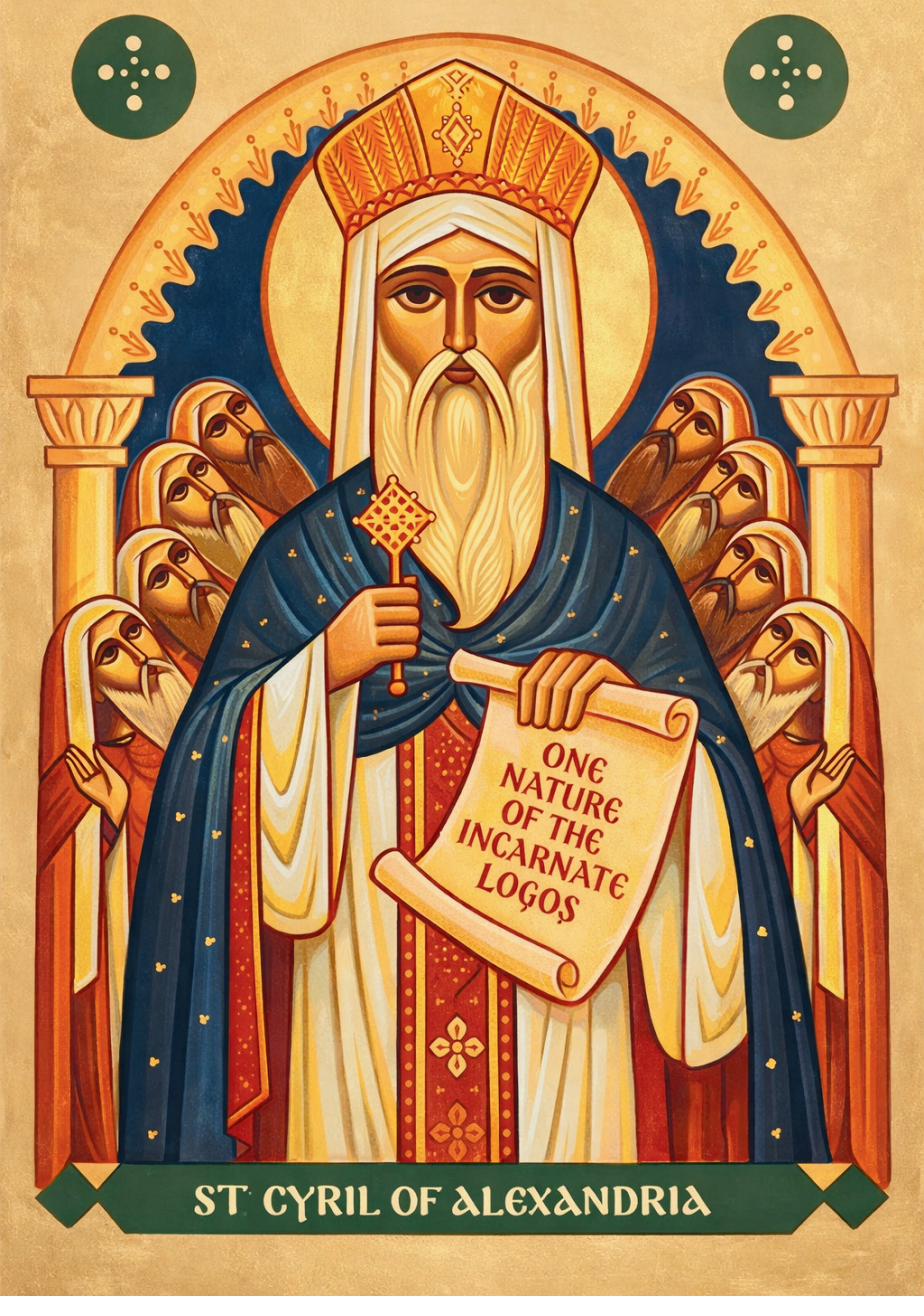
Eutyches: “I confess that our Lord had two natures before they were united, but I confess that after the union He had one nature” Nestorius: [Jesus was a] “God-bearer”. St. Cyril’s definition : “The One Nature of the Incarnate Logos”
St. Severus’s definition of Eutyches - “When we say ‘one incarnate nature of God the Word’, as Athanasius the proponent of the truth and the apostolic faith said in the books on the Incarnation of the Word, we use ‘nature’ in place of ‘individual designation’, denoting the one hypostasis of the Word himself, like that of Peter also or of Paul, or of any other single man. Wherefore also, when we say ‘one nature which became incarnate’, we do not say it absolutely, but by adding one nature of the Word Himself clearly denote the one hypostasis.” St. Severus – Letter 65 to Eupraxias (Oriental Orthodox Library, P.117)
St. Cyril’s definition of Eutyches - “The union was “at the level of concrete existence,” meaning by this simply that the Word’s nature, that is, his concrete existence, which is the Word Himself, was genuinely united to a human nature, quite apart from any change or confusion, as we have said often enough. He is reckoned to be, and actually is, a single Christ; the same individual is both God and man.” St. Cyril of Alexandria. Three Christological Treatises: 1. One Nature is not a mixture of the two natures into one new nature, 2. One Nature is not a union of two persons, 3. One Nature is one hypostasis = One Person out of two natures.
Implication on the Sayings and Actions of the Lord - “On the one hand, some of the sayings are very especially proper to His divinity. Others again are proper to His humanity. But others very specially pertain to a certain middle position, because they reveal the Son as God and man, both at the same time and in Him. Yet we say that those proper to His divinity and those proper to His humanity are the sayings of the one Son.” Cyril of Alexandria. Letters, 1–50.
‘So far, then, as the question of the manner of the Only-Begotten's becoming man appears for purely mental consideration by the mind's eye, our view is that there are two united natures but one Christ, Son and Lord, the Word of God become man and incarnate.’ - St Cyril of Alexandria. “First Letter to Succensus”
Do not, therefore, divide in these instances the expressions about the Lord, for they have in the same person what is proper to God and what is proper to His humanity; but rather apply them to the one Son, that is, to God the Word made flesh.
Definition of The One Nature - The Difference between Eastern Orthodox and Oriental Orthodox - The Sixth Ecumenical Council and the Tome of Leo
The sixth Ecumenical Council – The Definition of Faith - “Following the five Holy Ecumenical Councils and the Holy and approved Fathers, with one voice defining: [...] One and the same Christ our Lord the Only-Begotten Son of two natures unconfusedly, unchangeably, inseparably, indivisibly to be recognized, the peculiarities of neither nature being lost by the union but rather the proprieties of each nature being preserved, concurring in one Person and in one subsistence, not parted or divided into two persons but one and the same Only-Begotten Son of God, the Word, our Lord Jesus Christ. [...]
Liturgy of St. Basil/St. Gregory/St. Cyril “He made it one with His divinity, without mingling, without confusion, and without alteration.”
We glorify two natural operations indivisibly, immutably, inconfusedly, inseparably in the same our Lord Jesus Christ our true God. That is to say a divine operation and a human operation according to the divine preacher Leo, who most distinctly asserts as follows: “For each form does in communion with the other what pertains properly to it, the Word, namely, doing that which pertains to the Word, and the flesh that which pertains to the flesh.” For we will not admit one natural operation in God and in the creature, as we will not exalt into the divine essence what is created, nor will we bring down the glory of the divine nature to the place suited to the creature. [...]
His two natures shone forth in His one subsistence in which He both performed the miracles and endured the sufferings through the whole of His economic conversation, [...] for although joined together yet each nature wills and does the things proper to it and that indivisibly and inconfusedly.” The Third Council of Constantinople: The Definition of Faith.
“For neither do His Divine acts affect His human, nor His human acts His Divine, since both concur in this way and to this very end that in their operation His twofold qualities be not absorbed the one by the other, nor His individuality doubled.” Leo the Great. Letters
Exchange of Properties
St. Severus’ Objection to the Tome of Leo
“We therefore anathematize […] those who separate the properties, and apportion them to each nature apart. When the one Christ has once been divided (and He is divided by the fact that they speak of two natures after the union), separated into a distinct diversity go the operations and properties which are the offspring of this division, as the words of Leo's impious letter state in what he said: ‘For each of the forms effects in partnership with the other that which belongs to itself, the Word doing that which belongs to the Word, and the body performing the things which belong to the body.’ St. Severus of Antioch – Letter 1 to Oecumenius (Oriental Orthodox Library, P.17-19)
“Again the Tome of Leo says: ‘For each of the natures preserves its own property without diminution.’ Distributing the properties to the two severally as one who divides the one and only Christ into two natures.” St. Severus – Letter 1 to Oecumenius (Oriental Orthodox Library, P.17-19)
‘So far, then, as the question of the manner of the Only-Begotten's becoming man appears for purely mental consideration by the mind's eye, our view is that there are two united natures but one Christ, Son and Lord, the Word of God become man and incarnate.’
St. Cyril and the Analogy of Iron and Fire
“Against these things it is well to set the much-honored words of the holy Cyril: ‘For, as fire when it takes hold of wood and is introduced into it, prevails over it, and does not make it cease being wood, but rather changes it into the appearance and force of fire, and performs all its own acts in it, and is already reckoned as one with it, so understand in the case of Christ also. For, since God was ineffably united with manhood, He has preserved it as what we say it is, and He Himself also has remained what he was. But, after He has once been united, He is reckoned as one with it, appropriating its qualities to Himself, but He Himself also carried on the operation of His nature in it.’” St. Severus of Antioch – Letter 1 to Oecumenius (Oriental Orthodox Library, P.17-19)
The Use of the Word “Mingling”
Liturgy of St. Basil/St. Gregory/St. Cyril “He made it one with His divinity, without mingling, without confusion, and without alteration.”“The things of His humanity are to be placed with His divinity because of His commingling. For it was not a heavenly man who came down from heaven but rather God who was mingled with man. And the Lord of glory, who was God, could not be crucified unless He received a body.” Cyril of Alexandria. Letters, 51–110.
“Mingling” – Not Like Liquids
“For the name mixture, some of the holy fathers too have put: but since you say that you are afraid lest any confusion be deemed to take place, as in the case of liquids mingled with one another, I rid you from your fears, for not so did they deem (how could they?) but they used the word improperly, anxious to declare the extreme union of the things that had come together.” Cyril of Alexandria. Five Tomes against Nestorius; Scholia on the Incarnation; Christ Is One; Fragments against Diodore of Tarsus, Theodore of Mopsuestia, the Synousiasts
‘But if the two natures have been brought into one mingling, because they happen to be of different substances, neither one is preserved, but both have disappeared after they have been blended.’ - Cyril of Alexandria. (1987). Letters
Without Confusion
“to assert instead that the union was “at the level of concrete existence,” meaning by this simply that the Word’s nature, that is, His concrete existence, which is the Word himself, was genuinely united to a human nature, quite apart from any change or confusion, as we have said often enough. He is reckoned to be, and actually is, a single Christ; the same individual is both God and man.” St. Cyril of Alexandria, Three Christological Treatises
Other Analogies The Sun and the Mud
“The sun itself, when it casts its rays upon the very mud and mire, preserves its radiance quite unimpaired. And the divine, uncontaminated nature, which is above all else and which is quite incapable of suffering any of the things that normally cause distress: how could it be harmed by contact with what is lesser? Will it not rise above the nature that is inferior, and, by illuminating it with its own good things, transport it to what is incomparably better?” Cyril of Alexandria. Festal Letters, 13–30.
Other Analogies The Wool and the Dye
“Is it not totally obvious […] that the saving union was the means by which he injected himself into our own way of life? And also so that by making the human soul His very own He might demonstrate that it was superior to sin, as if He had dyed it like a piece of wool with His own nature’s unshakeable immutability?” St. Cyril of Alexandria. Three Christological Treatises.
Other Analogies By St. Cyril and other Father
Wood and Fire, The Two Goats One Killed and the Other Let Go into the Wilderness, The Shepherd holding the Sheep on His Shoulders, The Lily of the Valleys and the Scent that it Emits, Golden Pot of Manna, Bread Dipped in Wine, The Vessel of Ointment and the Odour, Drop of Vinegar in the Ocean.
Why is Christology so Important? Partakers of the Divine Nature
“Grace and peace be multiplied to you in the knowledge of God and of Jesus our Lord, as His divine power has given to us all things that pertain to life and godliness, through the knowledge of Him who called us by glory and virtue, by which have been given to us exceedingly great and precious promises, that through these you may be partakers of the divine nature, having escaped the corruption that is in the world through lust.” 2 Peter 1:2–4
‘justly marvel at the incomparable mercy of the divine nature toward us, which graces those whom He has made with what belongs to Him and shares with His creatures what belongs to Himself alone.’ -Saint Cyril of Alexandria. Commentary on John (Vol. 2, p. 307).
‘But when He was led astray by the deception of the devil, He despised the creator. He trampled on the law that was marked out for Him and grieved His benefactor. The benefactor took back the grace that was given to Him. When, for the first time, the one who came to life heard, “Earth you are, and to earth you will return,” the likeness to God was then marked with a false stamp through the sin that rushed in, and the engraving was no longer distinct. It became more obscure in him, so to speak, and darkened by the transgression. When the human race reached a great multitude and sin ruled over all of them, it thoroughly plundered the soul of each one, and nature was stripped of the original grace. The Spirit also departed completely, and the rational creature fell into utter irrationality, not even recognizing the creator Himself’ Saint Cyril of Alexandria. Commentary on John. (Vol. 1, p. 81-2)
Review of Part 1: Christology & Grace
St. Paul prays that the grace may increase in our lives. Thus we will shortly ask ourselves, what is the meaning of grace increasing in our lives?
All gifts from God are a grace. Him taking on the human nature is a gift and thus a grace He gave all mankind. Grace is a gift that leads to salvation. Because, at the creation, we were abounding in grace, and through the fall of man, mankind was stripped of this original grace. Thus the incarnation of Christ, graces us with a new nature that leads us towards the path of salvation.
By Grace you have been saved through faith
Saint Paul clearly teaches: “by grace you have been saved through faith” (Ephsians 2:8). Grace is inseparable from salvation. How we understand grace will affect our understanding of salvation. The Orthodox Church teaches, as do the Holy Scriptures, that we are saved by grace through faith. The question is, “What is grace and how is it acquired (i.e. what is faith)?”
Partakers of Divine nature through the gifts of Grace
It is mentioned in John 1:16, “ grace for grace”. The early church fathers teach us that there is a grace in the Old testament given to men through the law of Moses and is raised and upgraded to a new grace – a grace and truth through Jesus Christ. It is through Grace that we are partakers of the divine nature.
Similarly extracted from https://www.suscopts.org/q&a/index.php?qid=718 - St. Athanasius says “When once transgression had begun men came under the power of the corruption proper to their nature and were bereft of the grace which belonged to them as creatures in the Image of God. God created man for incorruption and as an image of His own eternity; but by envy of the devil death entered into the world. When this happened, men began to die, and corruption ran riot among them and held sway over them to an even more than natural degree, because it was the penalty of which God had forewarned them for transgressing the commandment. Indeed, they had in their sinning surpassed all limits; for, having invented wickedness in the beginning and so involved themselves in death and corruption, they had gone on gradually from bad to worse, not stopping at any one kind of evil, but continually, as with insatiable appetite, devising new kinds of sins. Adultery and thefts were everywhere, murder and rapine filled the earth, law was disregarded in corruption and injustice, all kinds of iniquities were perpetrated by all, both singly and in common.
God became man so that “For He became Man that we might be made good.” Athanasius of Alexandria. Athanasius: On the Incarnation of the Word of God. “In short, what is ours has become His in the economic appropriation, in order that we too, in what is peculiarly His, might ascend with Him and through Him, gaining that thing by the kindness that is from Him.” Cyril of Alexandria. Festal Letters, 13–30. “He took what is ours and gave us what is His.” Midnight Praises
That we may become partakers of His divine nature
‘The union with the vine of the branches that proceed from it belongs to the faculty of choice, and the vine’s union with us is relational. By a good choice, we have drawn near through faith and have become His offspring, receiving the honor of adoption from Him.’ Saint Cyril of Alexandria. (2015). Commentary on John. (D. Maxwell, Trans.) (Vol. 2, p. 210). Downers Grove: Intervarsity Press Academic.
‘those who are united to Him and fixed and rooted in Him, so to speak, who have come to share in His nature by participation in the Holy Spirit, are the branches. His Holy Spirit is what unites us to Christ our Savior.’ Saint Cyril of Alexandria. (2015). Commentary on John. (D. Maxwell, Trans.) (Vol. 2,
- 210). Downers Grove: Intervarsity Press Academic.
‘Paul expounds for us one true and general reason for the incarnation of the Only-Begotten when he says that God the Father was pleased “to recapitulate all things in Christ,” and that the term and the act of “recapitulation” refers to bringing back and taking up what had fallen into an unrecognizable end to what it was in the beginning. Saint Cyril of Alexandria. (2015). Commentary on John.
Conclusion
St. Cyril: “The One Nature of the Incarnate Logos” One Nature ≠ A mixture of the two natures into one new nature, One Nature ≠ A union of two persons, One Nature = One hypostasis = One Person out of two natures. There was no mixing/mingling of the natures in Christ but there was a mixing/mingling of the properties (ex: iron in the fire). All actions and sayings in the Gospels are attributed to the one Person of Jesus Christ and not to individual natures. His incarnation blesses us with the ability of being united with Him and restoring our image and likeness through grace. This is what St. Peter means when he says that we become “partakers of the divine nature” (2 Peter 1:4)