HIST201 - Heresies & Schisms
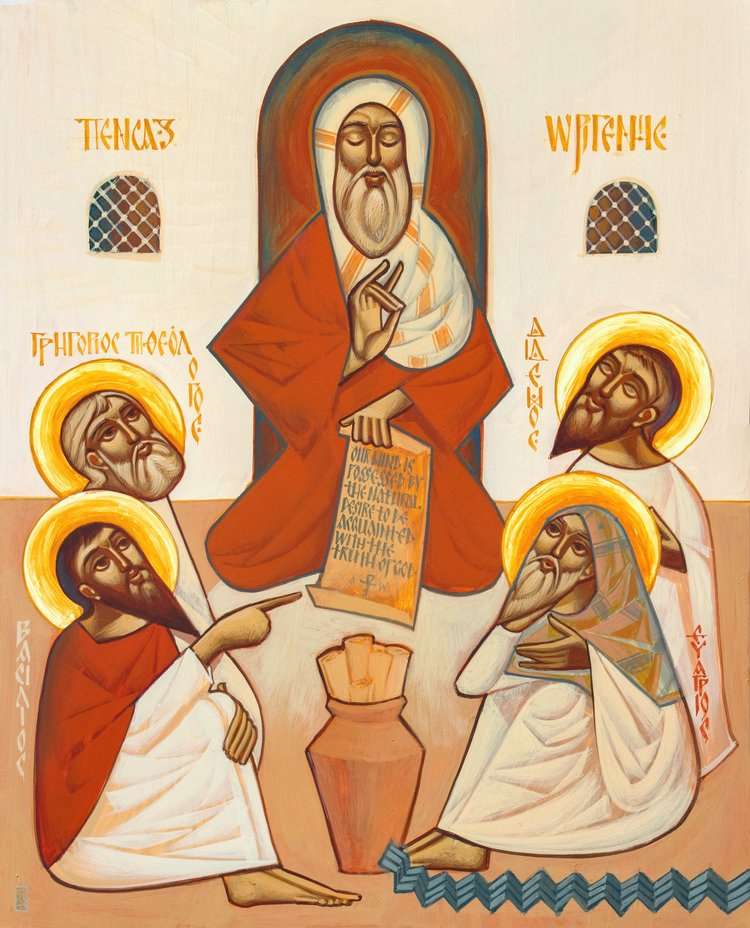
The Exile of St. Dioscorus
The Council of Chalcedon, convened in 451 AD, was sparked by the heresy of Eutyches. This influential monk asserted that Christ possessed only a divine nature, denying his human nature, a belief known as Monophysitism. In response to the growing influence of Eutyches and his followers, Flavianus, the bishop of Constantinople, convened a local council in Ephesus in the year 448 AD. The council, attended by prominent theologians and church officials, thoroughly examined Eutyches' beliefs and ultimately reached a decision. After careful deliberation, the council excommunicated Eutyches from the Church, declaring his teachings to be heretical and incompatible with orthodox Christian doctrine.
However, Eutyches felt deeply aggrieved by the council's decision. He believed that he had not been given a fair opportunity to present his case and defend his beliefs adequately. He maintained that the excommunication was unjust and that he had not been granted a proper platform to engage in a meaningful debate before such a drastic measure was taken against him. In an attempt to rectify the situation and seek redress, Eutyches composed a series of letters. These letters were addressed to influential figures within the Church hierarchy, including Pope Leo I of Rome. In these communications, Eutyches passionately defended his theological positions, arguing that they were based on sound scriptural interpretation and were in alignment with the teachings of the early Church Fathers. He implored the recipients of his letters to reconsider the council's decision and to grant him a fair hearing.
In the year 449 AD, news reached Emperor Theodosius II, a ruler who held the church of Alexandria in high regard and devotion. The Emperor, seeking to resolve a theological dispute, entrusted Pope Dioscorus, the patriarch of Alexandria, with the responsibility of overseeing a second council in Ephesus to hear the case of Eutyches, a monk who had been accused of heresy. This council, convinced by Eutyches' apparent repentance, readmitted him into the ranks of the clergy. However, in a controversial move, they also took punitive action against Pope Flavian of Constantinople and several other bishops who had supported him. The council accused Pope Flavian and his allies of political scheming and deposed them from their positions.
The council of Chalcedon that followed convened primarily to address the issue of Eutyches's heresy and to examine the actions of Pope Dioscorus of Alexandria. Many historians believe that the council was orchestrated as a trap for Pope Dioscorus, driven by the desire of other episcopal sees to diminish the influence and prestige of the Alexandrian Church within the Empire.
The Tome, intended to clarify the orthodox position on the dual nature of Christ, was presented to Pope Dioscorus for review. However, Pope Dioscorus interpreted the Tome as promoting Nestorian ideology, which posited that Christ had two distinct and separate natures. This misunderstanding exacerbated tensions, leading Pope Dioscorus to excommunicate Pope Leo. The majority of the council, however, opposed the stance taken by Pope Dioscorus and the Egyptian bishops. The council fathers, through vigorous debates and theological discussions, posited the belief in Christ's dual nature—both divine and human—as articulated in the Tome and sent Pope Dioscurus in exile.
Aftermath of Chalcedon
Following the exile of St. Dioscorus, the council convened numerous meetings to deliberate on various matters. One significant issue that arose was the question of which among them would hold the highest rank and enjoy greater prerogatives. This discussion laid bare their true intentions, which were to reduce the Coptic Church of Alexandria to a position of inferiority, thereby elevating the status of Constantinople and Rome.
Emperor Marcianus, in a move that furthered their agenda, confirmed the exile of St. Dioscorus to the remote island of Gangra, located off the coast of Asia Minor. This act symbolized their unwavering commitment to subjugating the Coptic Church and consolidating power within the Byzantine Empire.
The council's deliberations and decisions revealed a profound desire for control and dominance. By exiling St. Dioscorus and seeking to diminish the influence of the Coptic Church, they sought to establish a hierarchy in which Constantinople and Rome held unquestionable authority. This strategic move was not merely about ecclesiastical matters but also about consolidating political power and asserting their dominance over religious institutions.
However, their actions ignited a fire of resistance among the Coptic Christians, who remained steadfast in their faith and unwavering in their support of St. Dioscorus. The Coptic Church, despite facing adversity, continued to flourish, preserving its unique traditions and spirituality.
Assignment of Proterius
When Emperor Marcianus approved the Council’s verdict, and banished St.Dioscorus, he sent a message to the Alexandrian people informing them of this verdict and telling them that he had appointed a man by the name of Proterius to occupy his chair. He also warned them against any disobedience. Proterius was sent to Alexandria accompanied by troops who had orders to punish anyone who refused to submit to him. However, the Egyptians rebelled, as was their custom when they felt strongly about anything.
Upon approving the Council's verdict of banishing St. Dioscorus, the Patriarch of Alexandria, Marcianus dispatched a message to the Alexandrian people. The message conveyed not only the verdict of the Council but also the appointment of Proterius as the successor to St. Dioscorus and warned them of upcoming disobedience. Marcianus's decision was met with resistance. The appointment of Proterius, who was seen as an outsider, further inflamed tensions within the Alexandrian church.
To ensure the smooth transition of power, Marcianus sent troops alongside Proterius to Alexandria. These troops were instructed to quell any potential opposition to Proterius's authority. However, their presence further fueled the rebellion, as the Egyptians resented the perceived imposition of an external leader upon them.
The Coptic Church, known for their strong attachment to their traditions and religious beliefs, fiercely protested against the appointment of Proterius. They saw it as an encroachment upon their autonomy and a disregard for their deep-rooted customs. The rebellion was not merely a political act but also a manifestation of their convictions.
The Chair of the See of Alexandria
The Bishops met and decreed their unanimous support of St. Dioscorus. They officially excommunicated Leo and his Tome, the Chalcedon decrees, and Proterius. To counteract this measure, the imperial troops went to each bishop alone ordering him to sign the Chalcedon decrees. They all refused to sign, and regarded Proterius as a foreigner who seized a See he had no right to occupy. In the year A.D. 456, news came to Alexandria that St. Dioscorus had passed to the Kingdom of Heaven. Consequently, the entire country mourned.
In a grand assembly, the Bishops convened to deliberate upon matters of faith and governance. With solemn expressions, they unanimously declared their unwavering support for the revered St. Dioscorus. Their decree, resonating through the halls, officially excommunicated Leo and his Tome, along with the decrees of Chalcedon and Proterius. This momentous announcement sent ripples throughout the Christian world.
To counter this bold measure, the imperial troops embarked on a strategic mission. They approached each bishop individually, delivering a stern order to sign the Chalcedon decrees. However, their efforts proved futile as every bishop steadfastly refused to comply. They viewed Proterius with disdain, considering him an outsider who had audaciously seized a See that rightfully belonged to another.
Support and Mission
Many of St. Dioscorus' friends remained steadfast in their loyalty towards him, refusing to abandon him during his time of trial. Through correspondence and personal visits, they maintained contact with him, providing a vital lifeline of support. Among these loyal companions was a bishop from Iberia, present-day Spain, named Peter. In his initial letter to St. Dioscorus, Bishop Peter meticulously recounted the events that unfolded in Chalcedon after his departure. He chronicled the proceedings of the Council of Chalcedon, detailing the accusations leveled against St. Dioscorus and the subsequent decisions reached.
St. Dioscorus' replies to Bishop Peter consistently reflected his unwavering conviction that he had acted righteously. He firmly maintained that he had stood steadfast in defense of his faith, refusing to yield to worldly powers that sought to influence his judgments. In his letters, St. Dioscorus expressed a profound sense of inner peace and contentment, knowing that he had remained true to his principles.
Remarkably, St. Dioscorus extended forgiveness to those who had wronged him, despite that they “spitefully used him and persecuted him.” . He held no grudges or bitterness towards his detractors, acknowledging that they had acted out of spite and persecution. This act of forgiveness further underscores St. Dioscorus' unwavering commitment to Christian values, even in the face of adversity.
Through his correspondence with Bishop Peter and other loyal friends, St. Dioscorus found solace and strength. Their unwavering support and shared belief in the righteousness of his actions sustained him during his exile. Their unwavering loyalty served as a testament to the enduring bonds of faith and friendship that transcended geographical and political boundaries.
Service
During his exile on the remote island of Gangra, St. Dioscorus dedicated his life to spreading Christianity and bringing heretics back to Orthodoxy. He relentlessly served his Lord, touching the hearts of many pagan residents who embraced the teachings of Christ under his guidance. Additionally, he successfully led several heretics back onto the path of Orthodox Christianity, demonstrating his unwavering commitment to his faith. Throughout his life, God raised loyal witnesses who recognized St. Dioscorus's unwavering devotion. One such witness was St. Severus, the Patriarch of Antioch in the sixth century. He boldly proclaimed St. Dioscorus was a martyr of Christ; he alone, refused to worship Baal in that false council”, highlighting his steadfast refusal to bow down to Baal during the infamous Council of Chalcedon.
Another witness, Mar Zakareya, Bishop of Modally in Asia Minor, described St. Dioscorus as “the man whose faith was like that of Athanasius, Kyrillos, and the other Church Doctors. And seeing that this intrepid man – Dioscorus – had trained himself from his tender years in the Orthodox faith, he refused to bow to the doubt-faced idol set up by Leo at Chalcedon”. He marveled at St. Dioscorus's unwavering commitment to Orthodox Christianity since his youth, which gave him the strength to resist the false idols set up by Emperor Leo at Chalcedon.
Similarly, Abba Petros, the 27th Pope of Alexandria, honored St. Dioscorus as "Christ's loyal martyr," recognizing his unwavering dedication and unwavering faith. Five years after his sentence of exile, St. Dioscorus ascended to the heavenly ranks, leaving behind a legacy of steadfastness and unwavering devotion to his Lord.
Pope Timothy II
News spread like wildfire that St. Dioscorus, a pillar of faith and devotion, had passed away, leaving behind an immeasurable void in the hearts of his followers. The entire country plunged into mourning, as if a celestial light had been extinguished. The governor of Alexandria was out of the city when the sad news came. Seizing this chance, they convened a meeting, their hearts united in a common purpose. With unwavering determination, they unanimously elected St. Timothy, a revered secretary of the esteemed St. Dioscorus, to serve as the 26th successor to St. Mark, the founder of the
Church of Alexandria. St. Timothy, a man of profound faith and unwavering conviction, assumed the mantle of leadership with humility and grace. Together with his dedicated bishops, he reaffirmed their excommunication of the Council of Chalcedon, a decision that sparked controversy and divided the Christian world. The council's decrees, they believed, deviated from the true teachings of the faith, compromising the integrity of the church.
Emperor Marcianus, upon learning of these developments, responded with an iron fist. He ordered the exile of St. Timothy and his brother to the desolate island of Gangra, where St. Dioscorus had previously faced banishment. News of this harsh decree spread through the streets of Alexandria, igniting outrage and fury among the Egyptian populace.
The people, who held St. Timothy and his brother in high esteem, could not bear to see them unjustly exiled. They resolved to take matters into their own hands. Crowds gathered outside the palace occupied by Proterius. Panic-stricken, Proterius sought refuge in the baptistery of his church, but in their fury they pursued Proterius and killed him.
Emperor Basiliscus restores Pope Timothy
In the year 474 AD, the Eastern Roman Empire faced a significant transition as Emperor Marcianus, who ruled for seven years, passed away without an heir to succeed him. This event opened the door for Basiliscus to ascend to the imperial throne. Basiliscus, upon assuming power, made a crucial decision that would impact the religious landscape of the empire. He ordered the return of St. Timothy, a prominent patriarch of Alexandria, who had been forced into exile during the reign of Emperor Zeno.
St. Timothy, recognizing this opportunity, seized the moment to bring with him the body of St. Dioscorus, the patriarch of Alexandria from 444 to 454 AD, who had been condemned as a heretic by the Council of Chalcedon in 451 AD. Pope Timothy, the bishop of Rome, played a vital role during this pivotal period. He made a bold request to Emperor Basiliscus, urging him to allow the exiled bishops to return to their respective dioceses. His intervention aimed to foster reconciliation and restore the unity of the Church.
Recognizing the importance of addressing theological disputes and promoting unity, Pope Timothy convened a council in Constantinople, which was attended by an impressive number of 500 bishops from across the empire. This council served as a platform for discussing and resolving doctrinal differences. During the council, Pope Timothy reaffirmed the anathema, or condemnation, against the Eutychian heresy. Eutychianism, named after the monk Eutyches, held the belief that Christ's divine nature had absorbed his human nature, denying the full humanity of Jesus. The council rejected this teaching as incompatible with Christian orthodoxy. Furthermore, the council also rejected the Tome of Leo, a letter written by Pope Leo I that sought to define the relationship between the divine and human natures of Christ. The Tome of Leo was viewed by some as supporting Nestorianism, a doctrine that emphasized the separation of the divine and human natures in Christ.
Through these actions, Pope Timothy and the council endeavored to establish reconciliation among the churches of Jerusalem, Constantinople, Antioch, and Alexandria. The efforts of Pope Timothy and the council were successful in achieving their objectives. Reconciliation was established, and it endured for several years. However, the challenges facing the Eastern Roman Empire and the Church were far from over, and subsequent events would test the resilience of these hard-won agreements.
The Henoticon
On the 28th of July A.D 482, the emperor Zeno issued the "Henoticon," presenting a description of the religious situation in the East. It was a realistic report stating the condition of the church following the Council of Chalcedon. It said: “For it happened that throughout the previous decades (years), time has witnessed generations pass away, some deprived of the baptismal renovation, others without participation in the divine communion to the point of departure, and tens of thousands of death have been recklessly inflicted to the extent that not only the earth, but the atmosphere has been polluted. Who would not pray that such things may be substituted for better ones?”
Emperor Zeno, who began his royal rule by canceling the resolution of Emperor Basiliscus and sending the non-Chalcedonian bishops to exile, came to understand how the church in the East suffered bitterly from the persecution of the royal court. We do not forget that Zeno, later became amicable to the church of Alexandria, in particular to the monks of this church especially after his daughter Hilaria (Hillary) disguised in a monk's uniform and led an ascetic life. Nobody knew anything about her until she had healed her only sister from sickness. The Emperor then, gave generously to the monasteries in Egypt. In that proclamation Zeno ignored the Council of Chalcedon and the Tome of Leo. In the meantime he took the positive side to confirm the unity of the nature of our Lord Jesus Christ without reference to any particular text.
In fact the Henoticon did not return to the persecuted non- Chalcedonians their rights. It only allowed them the freedom of practicing their spiritual and ecclesiastical activities without being obliged to accept the resolutions of the Council of Chalcedon. Therefore they welcomed it, not for the theology it bears, but because it gave them the freedom to work regardless of the clear tendency it bears towards the thought of those who believed in one nature. This Henoticon gave an opportunity for the four main Sees of the East to unite. The See of the west in Rome didn't occupy itself with that matter. The delegates of Rome expressed their line of thought in the meeting of the Council of Chalcedon held on the 22nd of October A.D 451, saying that the East should accept Rome's point of view or else withdraw, leaving Rome on her own.
On the 28th of July 484, Filex III of Rome called a synod of 27 bishops and excommunicated Pope Peter of Alexandria and Patriarch Acacias, yet they didn't give the matter any attention. In spite of the death of Acacias in 489, Pope Peter III in 490 and Zeno in 491, Emperor Anastasius I (A.D 491-518) held to the Henoticon. The Patriarchs of Constantinople had to sign it when they were being ordained. This continued until the death of the emperor in 518. In that period St. Severus of Antioch (512-518) appeared as one of the most famous theologians on the subject of the one nature of our Lord Jesus Christ. The Church of Alexandria lived in peace together with the other Sees in the East, and had a loving relationship with Emperor Anastasius. This lasted until the enthronement of Justinian when the troubles newly began.
Post-Chalcedon
In the year Pope Timothy was ordained (A.D. 519), Anastasius died and Justinian became emperor. He inclined towards Chalcedonianism, yet his wife, Theodora the pious, played the role of trying to appease him at several occasions. Thus his era was characterized by periods of trouble and periods of rest. Once, as Justinian entered the church with bishop John the Cappadocian, some Chalcedonians shouted against St. Severus of Antioch and demanded his trial, while others shouted with applause as a reaction to the former disapproval. The emperor then convened a council to settle the matter. When the Pope of Alexandria learned about the emperor's intention, he didn't go to that council. The emperor commanded that he would be put under arrest, and sent him to exile.
A troop of soldiers entered the church by force while the people gathered in support of their pope. The matter developed into a battle between the armed soldiers and the unarmed congregation. The soldiers killed many of the people then arrested the pope and sent him to exile. The emperor imposed an alien patriarch named Apollinarius. Later on the Pope came back but he was hiding and running from a city to another running from Justanian.
Same strategy was adopted by Justanian with pope Theodosius (the 32nd pope). He ordered him to endorse the resolutions of the Council of Chalcedon, promising to appoint him a Patriarch all over Africa. The Pope considered these promises devilish and refused to sign. The emperor then summoned him and received him with a great welcome and tempted him six times but the Pope refused. The emperor then imprisoned him in Constantinople and ordained an alien patriarch (Paul El-Tanisi) and sent him with an entourage of soldiers. The alien bishop remained for a whole year without any of the congregation to pray with him except the ruler and the soldiers. He often heard slogans like, "down with the traitor! down with Jude the alien!," so he asked the emperor to relieve him. The Pope remained in prison for 28 years until he died in A.D 567.
Justinian I thought that he was capable of bringing back the unity to the empire by condemning the "Three Chapters (Tria Kephalaia)." These chapters were the writings of the semi- Nestorian authors and were included in the documents of the Council of Chalcedon [the writings of Theodore of Mopsuestia, Theodoret of Cyrus and Ibas of Edessa.] In A.D 553 the Council convened in Constantinople and affirmed the anathemas of the "Three Chapters". It also affirmed the emperor's anathema against the Origenists and Origen's writings.
But this council failed and didn't achieve what it was targeting especially that this council did not provide comfort to the people of Alexandria while their legitimate Pope spent the greater time of his papacy in a prison in Constantinople. Even when Paul El-Tenaisy, the alien patriarch, died, another named Apollinarius was ordained by the emperor's command. This man entered Alexandria in the uniform of a military commander and gave his orders to the people to assemble in the church. He then took off the military clothes and put on the priestly clothes and read to them the imperial decree. At that time cries of protest were heard aloud as the alien patriarch ordered the soldiers to use force and many were martyred. People called that day "The Massacre"... at that time the emperor was about to depart. Some historians assure that Justinian acted in good faith, but what happened to the Copts stirred them up against Byzantium.
When Emperor Justian died on November 14th, 565, he was succeeded in turn by Justine II (565-578), Tiberus (578-582), Maurice (582-602) and Phocas (602-610). They all followed in the line of Justinian I in supporting the alien patriarch who represented the Byzantine authority not the ecclesiastical ministry. This fermented the divide of the Chalcedonians and non-Chalcedonians churches.
Post-Chalcedon
Following the aftermath of the Council of Chalcedon, the Church divided into many branches and sects of Christianity, wherein we fall under Oriental Orthodox Christians. Below, one can see that we are linked to Roman Catholics who implicate Eastern Rites of the Church, as well as there is a union to those who use Western Rites. From Roman Catholicism there branched many other beliefs and differences, leading to the multitude of sects seen below.
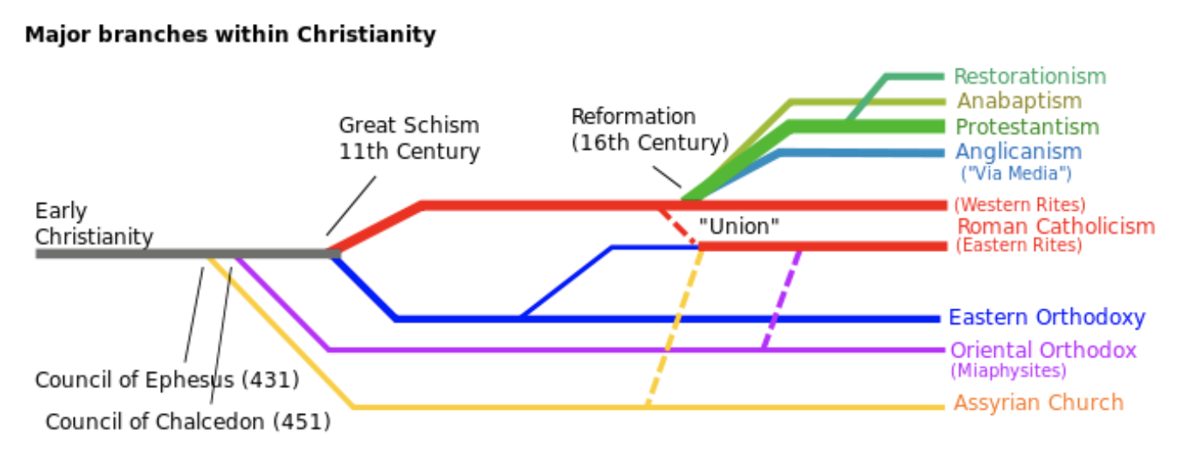
It is important to recognize that while we share a common foundation in the beliefs and values of early Christianity, the Great Schism of 1054 AD marked a permanent and enduring division within Christianity. This schism occurred due to theological disagreements, political tensions, and cultural differences between the Eastern and Western branches of the Church. Consequently, it is imperative for us to remain vigilant and avoid succumbing to the allure of heretical teachings propagated by other branches of the Church.
By staying true to the core principles and practices of early Christianity, we can strive to preserve the purity of our faith and maintain a deep connection with the teachings of Christ. Our hope lies in the eventual reunification of all Christians under the banner of the Father, where we can once again experience the unity and harmony that characterized the early Church.