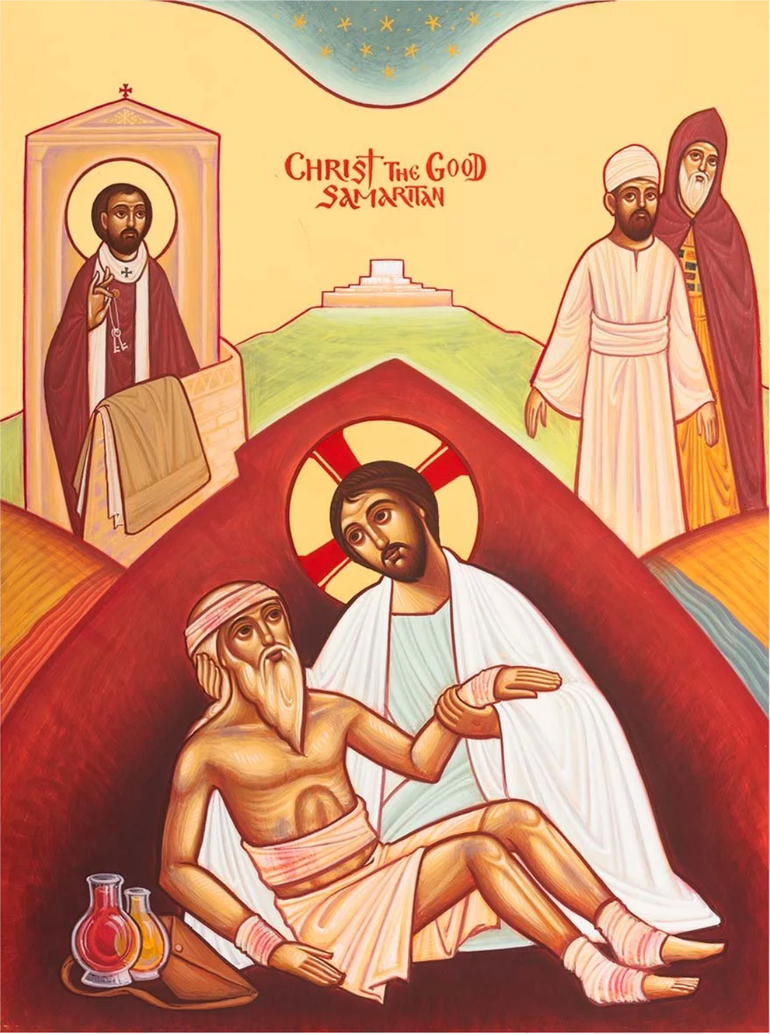
Every servant, if he walks long enough, arrives eventually at the door of tribulation. It is not a door we would have chosen, and our Lord does not scold us for the reluctance we feel as we approach it. He simply tells us, with a tenderness that is often missed, that this door has been built into the road of every disciple, and that He Himself has already walked through it before we ever had to. Tribulation is not the sign that something has gone wrong in our service. It is often the sign that something very right is about to happen in our soul. In this lesson we will sit with the Lord's own words about the sorrows of His disciples, and with the Fathers who discovered, through long experience, that the very pressing of the heart against grief is the way the heart becomes large enough to hold Christ. We will not pretend that tribulation is light. But we will learn to carry it as those who have a Comforter waiting on the other end of every weight — and who, quietly, has been with us the whole way.
The Lord Does Not Surprise Us with Sorrow
On the last night before His passion, in the stillness of the upper room, our Lord prepared His disciples for the sorrows that were already on their way. He did not soften the forecast. He did not promise that the faithful life would be an easy one. What He gave them instead was infinitely better — a sentence that every servant has carried into his own dark hours ever since:
“These things I have spoken to you, that in Me you may have peace. In the world you will have tribulation; but be of good cheer, I have overcome the world.” (John 16:33, NKJV)
Read the sentence slowly. He does not say, "You may have tribulation." He says, "You will have tribulation." It is not a possibility; it is a given. The Lord is so gentle with us about this, and yet so clear. He does not want us surprised by what is coming. He does not want us to reach our first real affliction and conclude, in panic, that we must have strayed outside of His will. Tribulation is inside the will. It was inside His will for Himself; it is inside His will for us.
And in the very same breath, He hands us what we will need. "In Me you may have peace." "Be of good cheer." "I have overcome the world." He does not only announce the sorrow; He announces the victory that has already been won over it. Between the announcement and the victory, the servant stands — not crushed, not abandoned, not surprised, but held.
St. John Chrysostom, preaching to a congregation worn down by the troubles of fifth-century Antioch, opened this verse with his usual warmth:
“He did not say, 'I will deliver you from tribulation,' but, 'in Me you shall have peace.' The storm is without; the calm is within. And the calm is stronger than the storm, because Christ Himself is in it.” — St. John Chrysostom, Homilies on the Gospel of John, LXXVIII
The calm is stronger than the storm. This is the secret that changes everything for a servant in tribulation. Our Lord has not spared us the weather of this world; He has given us a Person to stand with us inside it.
The Comfort That Meets Every Affliction
If the Lord is honest about the tribulation, He is even more generous about the comfort. The Christian servant is never left alone in his sorrow. St. Paul, who had seen more of both affliction and comfort than most of us will ever see, opens his second letter to the Corinthians with a blessing so full of tenderness that it is worth reading every time we find ourselves under a weight:
“Blessed be the God and Father of our Lord Jesus Christ, the Father of mercies and God of all comfort, who comforts us in all our tribulation, that we may be able to comfort those who are in any trouble, with the comfort with which we ourselves are comforted by God.” (2 Corinthians 1:3–4, NKJV)
Hear every word: Father of mercies, God of all comfort, comforts us in all our tribulation. The sentence is not rationed. There is no affliction too small for His mercy and no affliction too large for His comfort. And there is a purpose tucked quietly into the end of it — that we may be able to comfort others with the same comfort we have received. The Lord does not waste a single one of our sorrows. Every tear He has wiped away in us becomes a cup of water we can carry, one day, to someone else's thirst.
Many of us have stood beside a grieving friend and known, without being told, that the person sitting next to us understood our grief in a way the well-meaning stranger across the room simply could not. That knowing came from somewhere. It came from a tribulation our friend had once carried himself, and from the comfort the Lord had poured into him in it. This is one of the quiet miracles of Christian service: the sorrows we would never have chosen become, in His hands, the very instruments by which we bless the people He sends to us next.
St. Paul continues the thought a few verses later, with a sentence that every servant should memorize against the day he will need it:
“For we do not want you to be ignorant, brethren, of our trouble which came to us in Asia: that we were burdened beyond measure, above strength, so that we despaired even of life. Yes, we had the sentence of death in ourselves, that we should not trust in ourselves but in God who raises the dead, who delivered us from so great a death, and does deliver us; in whom we trust that He will still deliver us.” (2 Corinthians 1:8–10, NKJV)
Notice the threefold tense: delivered, does deliver, will still deliver. The comfort of God is not a past event to be remembered; it is a present river to be drunk from, flowing out of a future we already belong to. The servant in the middle of tribulation can say, in the same breath, He has delivered me before, He is holding me now, and He will not stop holding me until the work is done.
The Fire That Tests the Gold
Scripture gives us more than one image for what tribulation does in the life of a believer, but few are as tender or as penetrating as the image of the refiner's fire. The fire is not cruel. It is not punitive. It is the loving labor of a craftsman who will not stop until what is precious in the metal has been freed from what was never part of it.
“In this you greatly rejoice, though now for a little while, if need be, you have been grieved by various trials, that the genuineness of your faith, being much more precious than gold that perishes, though it is tested by fire, may be found to praise, honor, and glory at the revelation of Jesus Christ.” (1 Peter 1:6–7, NKJV)
St. Peter, a man who had himself been tried in the fire of denial and restored by a Lord who kept no record of it, speaks here with an inside knowledge. Trials do not destroy faith; they reveal it. Whatever survives the fire was real gold all along, and it is now free of the dross that had clung to it. What burns away in tribulation was not our faith; it was the pretensions that had accumulated around it, and which we could not have removed on our own.
St. James, in the opening lines of his letter, counsels the same thing and draws the same conclusion:
“My brethren, count it all joy when you fall into various trials, knowing that the testing of your faith produces patience. But let patience have its perfect work, that you may be perfect and complete, lacking nothing.” (James 1:2–4, NKJV)
Count it all joy. That is a startling instruction, and we should not pretend it comes easily. St. James is not asking us to feel joy in the moment of pain; he is asking us to reckon, with the mind of faith, that the pain is doing something in us we could not accomplish any other way. Patience is not given as a character trait; it is grown as a fruit, and it grows in only one soil. The servant who wants to be patient with his people must accept the curriculum the Lord has set for his own patience — and that curriculum, almost always, includes tribulation.
St. Macarius the Great, writing out of the long austerities of the Egyptian desert, saw this truth so clearly that he made it the axis of his teaching on the Christian life:
“As gold that has passed through the fire shines brighter, so the soul that has passed through many temptations shines with a brightness nothing can imitate. The fire did not destroy what was true; it revealed it. Do not be afraid of the fire, therefore; only be afraid of running away from it.” — St. Macarius the Great, Spiritual Homilies XXVI
Do not be afraid of the fire. It is not the fire that ruins the servant; it is the fleeing from the fire before its work is complete. If we will stand where the Lord has placed us, He Himself is the Refiner beside us, and He does not overheat His own gold.
Tribulation That Produces
St. Paul, in the fifth chapter of his letter to the Romans, traces one of the most beautiful chains of consequence in all of Scripture. Tribulation does not simply come and go; if we will let it, it begins a cascade inside the soul that ends, astonishingly, at hope and at the love of God poured out in our hearts. Read the chain slowly:
“And not only that, but we also glory in tribulations, knowing that tribulation produces perseverance; and perseverance, character; and character, hope. Now hope does not disappoint, because the love of God has been poured out in our hearts by the Holy Spirit who was given to us.” (Romans 5:3–5, NKJV)
Tribulation → perseverance → character → hope → the love of God poured out. That is the pathway the Apostle traces, and it does not run the other direction. The servant who has never been tried has nothing in him that perseveres. The servant who has never persevered has no character formed in the fire. The servant who has no character formed in the fire has a thin hope — the kind of hope that is really just a preference for things going well. But the servant who has walked all the way down that chain has a hope that does not disappoint, because it is held together on the other end by the Holy Spirit Himself.
There is a wonderful practical freedom in this verse for the servant in the middle of a difficult season. When the difficulty rises, he is not expected to enjoy it; he is expected to trust that it is producing something. Not wasted, not empty, not meaningless — producing. And if perseverance is being produced today, then character is being produced tomorrow, and hope is being produced next year, and the love of God is already flooding the heart of the servant who is still walking.
The Book of Acts summarizes the entire missionary theology of St. Paul and St. Barnabas in a single clause, as they strengthen the disciples of Lystra, Iconium, and Antioch:
“We must through many tribulations enter the kingdom of God.” (Acts 14:22, NKJV)
Many. Not a few. Not the occasional misfortune. Many. The plural is tender, because it means the Apostle knows what the servant is in for, and he still says, with his hand on the servant's shoulder, "Keep going. This is the road. It is the only road there is, and it leads all the way home."
St. Gregory the Great, a bishop who had more than once asked the Lord to be spared his own pastoral burdens, eventually wrote a sentence that every tired servant can carry in his pocket:
“The storms of this life are not punishments for the righteous; they are the winds by which God drives our ship toward the harbor we could not otherwise reach. Without them we would linger in shallow waters forever.” — St. Gregory the Great, Moralia on Job, XXVI
Winds that drive us toward the harbor. That is what tribulation does in the life of a soul that has stopped fighting the wind. The servant who can say, in the middle of the squall, "Lord, You are steering," is already halfway home.
The Company of Those Who Have Gone Before
One of the Lord's kindest gifts to a servant in tribulation is that He has not sent him down this road alone, or first. The entire eleventh chapter of Hebrews exists to remind us that we are walking a path whose every difficult turn has been walked already by saints who are now standing, finished, at the other end of it. When tribulation comes, the first pastoral thing we can do for ourselves is to remember that we are not the first.
“Others had trial of mockings and scourgings, yes, and of chains and imprisonment. They were stoned, they were sawn in two, were tempted, were slain with the sword. They wandered about in sheepskins and goatskins, being destitute, afflicted, tormented — of whom the world was not worthy.” (Hebrews 11:36–38, NKJV)
The writer of Hebrews is not trying to crush us under the weight of these examples. He is trying to situate our own troubles in the long procession of faithful sufferings, so that when our hour comes we will feel, not singled out for cruelty, but gathered into a company whose songs are already being sung. The very next verses complete the picture:
“Therefore we also, since we are surrounded by so great a cloud of witnesses, let us lay aside every weight, and the sin which so easily ensnares us, and let us run with endurance the race that is set before us, looking unto Jesus, the author and finisher of our faith, who for the joy that was set before Him endured the cross, despising the shame, and has sat down at the right hand of the throne of God.” (Hebrews 12:1–2, NKJV)
The cloud of witnesses. That image alone has carried countless servants through long dark nights. When we pray through our tribulation, we do not pray as isolated figures in an empty room; we pray as members of a throng who have prayed before us, who are still with the Lord, and who are, in some mysterious way, still with us. The martyrs under the altar, the desert fathers in their caves, the mothers of the Church at their weaving, the bishops in their exiles — they are praying with us.
And the One we are finally looking to is not any of them; He is Jesus Himself, who for the joy set before Him endured the cross. Even He, on the road of tribulation, did not endure for its own sake. He endured for the joy. He saw us, on the other side of that cross, and the seeing of us gave Him strength to finish. It is fitting, then, that we should see Him on the other side of our own small cross, and let the seeing of Him give us strength to finish.
St. Isaac the Syrian, writing out of a lifetime of monastic struggle, placed this truth at the very heart of his counsel to those learning to bear affliction:
“Do not look down at your feet when the road is rough; look up at the face of Christ. He walks before you. Every stone that bruises your foot first bruised His, and He has turned every stone into a step that leads home.” — St. Isaac the Syrian, Ascetical Homilies, LI
The Weight of Glory
There is a final mystery in Christian tribulation that Scripture simply hands to us, without arguing for it, because it can only be received. The mystery is this: the very weight we carry here, when carried in Christ, is being transmuted into a glory whose weight the present language cannot describe. St. Paul says it in a single sentence of almost unbelievable hope:
“For our light affliction, which is but for a moment, is working for us a far more exceeding and eternal weight of glory.” (2 Corinthians 4:17, NKJV)
Light affliction. A moment. And yet the very affliction that feels heavy to us is itself the instrument by which the Lord is forging an eternal weight of glory. Our tears, our tiredness, our long patience with a difficult year — none of it evaporates. All of it is being gathered, by Hands we cannot see, into a brightness that will justify every ounce of the carrying.
St. Paul pushes the contrast even further a chapter earlier, because he wants no servant to miss the proportion:
“For I consider that the sufferings of this present time are not worthy to be compared with the glory which shall be revealed in us.” (Romans 8:18, NKJV)
Not worthy to be compared. This is the voice of a man who has been stoned and shipwrecked and imprisoned speaking about his own sufferings, and deciding that the glory on the other side so outweighs them that the comparison is almost comical. If St. Paul, after all he endured, could say that, then the servant in the middle of his own hard season can borrow the Apostle's confidence and hold on.
And hear, finally, the last and greatest word of the chapter — the word that seals this whole lesson with the tenderness of the Father who has been there with us the whole time:
“For I am persuaded that neither death nor life, nor angels nor principalities nor powers, nor things present nor things to come, nor height nor depth, nor any other created thing, shall be able to separate us from the love of God which is in Christ Jesus our Lord.” (Romans 8:38–39, NKJV)
Nothing. No tribulation, however heavy, is strong enough to pry us from the love of God. This is the ground we walk on when everything else is shaking. It is the bedrock beneath the servant's feet when the road has grown long and the body has grown tired. And it is, in the end, not our grip on Him that keeps us, but His grip on us that holds.
May the Lord who wept over His friend's grave and wept over His own city keep our tears as His own. May He be, in our affliction, the calm in the middle of our storm, the comfort beneath every weight, the Refiner beside every fire, the Captain of the wind that drives our ship home. And may He teach us, in the quiet work of a long service, that tribulation is not the end of our story but one of the most cherished chapters of it — the chapter in which we finally stopped trusting ourselves and began to trust, with all our heart, the God who raises the dead.