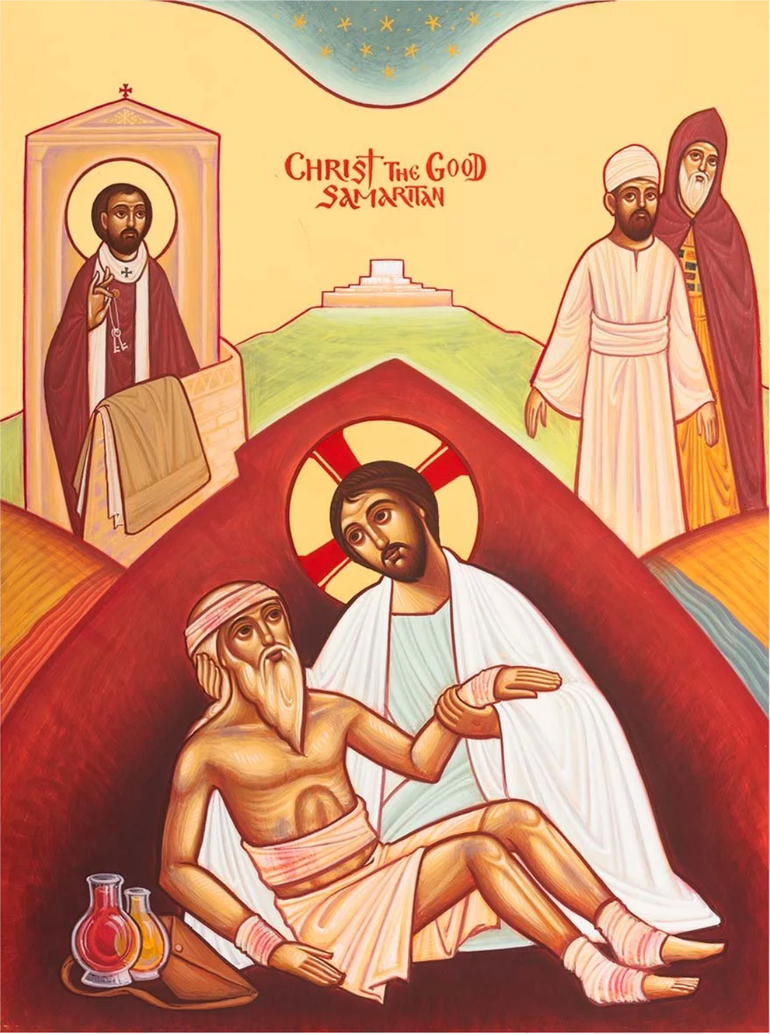
If the last lesson set our eyes on discipleship as the general calling of every servant, this one narrows in on the particular relationship that has always been its backbone: mentorship. The Lord Himself chose twelve — and within the twelve, three — and within the three, one whom He loved especially. The saints, without exception, were shaped by someone. St. Paul had Barnabas and Gamaliel. Timothy had Paul. Silouan had John of Kronstadt. Anthony of the desert had an older, silent brother whose name we do not know. Every servant who becomes fruitful does so, in some significant way, because an older voice walked beside him when he most needed it. And every servant who wishes to multiply that fruitfulness will, in turn, walk beside younger servants when they most need it. Mentorship is the intimate face of the chain of generations, and it is one of the most tender works the Spirit does through us. In this lesson we will sit with the Lord's own mentoring of the Twelve, watch Paul mentor Timothy and Barnabas mentor Paul, and learn from the Fathers what a healthy mentoring relationship looks like, how it begins, how it ripens, and how it is gracefully handed on.
The Master Who Mentored the Twelve
No figure in history has mentored more carefully or more fruitfully than our Lord Jesus Christ. We sometimes think of mentorship as a program, a curriculum, a series of scheduled meetings. What the Gospels show us is something quieter and more powerful — a Master who chose a small group, lived with them for three years, and formed them, day by day, into the men who would shape the world.
The initial call was warm and personal:
“Then He appointed twelve, that they might be with Him and that He might send them out to preach, and to have power to heal sicknesses and to cast out demons.” (Mark 3:14–15, NKJV)
Notice the order. That they might be with Him comes first. That He might send them out comes second. The sending is not possible without the being-with. Mentorship begins in presence, not in projects. A mentor who is never actually with his mentee — in the car, around a meal, on a walk, in silence during the Liturgy — has skipped the very ground on which formation happens. Our Lord gave three entire years to presence before any real mission was undertaken, and even during the mission, He kept calling them back to Himself to rest.
Within the Twelve He drew closer to three — Peter, James, and John — and within those three, John is called, in his own Gospel, 'the disciple whom Jesus loved.' This is not favoritism; it is capacity. A mentor cannot love everyone equally; he can only love everyone faithfully. Depth of relationship is limited by what human hearts can sustain. Our Lord Himself, being human as we are human, did not spread Himself across three hundred equally close friendships. He had His three, and His twelve, and His wider circle, and His multitude — concentric rings, each loved, but not all at the same depth. This is a gentle permission for every mentor: we are not meant to mentor everyone. We are meant to mentor whom the Lord has given us, and to mentor them well.
St. John Chrysostom, preaching on the selection of the Twelve, saw the principle clearly:
“The Lord did not hurry in the choosing of His own. He prayed through the night before He named them. The shepherd who names his sheep without prayer will lose them without warning. The shepherd who names them under prayer will not lose even one, save the son of perdition, and him not from neglect.” — St. John Chrysostom, Homilies on the Gospel of St. Matthew, XXXIII
Prayer precedes the choosing. This is the first quiet rule of a mentor's life. We do not pick up a mentee because the calendar had an empty slot; we pick up a mentee because, in prayer, the Lord has gently brought a particular soul to our heart and given us a quiet sense that we are to walk with this one for a season.
Barnabas, Who Opened the Door
One of the most moving mentoring stories in all of Scripture is the one we might miss on a first reading. It is the story of Barnabas and Saul — the story of an older, established servant who recognized the gift of a younger, troubled, newly converted man when no one else would take the risk of trusting him.
After his conversion on the road to Damascus, Saul returned to Jerusalem to join the disciples. No one believed that he had truly become a disciple. He had, after all, been the great persecutor. The Church was afraid of him, and understandably so. Every door was closed. And then comes a single sentence that changed the history of the Gospel:
“But Barnabas took him, brought him to the apostles, and declared to them how he had seen the Lord on the road, and that He had spoken to him, and how he had preached boldly at Damascus in the name of Jesus.” (Acts 9:27, NKJV)
Barnabas took him. Barnabas brought him to the apostles. Barnabas vouched for him publicly. The whole future of Paul's apostolic ministry hangs on the willingness of one older servant to take a risk on a younger one whom no one else would touch. Without Barnabas, there might not have been a Paul as we know him. Without Paul, there might not have been a Timothy, or a Titus, or an Epaphras, or any of the hundreds of second-generation disciples those letters touch. One old man's courage, one afternoon, blessed two thousand years of the Church.
And notice how Barnabas kept walking with Paul afterward. When the Antioch church needed a teacher, Barnabas, already serving there, went all the way to Tarsus to find Paul and bring him back to the work (Acts 11:25–26). When Paul and Barnabas set out on the first missionary journey, Barnabas's name is listed first (Acts 13:2). Somewhere along the way, as young Paul grew into his calling, the names quietly reverse in the narrative — now it is Paul and Barnabas — and the mentor has become the junior partner in the partnership he himself called into being. Barnabas does not seem to have minded at all. A true mentor never minds being eclipsed by the one he has formed.
St. Augustine noted this quiet grace in Barnabas and drew the lesson for every mentor:
“The gardener rejoices when the young tree he has staked begins to stand on its own, and when, in time, the fruit of the tree hangs higher than the gardener can reach. He does not mourn that he can no longer reach the branches; he marvels that the seed he once planted has grown so tall.” — St. Augustine, Sermon 340 (on pastoral love)
This is the disposition every mentor must learn, and the earlier the better. We are not in the business of growing ourselves larger by acquiring disciples. We are in the business of growing our disciples larger by spending ourselves on them — and rejoicing, quietly, when they pass us.
Paul and Timothy — A Mentor's Voice in Ink
The Church is indescribably blessed to have preserved for us the private letters of a mentor to his mentee. The two letters to Timothy are not formal epistles addressed to a congregation; they are the deeply personal instruction of an aging apostle to his beloved spiritual son. Every mentor who reads them carefully will find a mirror in them, and every mentee will feel, between the lines, what it is to be loved by a father in the faith.
Paul opens his first letter with the tenderest of addresses:
“To Timothy, a true son in the faith: Grace, mercy, and peace from God our Father and Jesus Christ our Lord.” (1 Timothy 1:2, NKJV)
A true son in the faith. Not a subordinate, not a junior colleague, not a protégé — a son. This is the deepest mode of Christian mentorship, and it is the one we are always quietly aiming toward. We begin by walking alongside someone; if the Spirit blesses the relationship, over time, a quieter kinship forms, and we find ourselves relating to the person not as a project but as a child — or, for the mentee, relating to the mentor not as a resource but as a father in the Lord. This does not mean we replace their biological family or their father of confession; it means that an additional bond, rooted in the common life of the Spirit, has been given.
Paul's letters to Timothy are full of practical wisdom, but the thing a mentor learns most from reading them is the mixture of exhortation and warmth. Paul corrects Timothy — about letting people despise his youth, about being bold, about guarding the deposit of the faith — and yet every correction is laid on a bed of affection:
“I thank God, whom I serve with a pure conscience, as my forefathers did, as without ceasing I remember you in my prayers night and day, greatly desiring to see you, being mindful of your tears, that I may be filled with joy, when I call to remembrance the genuine faith that is in you.” (2 Timothy 1:3–5, NKJV)
Mindful of your tears. Greatly desiring to see you. Remembering your genuine faith. These are the words of a father who loves his son. The corrections that follow land differently when the soil has been prepared this way. A mentor who corrects without first loving will be resisted. A mentor who loves first and corrects second will find his correction received as blessing.
And at the end of the last letter — written, we believe, from the last Roman imprisonment, shortly before his execution — Paul asks Timothy to come and to bring the cloak he left in Troas, and the books, and especially the parchments (2 Timothy 4:13). It is the request of an old man to a young one whose love can be counted on to make the journey. Paul's mentorship of Timothy did not end in a triumphant ceremony; it ended in a small practical request at the bedside of a tired saint. That ending is a gift in itself: mentorship is, at its heart, simply the trust of one soul that the other will come when called.
What a Mentor Actually Does
Beyond the high picture, the daily work of mentoring is composed of five small, repeatable practices, each of them unspectacular and each of them indispensable.
First, a mentor prays for his mentee by name. Every morning. Over the years. The intercession of a mentor for his mentee is probably the single most formative thing in the relationship, even though the mentee may never see or hear it. Many of the secret graces that come into a servant's life in his twenties and thirties were prayed into him by an older servant long before the younger one even knew enough to ask. A mentor who is not praying regularly for his mentee has already stopped mentoring.
Second, a mentor listens more than he talks. Younger servants usually arrive at a mentor's door with questions; the mentor's first temptation is to answer. The wiser path is usually to ask another question, and then another, and to let the mentee's own soul come into view before prescribing anything. Our Lord often answered questions with questions. This was not evasion; it was pedagogy. He was drawing out of the soul what the soul already knew but had not yet said.
Third, a mentor speaks honestly but gently when correction is needed. The world has many encouragers and many correctors; it has very few tender correctors. A mentor who cannot say a hard word will eventually be of no use, because every servant needs correction at some point in his formation. A mentor who can only say hard words will be avoided, because no human soul can bear unending severity. The tender corrector — who speaks the truth, once, clearly, and then sits in silence while the truth lands — is the mentor who changes lives.
Fourth, a mentor models more than he explains. The mentee is watching. Over years, the mentor's handling of stress, disappointment, praise, interruptions, and tiredness will teach the mentee more than any formal lesson could. This is why the Desert Fathers often said the simplest thing a young monk could do was to sit in the cell of an old one and watch. Ninety percent of formation happens by osmosis. The mentor's first responsibility, then, is to be, himself, someone worth watching — not because he has arrived but because he is visibly still growing.
Fifth, a mentor sends his mentee out. The goal of mentoring is not to keep the mentee close forever; it is to form him into a servant who can stand on his own and, eventually, mentor someone else. A mentor who cannot let the mentee go has not really mentored him; he has trained a dependent. Our Lord's mentoring of the Twelve ended, on earth, with a sending: Go, and make disciples. Every Christian mentorship ends, sooner or later, at that same doorway.
St. Basil the Great, writing about the formation of the younger brethren in his monastic communities, captured the rhythm of healthy mentoring with his usual balance:
“Hold the young servant close enough that he may learn, but not so close that he cannot grow. A vine too tightly bound to its stake cannot yield its fruit; a vine not bound at all will fall over. Wisdom is in the right tension of the cord.” — St. Basil the Great, The Long Rules, Q. 36
For the Mentee — The Holy Work of Receiving
Mentorship is not only about what the mentor does. It is also, and perhaps equally, about what the mentee does. Every servant who wants to grow into a mature disciple will, at some point, need to learn the holy work of being mentored. This is harder than it sounds, especially for those of us who have been told, all our lives, to be independent.
The first disposition the mentee must learn is openness. To be mentored is to allow another soul to see parts of our inner life we might have kept hidden. It is to confess struggles out loud, to ask questions we feel foolish asking, to reveal that we do not, in fact, have everything figured out. This openness is costly, and it is what separates a real mentoring relationship from a superficial one. The mentee who will not open his life cannot be mentored, no matter how wise the mentor.
The second is trust. The mentee must assume, until proven otherwise, that his mentor wants what is best for him. This is what allows the mentee to receive correction without flinching. Without trust, every correction feels like an attack; with trust, every correction feels like a gift. This is why choosing a mentor prayerfully matters so much — once the relationship begins, the mentee must be able to entrust himself to the mentor's care.
The third is patience. Mentorship is slow. The fruit takes years. The mentee who wants a fast answer to every question will be disappointed; the mentor often does not give the answer but asks the question that will let the mentee, in time, find the answer himself. A mentee who cannot bear the slowness of the process will leave before the formation ripens.
The fourth is gratitude. Mentors are not paid, and their deepest rewards are often invisible. The mentee who expresses, simply and honestly, that he has been helped, is already doing his mentor the greatest service the relationship can offer. A thank-you card, a quiet word after a meeting, a specific memory named years later — these small acts are how a mentee gives back to the one who has given him so much.
St. Paul's own thanks to his mentors shines through his letters. He mentions Barnabas again and again. He names those who taught him the faith before him. He even defers, at the Jerusalem Council, to the older apostles whose ministry preceded his. The Apostle to the Gentiles never forgot that he had been mentored, and he never let pride about his own ministry erase his gratitude to those who had made it possible.
Abba Dorotheos of Gaza, himself one of the most beloved spiritual fathers in the tradition, wrote to one of his own mentees a sentence that belongs on the desk of every young servant:
“Hold your elder in honor, and you will hold yourself in the way of growth. The soul that cannot receive from an older hand will remain forever in its own narrow thought. Receive, receive, and you will be given what you could never have reached on your own.” — St. Dorotheos of Gaza, Discourse I, On Renunciation
The Gift We Keep Passing On
Every servant who has been mentored well is, by that very fact, put under a quiet obligation. The grace he received was not given to him merely for himself; it was given to him so that, in time, he would pass it to another. Mentors are made by having been mentored. The older generation, which once poured into us, steps back and says, in effect, 'Now it is your turn.' We receive that turn not with ambition but with humility — and, above all, with gratitude.
There is no strict formula for when a servant is ready to begin mentoring others. A helpful rule of thumb is this: when we find ourselves able to walk a certain road without stumbling, we are probably ready to begin walking that road alongside someone who has not yet learned it. We do not have to be masters; we only have to be one or two steps ahead. A sixteen-year-old can faithfully mentor a twelve-year-old. A forty-year-old can faithfully mentor a twenty-year-old. The essential thing is not the gap in age but the honesty of the walk.
St. Paul's final words to Timothy about this chain of generations remain, two thousand years later, the clearest description of how the Church grows:
“And the things that you have heard from me among many witnesses, commit these to faithful men who will be able to teach others also.” (2 Timothy 2:2, NKJV)
Commit these to faithful men. Not to the most talented. Not to the most impressive. To the faithful. Mentorship is not for the charismatic few; it is for the faithful many. Every servant who has walked with the Lord long enough to have received something of His life has something worth passing on to someone a little behind him on the road.
May the Lord who mentored the Twelve and sent them to mentor the nations give each of us the mentor our soul needs and make each of us, in time, the mentor that some other soul needs. May He teach us to love our mentees with the quiet steadfastness of Barnabas, to write to them with the tenderness of Paul, and to send them out with the confidence of a Master who knows the Spirit will finish the work He has begun. And may the chain of generations, which our Lord Himself began on a mountain in Galilee, run right through our small service into hearts we will never meet on this side of the Kingdom.