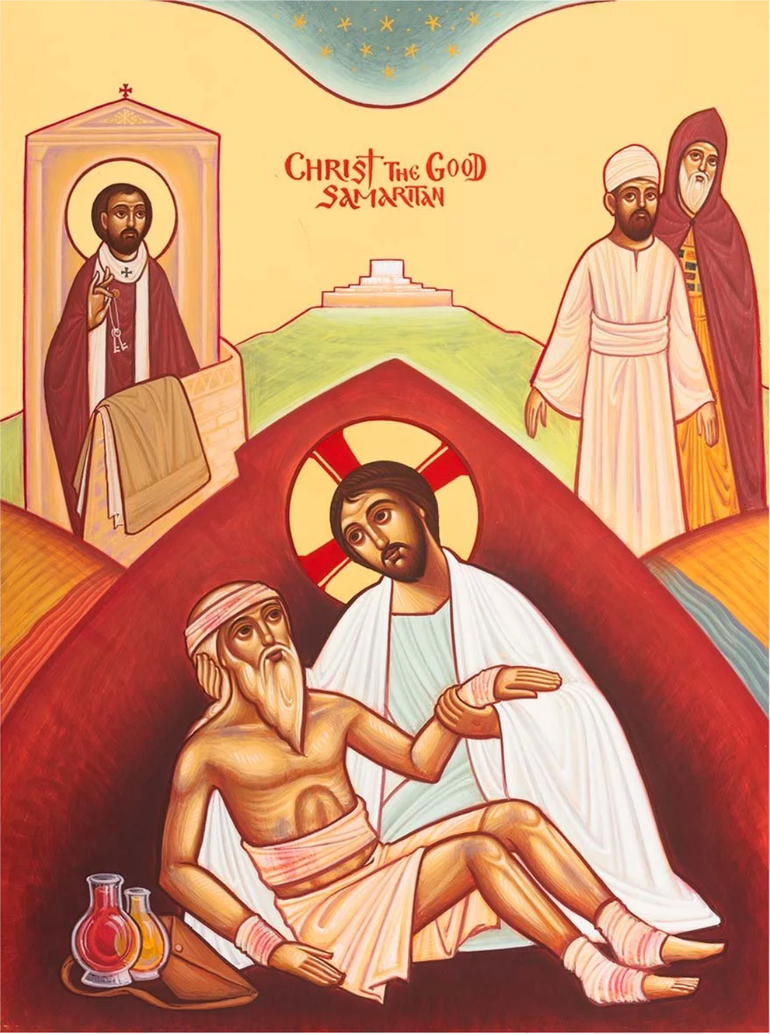
The Fathers are unanimous that humility is the foundation virtue — the one from which every other grows, and without which every other collapses. 'Humility,' says St. Isaac the Syrian, 'is the raiment of the Godhead, for the Word took it upon Him when He became incarnate.' No servant has ever served fruitfully in the Lord's house without humility; no servant has ever destroyed a ministry with humility in place. This lesson looks at what the Scriptures actually mean by humility, at the life of our Lord as the definitive picture of it, at the daily shape humility takes in the servant, at its most common counterfeits, and at how humility is grown — since no one, in the end, can simply decide to be humble. We close, as the Fathers did, with the quiet consolation that humility is the short road to everything else.
What Scripture Means by Humility
The Hebrew and Greek words our Bible translates as 'humility' carry a specific sense that is often blurred in modern usage. Humility is not low self-esteem. It is not the quiet pride of a man who has perfected self-deprecation. It is a right, true, and sober estimation of who we are before God — creatures, not creators; recipients, not owners; loved, but not on the basis of any merit we could produce.
“God resists the proud, but gives grace to the humble.” James 4:6, NKJV
This sentence is the New Testament's most compact statement about why humility matters so much. Grace, which is the one indispensable commodity of the Christian life, flows by gravity. It runs downhill, toward the low places. The proud soul is a hill too high to be watered. The humble soul is a valley in which grace naturally pools.
St. Augustine, in a famous phrase, answered a question about the chief of virtues by saying humility three times:
“If you ask me what is the first thing in religion, I answer the first, second, and third thing is humility.” St. Augustine, Letter 118 (paraphrased)
The Humility of Our Lord
The deepest teaching on humility in Scripture is not a sentence but a Person. Our Lord is humility made visible. The Philippian hymn traces the descent from heaven to the grave as the authoritative image of what humility looks like:
“Let this mind be in you which was also in Christ Jesus, who, being in the form of God, did not consider it robbery to be equal with God, but made Himself of no reputation, taking the form of a bondservant, and coming in the likeness of men. And being found in appearance as a man, He humbled Himself and became obedient to the point of death, even the death of the cross.” Philippians 2:5–8, NKJV
Every phrase deserves its own meditation. 'Made Himself of no reputation' — the Greek is ekenosen, emptied. The eternal Son did not cling to His prerogatives. 'Taking the form of a bondservant' — the position, in first-century vocabulary, of the lowest member of a household. 'Humbled Himself' — not humbled by another; His own act. 'Obedient to the point of death' — the descent did not stop at the manger; it went all the way.
This is the definitive picture. Humility is not a posture one occasionally adopts when convenient; it is a willing, reasoned descent for love's sake, motivated by the well-being of another. The Lord who is humility took the towel and washed His disciples' feet the night He was betrayed (John 13). That image is not accidental. It was given to us, the Lord said, 'that you should do as I have done to you' (John 13:15).
Our Lord's own words on Himself are few and precious, and humility is one of them:
“Take My yoke upon you and learn from Me, for I am gentle and lowly in heart, and you will find rest for your souls.” Matthew 11:29, NKJV
'Gentle and lowly.' Of all the adjectives the Lord could have chosen to describe Himself, these are the two He chose. A servant who has understood this will find a great deal of his anxiety about his own dignity quietly dissolving.
The Daily Shape of Humility
Humility is not a mood or a tone of voice. It has concrete shapes in the daily life of a servant, and the Fathers and the parish have named them clearly.
First, humility is attentive. It listens longer than it speaks. It notices the one person in the room no one has addressed. It takes interest in the story being told even when it knows the story already.
Second, humility is teachable. It is willing to learn from anyone — from an older father, from a peer, from a Sunday-school child, from a stranger on the bus. The proud soul has finished learning; the humble one is just beginning.
Third, humility is thankful. It sees every good in its life as a gift received, not a possession earned. Thanksgiving is the most reliable thermometer of humility. Complaint is its opposite.
Fourth, humility serves quietly. It does not announce its own service. It does not need credit. 'Take heed that you do not do your charitable deeds before men, to be seen by them' (Matthew 6:1). The truly humble servant is often invisible, because he has made a habit of being invisible.
Fifth, humility confesses. It does not defend itself reflexively when corrected. It does not attempt to prove, at length, that the correction was unfair. It is willing to be wrong — sometimes wrong out loud, in front of others — because it has already given up the brittle project of protecting an image of itself.
Sixth, humility submits. It is willing to receive direction from its father of confession, its bishop, its priest, its spouse, its parish council, the Gospel itself — without turning every instruction into a negotiation.
These six together describe a recognizable kind of person. We have all met such a servant. In the Lord's providence, we have usually met them quietly, because the humble servant has no interest in being met.
St. Dorotheos of Gaza was asked what humility is, and answered:
“The humble man never falls. How could he? For he is already below everyone. And the proud man never rises — for how could he rise, when his mind is already above where it ought to be?” St. Dorotheos of Gaza, Discourses and Sayings II (paraphrased)
The Counterfeits
Humility has several common counterfeits, and naming them is useful — because servants often imagine they have the virtue when they have only the imitation.
The first counterfeit is self-deprecation. It looks like humility; it is a form of pride in reverse. The self-deprecating servant speaks of himself constantly, only with a negative valence. His soul is as occupied with itself as the boaster's is. The truly humble person thinks of himself seldom.
The second is performance of humility. We know we are supposed to be humble, so we perform its outward gestures — the soft voice, the downcast eye, the quick denial of any compliment — without the underlying reality. The Lord's words against the scribes who loved to 'sit in the chief seats of the synagogues' (Matthew 23:6) apply equally to those who love to sit in the last seat, provided everyone can see.
The third is false smallness. A servant declines a role he is gifted for and obligated to, and covers this with the language of humility. It is not humility to refuse what the Lord has asked of us. It is fear dressed in humble clothes.
The fourth is the refusal of praise. When a brother thanks us honestly, to brush it off violently — 'oh, no, it was nothing' — is often not humility but discomfort. Humility can receive thanks graciously, giving the glory quietly to God, without spectacle either way.
The fifth is comparison in the form of self-abasement. 'I am not like that great servant over there,' we say, and we have already turned our soul back onto itself. The humble servant does not compare. He attends to the work in front of him.
How Humility Is Grown
No one becomes humble by deciding to. Humility is not produced by willpower; if it were, the exercise would immediately destroy itself. Humility is grown slowly, by the quiet work of grace through ordinary means. A few of these means are worth naming.
First, regular confession. Nothing humbles a soul like telling the truth about itself to another human being before God. A servant who keeps a living relationship with a father of confession is being slowly, reliably, lowered.
Second, the Psalms. The daily praying of the Psalter — 'I am a worm, and no man' (Psalm 22:6), 'Create in me a clean heart, O God' (Psalm 51:10) — teaches the soul its right register over time.
Third, gratitude practiced at the end of each day. A short review, naming the day's gifts by name, teaches the soul that it is a receiver. Receivers are naturally lower than givers.
Fourth, the small humiliations we would not have chosen. A correction from a child. A mistake noticed in front of others. A meeting we prepared for carefully that went poorly anyway. The Fathers called these providential humiliations. The soul that receives them without protest is being formed.
Fifth, the company of humble servants. We become like the people we keep close. A wise friendship with a genuinely humble servant — even one, even once a week — works on the soul more than a month of reading about humility.
Sixth, long attendance at the Liturgy. The one who has been worshiping the crucified Lord week after week, year after year, is being shaped by the thing he adores. 'We all, with unveiled face, beholding as in a mirror the glory of the Lord, are being transformed into the same image' (2 Corinthians 3:18). The worshiped Lord was humble; the worshipers are, slowly, becoming humble too.
St. Isaac the Syrian's famous saying captures what this growth finally looks like:
“Humility is the raiment of the Godhead, for the Word who became man clothed Himself with it, and spoke to us in it. And every one who hath clothed himself therewith hath verily been made like unto Him who came down from His own height, and hid the splendor of His majesty, and veiled His glory in humility, lest creation should be destroyed by the sight of Him.” St. Isaac the Syrian, Ascetical Homilies, Homily 77 (paraphrased)
Humility in the Service
In the concrete life of a parish, humility has a recognizable look.
The humble teacher prepares carefully, teaches his best, and then quickly forgets whether he taught well. He does not replay his performance. He does not fish for compliments. He thinks, instead, about the children whose eyes looked tired.
The humble leader invites correction. He actually wants to hear what the others in the meeting think. He is not threatened when a younger servant proposes a better idea; he is glad, because the kingdom has benefited.
The humble parent confesses his own failures to his children. He does not pretend. The child learns, from this, what to do when his own failures come.
The humble spouse apologizes first. He has given up on the calculation of whose fault it was. Love, in his marriage, is larger than the accounting of who owes what.
The humble deacon, chanter, or subdeacon arrives on time, stays until the end, and is as serious about the Wednesday evening Vespers with fifteen people as about the Paschal liturgy with five hundred. The crowd is not why he serves.
The humble servant, facing a failure in ministry, does not look first for someone else to blame. He asks, 'Where did I contribute to this?' and he goes to confession. The ministry heals because the servant has.
A common pastoral test, handed down in many spiritual traditions: if a servant can be overlooked without resentment, he has begun to learn humility. If he can be wrongly blamed without defending himself at length, he has grown further. If he can be outright insulted and feel no ripple of wounded pride, he has nearly arrived. Most of us are on the first step. The Lord is patient.
The Short Road
There is one last word to add. The desert Fathers considered humility not a burdensome virtue but the shortest road home.
“I saw all the snares of the enemy spread out upon the earth, and I groaned and said, 'Who then can pass through them?' And I heard a voice saying to me, 'The humble, my son.'” Abba Anthony, Apophthegmata Patrum
The humble pass through every snare of the enemy, because there is nothing in them for the snares to catch on. Pride is the hook the devil most reliably uses. Humility leaves no hook.
This is also why humility is the shortest road to joy. The proud soul is exhausted — constantly defending, comparing, performing. The humble soul has set all that down. It has less to protect, therefore less to lose. It is lighter. It laughs easily. It rests.
The Mother of God, whose humility carried the Son of God, sang at the beginning of the Gospel a song that is the whole curriculum in miniature:
“My soul magnifies the Lord, and my spirit has rejoiced in God my Savior. For He has regarded the lowly state of His maidservant... He has put down the mighty from their thrones, and exalted the lowly.” Luke 1:46–48, 52, NKJV
He exalts the lowly. That is the direction of grace. That is the map of the Christian life.
May the Lord who took the towel on the night He was betrayed teach us to take it too. May He free us from the small exhausting work of defending ourselves, and set us free for the lighter work of loving the people He has placed before us. May He expose the humility's counterfeits in our own hearts without shaming us. May He use the small, unchosen humiliations of our days as the quiet instruments of our growth. And may He grant us, before our service is done, that humility which St. Isaac called the raiment of the Godhead — the very robe He Himself wore into our flesh. To Him be the glory, now and ever and unto the ages of ages. Amen.