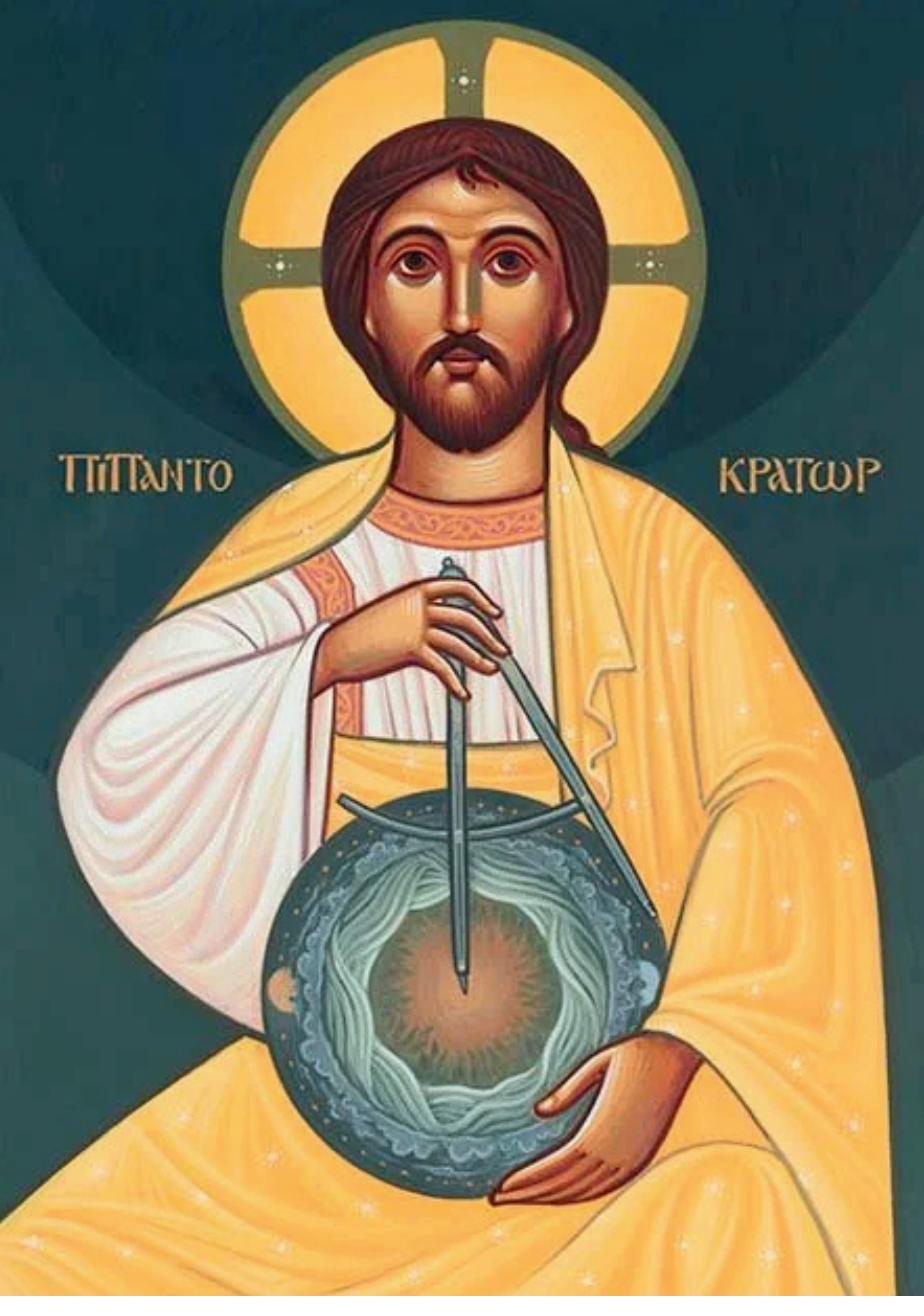
A Divine Initiative, Not a Human Aspiration
Salvation, in Orthodox theology, is not man reaching for God; it is God bending down in love toward man. You don't climb a ladder to heaven by merit or effort — the ladder descended to you, in the Person of Jesus Christ. Scripture insists on this order before it says anything else:
“How shall we escape if we neglect so great a salvation?” Hebrews 2:3, NKJV
Salvation is called great because it isn't a human aspiration that God has accepted, but a divine initiative that God has brought to you. You do not ascend; He descends. You do not reach up; He bends down. St. Irenaeus put the whole logic of the Incarnation in a single line: the Word of God, our Lord Jesus Christ, “did, through His transcendent love, become what we are, that He might bring us to be even what He is Himself.” The story of salvation isn't primarily about escaping punishment, though it does deliver you from judgment — it's about union with God, the healing and elevation of your nature into communion with Him.
The blood of Christ, in which this salvation is sealed, is not a legal transaction. It is life poured out. Salvation didn't come through law, philosophy, or force, but through the precious blood of the Son of God. Scripture is emphatic:
“Without shedding of blood there is no remission.” Hebrews 9:22, NKJV
As Orthodox Christians you don't read the Cross as a moment in which the Father punishes the Son in your place. The Cross is the moment in which the Son offers Himself to the Father through the eternal Spirit, and the love of the Holy Trinity is revealed in its fullness. The blood of Christ is the currency of divine love, not the price of wrath appeased. The whole of Orthodox soteriology is built on this foundation.
The Blood of Christ and Salvation
Blood as the Seal of the New Covenant
Salvation is only available through the blood of Christ. “Without shedding of blood, there is no remission” (Hebrews 9:22). The Passover lamb was a symbol of our Lord: “For indeed Christ, our Passover, was sacrificed for us” (1 Corinthians 5:7). Through the blood of the lamb, the Israelites were saved from death: “Now the blood shall be a sign for you on the houses where you are, and when I see the blood, I will pass over you and the plague shall not be on you to destroy you when I strike the land of Egypt” (Exodus 12:13). And through this precious Blood, sins are remitted and you enter a new covenant with God: “This is My blood of the new covenant which is shed for many for the remission of sins” (Matthew 26:28).
Typology: The Old Testament as a Map to Golgotha
Typology here is not metaphor — it is prophecy through shadow. Every sacrifice in the Old Testament, every ritual washing, every drop of blood that fell from the altar of the Tabernacle was a whisper of the Incarnate Logos. The Orthodox Church reads the Old Testament not as discarded history but as a map pointing toward Golgotha … from:
- Adam's covering with garments of skin (Genesis 3:21), a type of the Lamb slain to cover our nakedness, to
- the ram in Isaac's place (Genesis 22:13), a substitute, yes, but also a revelation that “God will provide for Himself the Lamb,” to
- the blood on the doorposts (Exodus 12:13), a seal against death fulfilled in the blood on the wood of the Cross
These events foreshadowed a greater offering, the sinless, spotless sacrifice of Christ. Through this blood the New Covenant was established. You are no longer bound to the letter of the Law but to life in the Spirit: purchased, washed, and redeemed.
Blood in the Life of the Church
The blood of Christ is not confined to Calvary. It flows through the Mysteries, and preeminently through the Eucharist. When the priest elevates the chalice and proclaims that what is given is for the remission of sins and eternal life to those who partake of it, this is no empty ritual. St. Cyril of Jerusalem taught the newly baptized to trust exactly this: “Consider therefore the Bread and the Wine not as bare elements, for they are, according to the Lord's declaration, the Body and Blood of Christ.” This is why the Orthodox faithful approach the chalice with fear and love — not a servile fear, but the holy awe of those who know they are receiving not merely grace but the very Person of Christ. The Scriptures, read with the mind of the Church, bear continual witness to the centrality of this Blood:
Scripture
Verse
Acts 20:28 “Shepherd the Church of God which He purchased with His own blood.”
Romans 5:9 “Having now been justified by His blood, we shall be saved from wrath through Him.”
Ephesians 1:7 / “In Him we have redemption through His blood.” Col. 1:14
Ephesians 2:13 “In Christ Jesus you who once were far off have been made near by the blood of Christ.”
Colossians 1:20 “Having made peace through the blood of His cross.”
Hebrews 9:12 “Not with the blood of goats and calves, but with His own blood He entered the most Holy place once for all, having obtained eternal redemption.” - Hebrews 9:12
Hebrews 9:14 “…How much more shall the blood of Christ, who through the eternal spirit offered Himself without spot to God, purge your conscience from dead works to serve the living God.”
Hebrews 10:19 “Therefore brethren having boldness to enter the Holiest by the blood of Jesus.”
Hebrews 10:29 “Of how much worse punishment, do you suppose, will be thought worthy who has trampled the son of God underfoot, counted the blood of the covenant by which he was sanctified a common thing, and insulted the Spirit of grace?”
Hebrews 12:24 “…To Jesus the Mediator of the new covenant, and to the blood of sprinkling that speaks better things than that of Abel”
Hebrews
“Now may the God of peace … through the blood of the everlasting covenant, make you 13:20–21
complete in every good work to do His will.”
1 Peter 1:18–19 “You were not redeemed with corruptible things …but with the precious blood of Christ as of a lamb without blemish and without spot.”
1 John 5:8 “There are three that bear witness on earth: the Spirit, the water, and the blood; and these three agree as one.”
1 John 1:7 “… The blood of Jesus Christ His Son cleanses us from all sin.”
Revelation 1:5 “… To Him who loved us and washed us from our sins in His own blood …”
Revelation 5:9 “… You were slain, and have redeemed us to God by Your blood …”
Revelation 7:14 “These are the ones who came out of the great tribulation, and washed their robes and made them white in the blood of the lamb.”
Revelation 12:11 “And they overcame him by the blood of the lamb …”
Each passage lifts the veil and reveals the mystery hidden for ages and generations: Christ crucified, Christ risen, Christ alive in His Church. When the Holy Scriptures are read prayerfully and with the mind of the Church, they cease to be isolated verses and become a means by which the soul contemplates Christ, crucified and risen.
The Church: Purchased by Blood
Take the first of them. “Shepherd the Church of God which He purchased with His own blood” (Acts 20:28). The Church is not a religious organization, not merely a community of like-minded believers — she is the very Body of Christ, purchased not with gold or silver but with the divine blood of the Son of God. To understand this verse is to understand the dignity of the Church: she is the bride for whom Christ died, the living temple of the Holy Spirit, not a man-made construct. To treat her lightly, to neglect her sacraments, her teachings, her unity is to forget the cost at which she was bought. St. John Chrysostom, commenting on this verse, drives the point home:
“…which He has purchased with His own blood.” It shows how precious the concern is; that the peril is about no small matters, seeing that even His own blood He spared not.
He indeed, that he might reconcile those who were enemies, poured out even His blood. — St. John Chrysostom, Homily 44 on the Acts of the Apostles
He does not say “with His blood” but “with His own blood” showing the intensity of the sacrifice. He who shed it was not man only, but God. Approach the Church, then, not as a critic or a consumer, but as one beholding a mystery. Love her because He loved her first, and gave Himself for her.
A Sacred Responsibility
One of the most sobering verses in the New Testament follows the same thread:
“Of how much worse punishment, do you suppose, will he be thought worthy who has trampled the Son of God underfoot, counted the blood of the covenant by which he was sanctified a common thing, and insulted the Spirit of grace?” (Hebrews 10:29).
To despise the Blood of Christ is to insult the very Spirit who sanctifies you. Salvation is not only a gift — it is a responsibility. You are accountable to grace. The blood of Christ is not common, not ordinary; it is sacred, powerful, divine, the means by which you are set apart for God. When you fall into sin after baptism, the Church calls you to repentance through confession and tears — not because you've lost God's love, but because you must not grow cold to the cost of your redemption.
Blood as a Weapon in Spiritual Warfare
Revelation shifts the focus from contemplation to warfare:
“And they overcame him by the blood of the Lamb and by the word of their testimony, and they did not love their lives to the death” (Revelation 12:11).
The blood of Christ is not only your cleansing, it is your weapon. When the devil accuses you of sin, you don't argue your own righteousness; you plead the blood. You don't turn inward under guilt; you turn outward, toward the altar, toward the Cross, toward the Lamb who was slain. The blood of the Lamb is the foundation of the martyrs' courage and the faithful's perseverance. Even today, the Church is persecuted, her children martyred, her teachings mocked yet the blood remains the victory. It is not something shed only long ago; it is ever present, ever powerful, ever interceding.
Christ's Blood Compared to Abel's
The blood of our Lord Jesus Christ speaks better things than that of Abel, because the blood of Abel was seeking revenge. God said to Cain, “The voice of your brother's blood cries out to Me from the ground” (Genesis 4:10) — while the blood of the Lord Jesus Christ was seeking forgiveness of sins: “Father, forgive them for they do not know what they do” (Luke 23:34).
Forgiveness Before the Cross
Forgiveness stands at the center of our understanding of salvation. Yet when we speak of those who lived before the Cross of Christ, we must tread carefully and precisely. Many were declared righteous in the Old Testament — Noah, Abraham, Moses, David — yet Paradise remained closed. Why? Because the remission of sins was not yet accomplished in essence; it was only anticipated in shadow.
Scripture does not say David was forgiven, but rather that his sin was 'put away' (2 Samuel 12:13). The Hebrew phrase carries a legal nuance — a sin deferred, set aside temporarily. Why not 'forgiven'? Because, as Hebrews solemnly reminds us, 'without the shedding of blood there is no remission' (Hebrews 9:22). The blood of animals, offered year after year, could never cleanse the conscience nor satisfy divine justice (cf. Hebrews 10:1-4). The sacrifices of the Old Covenant functioned as placeholders, pointing forward to a greater Sacrifice.
What happened, then, to the sins of the righteous before Christ's crucifixion? They were not erased; they were transferred. The ledger of every righteous man bore the ink of sin, but through faith and covenantal obedience, that debt was placed upon the One to come. In the fullness of time, Christ carried those ledgers to the Cross.
Our Lord's words to the paralytic, 'Your sins are forgiven you' (Luke 5:20, NKJV), must be understood within this framework. They were not a retroactive cancellation but a prophetic promise, issued by the One who knew precisely what He would pay. The authority of forgiveness was real, yet the transaction would be settled on the Cross. The same pattern appears in the case of the sinful woman who washed His feet with her tears (Luke 7), of the tax collector who cried, 'God, be merciful to me, a sinner!' (Luke 18:13, NKJV), and of Zacchaeus the publican (Luke 19). To each of these, Christ extended forgiveness, not because the Cross was unnecessary, but precisely because it was certain.
Conditions for Salvation
Christ said His blood is shed for many (Matthew 26:28), but in reality only few are saved (Matthew 7:13-14; John 6:52-66). Salvation, in Orthodox theology, is neither a blanket pardon nor a transactional exchange — it is union with God, a healing, a restoration, a participation in divine life. While the Cross is the foundation and fountain of this gift, its benefits aren't automatically distributed; they are mediated through conditions divinely instituted for your free cooperation. As St. Paul wrote, “We then, as workers together with Him, also plead with you not to receive the grace of God in vain” (2 Corinthians 6:1). God doesn't impose salvation; He offers it, and you have to receive it rightly.
The First Condition: Faith
The first condition is faith — the root of your response. Without it, no other condition can take root. “Without faith it is impossible to please Him” (Hebrews 11:6). But this faith isn't passive belief or intellectual agreement; it's living trust, obedient assent, fidelity to the covenantal promises of God. Abraham believed God, and it was accounted to him for righteousness (Genesis 15:6; Romans 4:3), but that belief compelled him to leave his homeland, to offer up Isaac, to live as a stranger awaiting a better country. Even before the Cross, faith was necessary. After the Cross, faith has to be placed not just in God generically but in Jesus Christ specifically; crucified, risen, ascended, and returning.
The Second Condition: The Sacramental Life
The second condition is the sacramental life — Baptism, Confirmation, Repentance and Confession, and the Eucharist. These are the saving Mysteries through which Christ's saving work is applied to you personally, and this lesson returns to each of them in turn below.
The Third Condition: Good Works
The third condition is good works — the fruit of authentic faith. “Faith without works is dead” (James 2:26). The one who truly believes is the one who feeds the hungry, clothes the naked, visits the sick, forgives the enemy, and bears the Cross. Works without faith are barren; faith without works is a corpse. Salvation is synergistic — not in that you merit it, but in that God honors human freedom and asks for your cooperation. As St. Augustine wrote, “He who created you without you will not save you without you”.
Necessary Clarifications
A few clarifications keep these conditions from being misapplied. Baptism, Confirmation, and the Eucharist don't apply directly to the people of the Old Testament, because they draw their saving efficacy from the blood of the Lord and the work of the Holy Spirit, which belong to the New Testament. Even so, the Old Testament faithful had symbols of these Sacraments — circumcision, for instance, standing in symbolically for Baptism (Colossians 2:11-12). The conditions above apply to normal, responsible adults while challenged individuals and infants who don't possess the intellectual capacity to understand and believe, could lighten expectation of the condition of faith.
The Sacrament of the Priesthood administers to you the saving Sacraments and so plays a major role in your salvation — you don't have to become a priest to be saved, but you need priests for your salvation, since they are “stewards of the mysteries of God” (1 Corinthians 4:1). It thus must be said that the conditions for salvation differ based on one’s capacity and the dispensation in which one lives:
- Faith remains a universal requirement, yet infants and the mentally disabled are not judged by the same measure as responsible adults.
- The Holy Sacraments, especially Baptism, Chrismation, and the Eucharist, are essential for those living after the Cross.
- The priesthood is indispensable—not as a personal condition for salvation, but because priests are “stewards of the mysteries of God” (1 Cor. 4:1). Through them, we receive what Christ purchased for us.
Salvation Is the Story of Your Whole Life
Salvation is not merely a singular historical event relegated to the past; it's an ongoing, dynamic reality encompassing the entirety of human existence. St. Paul's words capture the paradox: “The message of the cross is foolishness to those who are perishing, but to us who are being saved it is the power of God” (1 Corinthians 1:18).
A Threefold Understanding: Saved, Being Saved, Will Be Saved
To grasp the Orthodox concept of salvation, hold it in a threefold lens:
- Past: You believe that you have been saved, having put on our Lord Jesus Christ in Baptism, the initial step in the journey.
- Present: You believe that you are being saved through the sacramental life of the Church, an ongoing process nourished by regular reception of the Eucharist, confession, and the other sacraments.
- Future: And you believe that you will be saved, by God's mercy, on the Last Day of Judgment — the eschatological dimension in which the fullness of God's Kingdom will be realized.
This understanding is a journey initiated through Baptism, nurtured through the Church's sacramental life, and ultimately fulfilled in the age to come. It calls for a lifelong commitment to spiritual growth, since salvation is not a static state but an ongoing process of drawing closer to God.
The Sacraments: The Grace-Filled Means of Salvation
The story of salvation starts with faith, repentance, and Baptism, and continues through the whole sacramental life of the Church. What follows traces each of the Mysteries in turn: what each one gives you, and why none of them is optional.
Baptism: Death and Rebirth
To many modern Christians, Baptism is reduced to a symbol — a public declaration or outward ritual. But in the ancient Church, and throughout the Orthodox Tradition, Baptism is the very door to salvation. It is not a sign of salvation already achieved; it is the means by which salvation begins in you. It is nothing less than participation in the Pascha of Christ: “For as many of you as were baptized into Christ have put on Christ” (Galatians 3:27).
A Real Union, Not a Symbol
St. Paul is not being poetic here — he speaks of a real union. In Baptism the old man is buried and the new man rises. Just as Christ died and was buried, so you descend into the waters; just as He rose, so you emerge from the font, not only cleansed but reborn. St. Cyril of Jerusalem described exactly this to the newly baptized: after you were led to the holy pool of Divine Baptism and asked whether you believed in the Father, the Son, and the Holy Spirit, and had made that saving confession,
You were led by the hand to the holy pool of divine Baptism... and each of you was asked, 'Do you believe?'... you descended three times into the water, and ascended again; here also hinting by a symbol at the three days burial of Christ. — St. Cyril of Jerusalem, Catechetical Lecture 20 (Mystagogic Catechesis II), §4
Tomb and Womb
The Baptismal font is a tomb and a womb — a place of death and rebirth. You do not emerge as an improved version of yourself; you emerge as a new creation. Salvation is not abstract, believed only in the mind; it is embodied, lived, received, entered into. It begins at the font, where the mystery of the Cross and Resurrection becomes yours.
“Unless one is born of water and the Spirit, he cannot enter the kingdom of God.” John 3:5
“Do you not know that as many of us as were baptized into Christ Jesus were baptized into His death?” Romans 6:3
“Repent, and let everyone of you be baptized in the name of Jesus Christ for the remission of sins.” Acts 2:38
What Baptism Accomplishes
This remission includes original sin as well as all actual sins committed before Baptism. In Baptism you are buried with the Lord Jesus Christ (Colossians 2:12); you die and rise with Him in the newness of life (Romans 6:4): “Knowing this, that our old man was crucified with Him, that the body of sin might be done away with, that we should no longer be slaves of sin” (Romans 6:6). Through Baptism you become a child of God and a member of His body, the Church: “As many of you as were baptized into Christ have put on Christ” (Galatians 3:27).
Chrismation: The Gift of the Spirit
Following Baptism, the Orthodox Church immediately administers Confirmation — anointing with holy Myron — as the personal Pentecost of every believer. Just as the Apostles received the Holy Spirit through fiery tongues, so you receive Him through the anointing of the body.
“You were sealed with the Holy Spirit of promise.” Ephesians 1:13
“You have an anointing from the Holy One.” 1 John 2:20
Becoming a Temple of the Spirit
You consequently become a temple of the Holy Spirit: “Do you not know that your body is the temple of the Holy Spirit who is in you, whom you have from God” (1 Corinthians 6:19). Confirmation is not optional; it is essential — without the Spirit, Baptism would be incomplete. Salvation is not simply forgiveness; it is divine life dwelling in you. As a result of your response to the work of the Holy Spirit within you, you grow spiritually and bear the fruits of the Spirit (Galatians 5:22-23).
The Rite of Anointing
The anointing is made on the forehead, eyes, nostrils, mouth, ears, chest, hands, and feet — sanctifying the whole person. The priest proclaims, “The seal of the gift of the Holy Spirit,” and the people answer, “Amen.” This is the divine signature, the imprint of the King upon His newly born servant.
The Eucharist: Communion with the Crucified and Risen Christ
At the Last Supper, our Lord took the cup and said, "This is My blood of the new covenant, which is shed for many for the remission of sins" (Matthew 26:28). When we receive this cup at the altar, we are not merely remembering a past event. We are receiving, here and now, the very blood by which God accomplished our salvation—the blood that inaugurated a new covenant between God and mankind. "This Is My Blood": Not a Symbol, But a Mystery
The Eucharist is not a metaphor—it is a mystery. St. Ignatius of Antioch made this the test of true faith itself, writing against those who denied it: "Take note of those who hold heterodox opinions… they abstain from the Eucharist and from prayer, because they confess not the Eucharist to be the flesh of our Savior Jesus Christ, which suffered for our sins, and which the Father, of His goodness, raised up again." Notice that Ignatius ties the Eucharist to both the cross and the resurrection in a single breath: the flesh that suffered is the same flesh the Father raised. Communion is never severed from either.
Because this is no ordinary bread and cup, Scripture speaks of it with the highest possible language. St. Paul charges the elders of Ephesus to "shepherd the Church of God which He purchased with His own blood" (Acts 20:28), and the author of Hebrews asks, "How much more shall the blood of Christ, who through the eternal Spirit offered Himself without spot to God, purge your conscience from dead works to serve the living God" (Hebrews 9:14). This is why St. John can write, "There are three that bear witness on earth: the Spirit, the water, and the blood; and these three agree as one" (1 John 5:8)—the Church has long read this as pointing to baptism and the Eucharist, the two mysteries through which the Spirit applies Christ's saving work to us personally.
The Blood That Saves, Now Given to Us
Scripture describes what Christ's blood accomplished at the cross, and it is this same blood we receive at communion. Our salvation was an act of great mercy: our Father offered His Son for our sins and for the sins of all who came before, "having now been justified by His blood, we shall be saved from wrath through Him" (Romans 5:9), because "the blood of Jesus Christ His Son cleanses us from all sin" (1 John 1:7) and "in Him we have redemption through His blood" (Ephesians 1:7; Colossians 1:14). Our Savior "loved us and washed us from our sins in His own blood" (Revelation 1:5), "having made peace through the blood of His cross" (Colossians 1:20). None of this is abstract history. Each time we approach the chalice, we are brought into direct contact with the event that accomplished it.
Better Than the Blood of Abel
Scripture calls Jesus "the Mediator of the new covenant, and… the blood of sprinkling that speaks better things than that of Abel" (Hebrews 12:24). The comparison is deliberate. The blood of Abel cried out for justice against his murderer—God said to Cain, "The voice of your brother's blood cries out to Me from the ground" (Genesis 4:10). The blood of Christ cries out for something else entirely: forgiveness. As He hung on the cross, He prayed, "Father, forgive them, for they do not know what they do" (Luke 23:34). Abel's blood demanded an accounting. Christ's blood, which we receive at the altar, pleads mercy on our behalf.
Communion with the Risen Christ
Yet the Eucharist does not leave us at the cross. Christ Himself said, "I am the living bread which came down from heaven… whoever eats My flesh and drinks My blood has eternal life, and I will raise him up at the last day… He who eats My flesh and drinks My blood abides in Me, and I in him" (John 6:51–56).
This is communion with a living Lord, not a memorial of a dead one. St. Paul makes the same point: "The cup of blessing which we bless, is it not the communion of the blood of Christ? The bread which we break, is it not the communion of the body of Christ?" (1 Corinthians 10:16)—a present-tense fellowship with the risen Christ, sustained every time the Church gathers at His table.
It is fitting that the two disciples on the road to Emmaus recognized the risen Jesus not in His teaching but "in the breaking of bread" (Luke 24:30–31). The Eucharist has always been the place where the Church meets her risen Lord face to face. And because we are united to Him in this mystery, we are united also to His resurrection life: "if we have been united together in the likeness of His death, certainly we also shall be in the likeness of His resurrection" (Romans 6:5).
The Eucharist, then, holds together what must never be separated: the blood shed on the cross for the remission of sins, and the living, risen Christ who gives Himself to us at the altar. In receiving Communion, we do not merely recall His death—we partake of His life. As St. Paul writes, "For as often as you eat this bread and drink this cup, you proclaim the Lord's death till He comes" (1 Corinthians 11:26): a death that saves us, proclaimed by a Church already living in the power of His resurrection.
Repentance & Confession: Human Fallibility
Renewed, Not Infallible
Unfortunately, you still sin after being baptized and confirmed. "If we say that we have no sin, we deceive ourselves, and the truth is not in us" (1 John 1:8). Baptism truly renews us, as St. Paul says, "if anyone is in Christ, he is a new creation" (2 Corinthians 5:17), raised to "walk in newness of life" (Romans 6:4). This renewal, however, does not make us infallible. The Church has always taught that the nature we receive in Baptism is pure yet still liable to sin, much as Adam's nature was before the fall: capable of standing, but also capable of falling. The gift of regeneration you receive in Baptism does not cancel the gift of free will. God renews the will; He does not remove it.
The Difference After Baptism
There is a difference, though, between people who sin without being baptized, living a life of wickedness, and those who sin after Baptism. The latter have the Holy Spirit dwelling in them to rebuke them and lead them to repentance. Because of this indwelling presence, sin after Baptism is meant to be temporary—a fall to be gotten up from, not a permanent condition.
It becomes permanent only when a person, by his or her own free will, refuses that call to repentance altogether. Scripture describes this refusal in the strongest possible terms. St. Paul, in the book of Hebrews, warns that one who deliberately tramples the gift of salvation "has insulted the Spirit of grace" (Hebrews 10:29), a willful, final rejection of the very grace that would restore him. This is not the same thing as any single sin, however serious; it is the settled refusal of grace itself, the kind of hardened rejection Christ calls blasphemy against the Holy Spirit, "which will not be forgiven" (Luke 12:10); not because God's mercy runs out, but because the one who rejects the Spirit's call has cut off the only means by which mercy reaches him.
The Path Back: Repentance and Confession
This is why the ordinary Christian life is not one of despair but of return. Through repentance and confession you are restored: "Unless you repent you will all likewise perish" (Luke 13:3, 5). "If we confess our sins, He is faithful and just to forgive us our sins and to cleanse us from all unrighteousness" (1 John 1:9).
That restoration is renewed after confession each time you approach the Holy Eucharist, as the priest says in the Divine Liturgy, "given for us salvation, remission of sins, and eternal life to those who partake of it"—recalling Christ's own words, "whoever eats My flesh and drinks My blood has eternal life" (John 6:54). The Eucharist does not re-earn your salvation as though it were lost and regained each time; it is the continual means by which the one salvation given to you in Baptism is sustained, renewed, and deepened as you return to God in confession and repentance.
Working with Grace: The Test of Your Faith
Salvation is not a moment, nor a singular transaction of grace; it shaped by faith, refined through trials, sustained by the sacraments, and sealed in enduring love for Christ. It's a journey in which you walk not merely as a recipient of divine mercy but as a combatant in a lifelong spiritual struggle.
Scripture reminds you from the very beginning that your life is a proving ground for your faith:
“Now for a little while, if need be, you have been grieved by various trials, that the genuineness of your faith, being much more precious than gold that perishes, though it is tested by fire, may be found to praise, honor, and glory at the revelation of Jesus Christ” (1 Peter 1:6-7).
These trials aren't random cruelty; they're purposeful refinement, gold tested by fire and they come within an invisible war: “We do not wrestle against flesh and blood, but against… the rulers of the darkness of this age, against spiritual hosts of wickedness in the heavenly places” (Ephesians 6:12). The devil stalks the earth like a lion (1 Peter 5:8), but you're called to resist him, clothed in the armor of God and watchful in prayer. As St. Paul reminds you elsewhere, you “must through many tribulations enter the kingdom of God” (Acts 14:22).
Enduring to the End
It is not enough merely to begin the race. Our Lord made it clear: “He who endures to the end will be saved” (Matthew 10:22). Salvation is not a sprint but a pilgrimage. St. Paul understood this when he wrote of disciplining his own body, “lest, when I have preached to others, I myself should become disqualified” (1 Corinthians 9:27). He exhorted the faithful to “work out your salvation with fear and trembling” (Philippians 2:12) and to “conduct yourselves throughout the time of your sojourning here in fear” (1 Peter 1:17).
Kept by the Power of God
This vigilant perseverance is only possible through the sustaining power of Christ. You are “kept by the power of God through faith for salvation ready to be revealed in the last time” (1 Peter 1:5). Your salvation isn't static; it's a narrative whose final chapter is unveiled on the last day. That's why the Lord says, “Be faithful until death, and I will give you the crown of life” (Revelation 2:10).
The Lamb: Beginning, Sustenance, and Hope
The foundation of this long journey is the Lamb of God. In Him is your beginning, your sustenance, and your final hope. “Christ, our Passover, was sacrificed for us” (1 Corinthians 5:7). His blood is the seal of the New Covenant: “Without the shedding of blood there is no remission” (Hebrews 9:22). Just as the Israelites were saved from death through the blood of the lamb (Exodus 12:13), you too are saved by Christ's blood, which marks your heart and consecrates your life: “And they overcame him by the blood of the lamb” (Revelation 12:11).
Called to Follow His Pattern
This Lamb is not only your Redeemer but also your model in purity and a renewed start: “These are the ones who came out of the great tribulation and washed their robes and made them white in the blood of the Lamb” (Revelation 7:14). He endured, and so you too must endure. He suffered, and so you must not be surprised by suffering. He was misunderstood, and you, too, should expect resistance. As you walk the path of salvation, keep your eyes fixed on Him: “You were not redeemed with corruptible things… but with the precious blood of Christ as of a lamb without blemish and without spot” (1 Peter 1:18-19).
A Solemn Warning
Yet not all welcomed Him, even though His blood was poured out for all — and the rejection of the Son of God is a solemn warning: “Of how much worse punishment… will he be thought worthy who has trampled the Son of God underfoot… and insulted the Spirit of grace?” (Hebrews 10:29). This makes your calling urgent. Christ's sacrifice is not to be taken lightly, for He did not enter a sanctuary made with hands but the true heavenly Holy of Holies, to bring eternal redemption (Hebrews 9:12).
Living as a Faithful Steward
Your story of salvation continues. You live each day not as a passive recipient of grace but as a faithful steward of the mystery entrusted to you. With the sacraments as your nourishment, repentance as your daily posture, and the Lamb as your guide, you press on to the very end. Since the spiritual struggle and warfare takes up your whole life, salvation is indeed the story of your whole life — and your enduring, saving grace. And He who endures shall inherit all things, and God will be his God, and he shall be His son (Revelation 21:7).