HIST101 - Councils
Upholding the Unity of the Church
The Council of Constantinople, convened in 381 AD by Roman Emperor Theodosius I in Constantinople, served as an important gathering of Christian bishops. The council primarily focused on addressing two notable heresies that had emerged within the Church at the time. The first heresy, known as Macedonianism, challenged the divinity of the Holy Spirit. The second heresy, proclaimed by Apollinarius, claimed that Jesus Christ was not in need of a soul.
Approximately 150 bishops attended the Council of Constantinople, representing various Christian communities across the Roman Empire. These bishops engaged in theological discussions, scriptural analysis, and debates to address the prevailing heresies and reaffirm the orthodox beliefs of the Church. The council's deliberations resulted in the condemnation of Arianism and Macedonianism. The expanded Nicene Creed, incorporating these condemnations, became a cornerstone of Christian doctrine and remains an essential statement of faith to this day.
The Council of Constantinople played a crucial role in upholding the unity of the Church by providing a forum for theological reflection and consensus building. It fortified the Church's understanding of the Trinity and contributed to the ongoing development of Christian theology. The council's decisions had a profound impact, shaping the beliefs and practices of Christians for centuries to come.
Historical Background
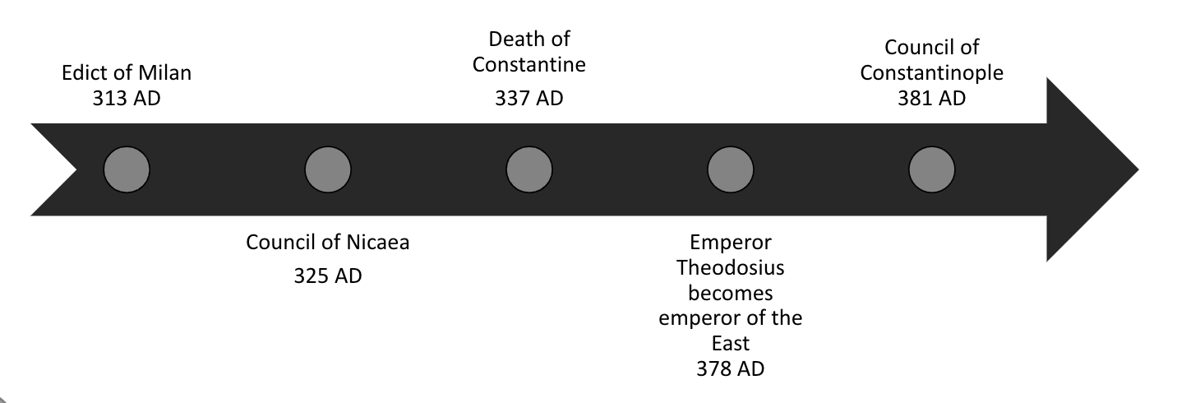
The Arian heresy, which denied the full divinity of Jesus Christ, persisted after the Council of Nicaea in 325. Despite the condemnation of Arianism by the council, it continued to gain adherents, particularly in the Eastern Roman Empire. This was largely due to the support of Emperor Constantius II, who succeeded his father Constantine the Great in 337 and was sympathetic to the Arian cause. Constantius's patronage of Arianism enabled its proponents to spread their beliefs more freely and to gain influence within the Church.
Around 360 AD, theological debates shifted from the divinity of the Son to the divinity of the Holy Spirit. The Council of Nicaea, though recognizing the Trinity, had not explicitly addressed the nature of the Holy Spirit, leaving room for interpretation. This resulted in the emergence of a new group of heretics known as the Macedonians, who denied the full divinity of the Holy Spirit. Their beliefs, known as Pneumatomachianism, posed a significant challenge to the Church's understanding of the Trinity.
In 380, Emperor Theodosius I ascended to the imperial throne and initiated a campaign to restore the Eastern Church to Nicene Christianity. Theodosius sought to unify the entire empire behind the orthodox faith and recognized the need for a church council to address outstanding matters of faith and discipline. He worked closely with St. Gregory Nazianzus, a prominent theologian and bishop, who shared Theodosius's desire for unity within Christianity.
In the spring of 381, the Second Ecumenical Council was convened in Constantinople. This council brought together bishops and theologians from across the Eastern Roman Empire to address the Arian heresy and the Pneumatomachianism of the Macedonians. After extensive debate and discussion, the council fathers reaffirmed the Nicene Creed and clarified the divinity of the Holy Spirit, declaring that the Spirit is fully God and equal in essence with the Father and the Son. This council played a pivotal role in establishing the orthodox understanding of the Trinity, which is still held by the Christian Church today.
Events Leading Up
When Abba Petros II, the patriarch of Alexandria, passed away, the mantle of leadership fell upon Timotheos, a disciple of the revered St. Athanasius. Timotheos thus became the twenty-second successor of St. Mark the Apostle, an illustrious line of patriarchs who had safeguarded the Christian faith in Alexandria since apostolic times. However, this period was not without its challenges, as a new heresy emerged, propagated by Macedonius, the bishop of Constantinople.
Macedonius proclaimed his denial of the divinity of the Holy Spirit. This grave theological deviation sent shockwaves through the Church, prompting deep concern among the bishops. They recognized their sacred duty as custodians of the apostolic legacy and felt an urgent responsibility to address this matter.
Through extensive deliberations and exchanges of views, the bishops arrived at the solemn conclusion that convening another ecumenical council was imperative. Such a gathering would provide a platform for discussing and resolving theological disputes, reaffirming the true faith, and preserving the unity of the Church.
Recognizing the profound significance of the issue at hand, Emperor Theodosius himself shared the conviction of the bishops regarding the necessity of such an assembly. He extended an invitation to all bishops to gather in Constantinople in May of 381 A.D. The response to his invitation was overwhelming, as one hundred and fifty bishops responded enthusiastically, eager to participate in this momentous event.
The gathering, subsequently known as the 2nd Ecumenical Council, marked another pivotal moment in Christianity. Its significance was amplified by the presence of Emperor Theodosius, who attended the inaugural session and graced the assembly with a heartfelt address. In his speech, he warmly welcomed the members and expressed his profound joy at their gathering. His presence underscored the gravity of the situation and the importance that both the Church and the Empire attached to the matter.
The 2nd Ecumenical Council stands as a testament to the collective wisdom and dedication of the bishops in safeguarding the purity of Christian doctrine. Through their deliberations, discussions, and resolutions, they sought to uphold the true faith and ensure the preservation of apostolic teachings for generations to come. Their efforts resulted in the reaffirmation of the divinity of the Holy
Spirit, the condemnation of Macedonius and his followers, and the adoption of a creed known as the Nicene-Constantinopolitan Creed, which remains a foundational statement of Christian belief to this day.
The 2nd Ecumenical Council was another triumph of orthodoxy over heresy, a testament to the enduring power of the Holy Spirit, and a reminder of the Church's commitment to safeguarding the integrity of the Christian faith for all eternity.
The First Heresy
The Council of Constantinople convened in 381 AD to discuss a number of matters. Among the matters discussed and addressed by the Council, the examination and condemnation of the Macedonian heresy took center stage as a top priority. Macedonianism, also known as the Pneumatomachian heresy, posed a significant challenge to the fundamental beliefs of the Christian faith. Its proponents, led by Macedonius, Bishop of Constantinople, denied the full personhood and divinity of the Holy Spirit. According to this heretical teaching, the Holy Spirit was created by the Son and was thus subordinate to the Father and the Son. Pneumatomachians arrived but were said to have refused to even accept the Nicene creed.
St. Gregory of Nazianzus presided over the council yet resigned from the position due to the conflict that arose: "Let me be as the Prophet Jonah! I was responsible for the storm, but I would sacrifice myself for the salvation of the ship. Seize me and throw me... I was not happy when I ascended the throne, and gladly would I descend it."
After careful deliberation and analysis, the Council unanimously condemned Macedonianism. As a consequence of this condemnation, the council expanded the Nicene Creed, which had been established in the Council of Nicea in 325 AD, by adding to it the clause concerning the Holy Spirit which is still upheld by all Orthodox Churches to the present day. Furthermore, the Council expanded the Nicene Creed to include other important affirmations of faith. It declared the belief in the universal church, the oneness of baptism and in awaiting the resurrection of the dead and eternal life.
The expanded Nicene Creed, as formulated by the Council of Constantinople, has endured to the present day and is upheld by all Orthodox Churches. It serves as a foundational statement of faith, outlining the core beliefs and doctrines of Christianity. The Council's condemnation of Macedonianism and its subsequent expansion of the Nicene Creed ensured the preservation of orthodox beliefs and the unity of the Church. The Creed was expanded with the following:
“Yes, we believe in the Holy Spirit, the Lord, the Giver of Life, Who proceeds from the Father, Who with the Father and the Son, is worshiped and glorified, Who spoke by the prophets. And in one holy, catholic, and apostolic church. We confess one baptism, for the remission of sins. We look for the resurrection of the dead, and the life of the age to come. Amen.”
The added clause begins with a resounding affirmation of belief in the Holy Spirit, acknowledging him as the Lord and the Giver of Life. It emphasizes the procession of the Holy Spirit from the Father, emphasizing his distinct but inseparable relationship with God the Father. Furthermore, the clause affirms that the Holy Spirit is to be worshiped and glorified alongside the Father and the Son, recognizing his equal status within the Trinity. The Holy Spirit is also acknowledged as the source of divine inspiration, having spoken through the prophets of old.
The Second Heresy
The Council of Constantinople addressed yet another heresy that had emerged within the Christian community. This heresy was proclaimed by Apollinarius, the Bishop of Laodicea, who held unorthodox beliefs regarding the nature of Jesus Christ.
Apollinarius acknowledged the divine nature of our Lord Jesus Christ, but did not believe in His complete human nature. He considered that the human nature of Christ was not in need of a soul and thus He was without a soul because God the Logos provided the needed life. This implied that the human nature of Christ was incomplete, lacking an essential component fo human existence. The Holy Ecumenical council of Constantinople condemned Apollinarius and rejected his idea declaring it a heresy. The Appolinarus movement may have been an overreaction of Arianism.
The Council emphasized that the Savior must possess both complete divine nature and complete human nature. Jesus Christ is fully God and fully man, embodying the perfect union of divine and human attributes. This understanding preserves the essential mystery of the Incarnation, where God became man to redeem humanity.
Canonical Outcomes
At the council, a key principle that was brought up and reaffirmed was the prohibition against transferring a bishop from the diocese where they were initially ordained to a different diocese. The canon's text makes it clear that "The bishops are not to go beyond their dioceses to churches lying outside of their bounds, nor bring confusion on the churches; but let the Bishop of Alexandria, according to the canons, alone administer the affairs of Egypt; and let the bishops of the East manage the East alone, the privileges of the Church in Antioch, which are mentioned in the canons of Nice, being preserved; and let the bishops of the Asian Diocese administer the Asian affairs only; and the Pontic bishops only Pontic matters; and the Thracian bishops only Thracian affairs. And let not bishops go beyond their dioceses for ordination or any other ecclesiastical ministrations, unless they be invited."
The canon further emphasizes that the decision to transfer a bishop should not be made lightly or based solely on the bishop's personal desires or preferences. It requires careful consideration of the broader implications for both dioceses and the well-being of the faithful. Numerous bishops must come together to evaluate the situation, assess the potential benefits and drawbacks, and ultimately make a decision that is in the best interests of both dioceses and the church as a whole.
The canons of Constatinople can be summarized as follows:
| Canon | Description |
|---|---|
| 1 | Condemns Arianism, Macedonianism, and Apollinarianism. |
| 2 | Renews the Nicene legislation imposing diocesan and patriarchal limits on bishops. |
| 3 | Declares that the Bishop of Constantinople should have a pre-eminence of honour after the Bishop of Rome. |
| 4 | Declares the consecration of Maximus the Cynic as Bishop of Constantinople invalid. |
As the council concluded, Saint Timothy, alongside his delegation, embarked on their return journey to Alexandria. The reign of Emperor Theodosius brought forth a tranquil environment, allowing St. Timothy and his followers to bask in the peace it offered. Amidst this peaceful atmosphere, he devoted himself to the construction of numerous churches, endeavoring to restore Orthodoxy among many who had strayed towards Arianism. His prolific writing included several epistles, most of which have unfortunately been lost to time. Additionally, St. Timothy dedicated himself to chronicling the lives of numerous saintly monks, preserving their remarkable stories for posterity. His unwavering dedication to his faith and his role as a spiritual leader left an enduring mark on Christianity, shaping the course of religious thought and practice in Alexandria and beyond.