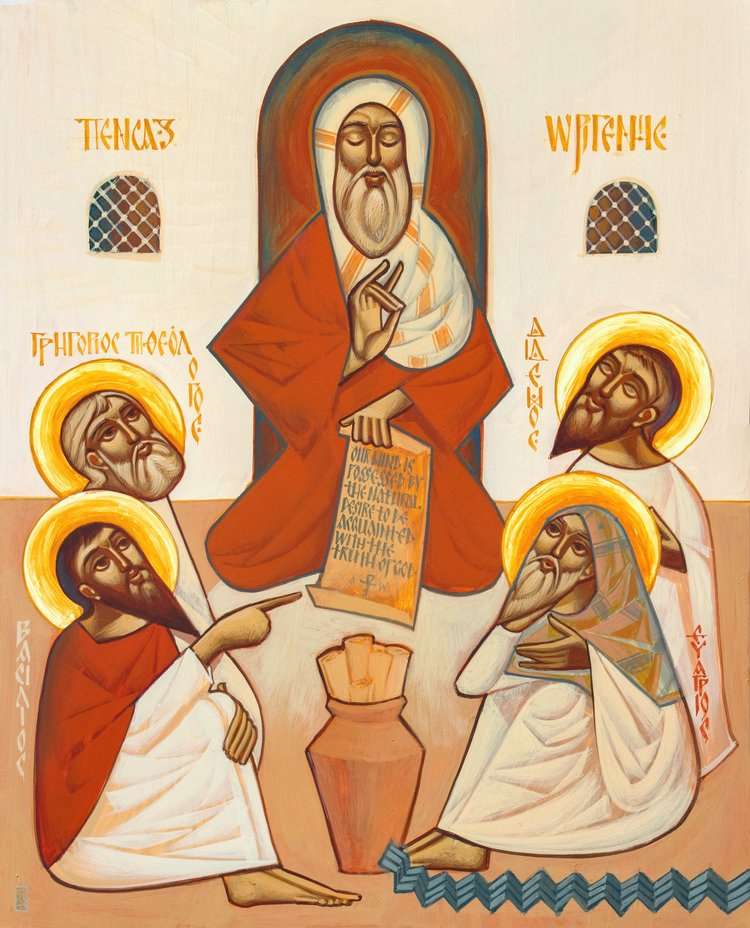
HIST101 - Councils
Commemoration of the Saints
Throughout the commemoration of the saints, believers are reminded of the extraordinary individuals whose lives and sacrifices have indelibly shaped the Christian faith. Among those honored are Saint Gregory the Theologian, renowned for his eloquence and theological insights, and Saint Cyril the Pillar of the Faith, known for his steadfast defense of orthodoxy. Saint Demetrious and Saint Severus stand as unwavering champions of the faith, while Saint Athanasius's unwavering commitment to upholding the truth against heresy earned him the title "Father of Orthodoxy."
Who are all these individuals mentioned in the commemoration of the saints and why commemorate? What thoughts are invoked during the prayer?
The names of these saints should evoke a sense of awe, inspiration and gratitude reminding believers of the rich heritage and unwavering commitment that have characterized the Christian faith throughout history. The commemoration of the saints is not merely a historical exercise but a vibrant and transformative experience. It offers a glimpse into the lives of extraordinary individuals who dedicated their lives to preserving and propagating the Christian faith. Through their stories, we are reminded of the power of faith, the importance of unwavering commitment, and the beauty of a life lived in service to God and humanity.
The Councils of Nicaea, Constantinople, and Ephesus also hold a prominent place in the commemoration of the saints. Why do are these commemorated? These gatherings brought together prominent theologians and church leaders to address critical issues facing the early church and define essential doctrines that would shape the foundations of Christianity. By recollecting all these saints and events, our hearts are enlightened with their impact. But how do these impact us today?
Ecumenical Councils
In the year 325 AD, the Council of Nicea marked the first ecumenical council, marking a significant milestone in Christianity. This gathering of bishops and church leaders, numbering approximately 318, was not merely another council, but rather the first ecumenical council, a distinction that set it apart from previous assemblies.
The term "ecumenical" holds great significance in the context of Christianity. Derived from the Greek word "oikoumene," meaning "the inhabited world," it denotes the pursuit of unity and cooperation among Christian churches worldwide. The Council of Nicea embodied this spirit, as it brought together representatives from different regions and denominations, united in their shared faith.
Several factors contributed to the unique status of the Council of Nicea as an ecumenical council. Firstly, its convening was authorized by the Roman Emperor Constantine I. Constantine's involvement lent an air of legitimacy and authority to the council, ensuring that its decisions would carry weight and be recognized by a broad spectrum of Christians.
Secondly, the Council of Nicea addressed matters of fundamental importance to the Christian faith. It focused on theological controversies, particularly the nature of Christ and his relationship with God the Father. The creed that emerged from the council, known as the Nicene Creed, became a foundational statement of faith for many Christian denominations.
Thirdly, the Council of Nicea established a precedent for future ecumenical councils. It set the stage for regular gatherings of church leaders to discuss and resolve doctrinal and ecclesiastical issues that affected the entire Christian community. These subsequent ecumenical councils, such as the Council of Constantinople in 381 AD and the Council of Ephesus in 431 AD, built upon the legacy of Nicea and contributed to the development of a unified Christian tradition.
In essence, the Council of Nicea marked a turning point in the history of Christianity. It showcased the potential for unity and cooperation among different Christian communities, paving the way for future ecumenical councils and shaping the course of Christian theology and practice for centuries to come.
The First Apostolic Sees
Although the Council of Nicaea, held in 325 AD, was a significant event in the history of Christianity, marking the first ecumenical council of the Church, it is important to note that the Council of Nicaea was not the first council convened by the Christian Church. Prior to the Council of Nicaea, the Church had spread throughout the Roman Empire and beyond, establishing five major apostolic sees. These sees were centers of Christian authority and leadership, each associated with one or more of the apostles of Jesus Christ.
| Apostolic See | Description |
|---|---|
| Rome, Italy | Martyrdom and burial place of the apostles St. Paul and St. Peter. Rome became the center of the Western Church and the seat of the Bishop of Rome, known as the Pope |
| Constantinople, Turkey | Associated with the apostle Andrew. Constantine the Great designated Constantinople as the new capital of the Roman Empire in 330 AD, and the city quickly grew in importance as a center of Christianity. |
| Alexandria, Egypt | Home to the St. Mark the Evangelist; the Church of Alexandria became one of the most prominent in the early centuries of Christianity. Renowned for its theological school. |
| Antioch, Turkey | Traditionally considered to be the first see of the apostle Peter; a thriving city where the followers of Jesus were first called "Christians" |
| Jerusalem, Holy Land | Center of Jesus' ministry and crucifixion; the apostle St. James, the brother of Jesus, led the Church in Jerusalem after Jesus' resurrection |
As the churches in each of these apostolic sees grew and developed, they faced a variety of challenges and controversies. To address these issues, local, pre-ecumenical, councils were convened to discuss and resolve theological disputes, establish church policies, and maintain unity among the Christian communities.
Pre-Ecumenical Councils: Council of Jerusalem
One notable example of a pre-ecumenical council is the Council of Jerusalem, described in Acts 15. This gathering of apostles and elders in Jerusalem was convened to address a pivotal question: Were Gentile converts to Christianity obligated to undergo circumcision and adhere to the Mosaic law? At the heart of the debate was the tension between Jewish and Gentile believers. Many Jewish Christians believed that salvation was only possible through adherence to the Mosaic law, including the rite of circumcision. They argued that Gentile converts should be required to adopt these Jewish practices to be considered full members of the Christian community. The council's decision, known as the "Apostolic Decree," affirmed that Gentile converts were not required to follow these Jewish practices.
At the Council, St. Barnabas and St. Paul told about the miraculous signs and wonders God had done through them among the Gentiles and St. Peter testified that God had shown him that the
Gentiles were not to be excluded from the message of salvation (Acts 15:7–11). After, St. James, the leader of the Jerusalem Church, gave his decision (later known as the "Apostolic Decree") saying, “Therefore I judge that we should not trouble those from among the Gentiles who are turning to God, but that we write to them to abstain from things polluted by idols, from sexual immorality, from things strangled, and from blood. For Moses has had throughout many generations those who preach him in every city, being read in the synagogues every Sabbath.” (Acts 15:19–21)
In a letter sent to the Church of Antioch, the council expressed that the Holy Spirit had guided their decision. “For it seemed good to the Holy Spirit, and to us, to lay upon you no greater burden than these necessary things: that you abstain from things offered to idols, from blood, from things strangled, and from sexual immorality. If you keep yourselves from these, you will do well. Farewell.” (Acts 15:28–29)
The council's decision represented a significant step in the development of early Christianity. It marked the recognition of the Gentiles as equal partners in the faith and paved the way for the rapid spread of Christianity throughout the Roman Empire. The Apostolic Decree became a foundational document for the early church, guiding the practice and beliefs of Christians for centuries to come.
The Entirety of the Pre-Ecuminical Councils
Early Christian councils, such as those held in Jerusalem, Rome, and Carthage, were instrumental in shaping the practices and beliefs of the early Christian Church. These councils brought together representatives from different Christian communities to discuss and decide on matters of doctrine, discipline, and practice.
One important function of the early Christian councils was to emphasize Christian identity. In a world dominated by paganism, it was essential for Christians to define themselves and their beliefs. Eventually, the Council of Ephesus, held in 381 AD, issued a creed known as the Nicene Creed. This creed summarized the basic beliefs of Christianity and became a standard for Christian orthodoxy. It affirmed the belief in one God, the divinity of Jesus Christ, and the Holy Trinity.
The early Christian councils played a vital role in the development of Christianity. They established guidelines for Gentile converts, emphasized Christian identity, addressed theological controversies, and helped to shape the practices and beliefs of the early Christian Church. Their decisions continue to influence Christian thought and practice today.
| Council | Date | Purpose | Outcome |
|---|---|---|---|
| Council of Jerusalem | 49 AD | To address the issue of whether Gentile converts should be required to observe the Law of Moses | Gentile converts were not required to observe the Law of Moses, but they should abstain from certain practices considered offensive to Jewish sensibilities. |
| Council of Rome | 155 AD | To address the issue of Quartodecimanism, the practice of celebrating Easter on the 14th day of Nisan regardless of the day of the week | The council failed to reach a consensus, and the practice of Quartodecimanism continued in some regions for several more centuries. |
| Council of Ephesus | 193 AD | To decree that Easter should be celebrated on Sunday, rather than Passover | This decision was made to dissociate Christianity from Judaism and establish a distinct Christian identity. |
| Council of Carthage | 251 AD | To address the issue of Lapsi bishops, who had renounced their faith during times of persecution and later returned to the Church | Lapsi bishops could be reinstated if they demonstrated genuine repentance and underwent a period of penance. |
| Council of Iconium | 258 AD | To confirm the decrees of the Council of Carthage and issue additional canons to address related issues | Additional canons were issued to address issues such as the treatment of lapsed Christians and the regulation of clerical discipline. |
| Council of Antioch | 264 AD | To address the teachings of Paul of Samosata, the bishop of Antioch, who denied the full divinity of Jesus Christ | Paul's teachings were condemned as heretical, and he was deposed from his position as bishop. |
| Council of Arabia | 246–24 7 AD | To address the teachings of Beryllus, the bishop of Bostra, who maintained that the soul perished after death and would eventually be resurrected with the body | Beryllus's views were condemned as heretical. |
| Council of Elvira | 306 AD | To discuss issues of order, discipline, and conduct among the Christian community | The council adopted 81 canons that addressed topics such as the proper observance of Sunday, the prohibition of certain pagan practices, the regulation of clergy conduct, and the establishment of guidelines for the administration of penance. |
| Council of Ancyra | 314 AD | To address the growing influence of Donatism, a schismatic movement that rejected the authority of the Roman Catholic Church | The council adopted canons that condemned Donatism and established guidelines for the reconciliation of Donatists to the Catholic Church. |
| Synod of Neo-Caesarea | 314 AD | Sought to regulate and maintain order within the Church, emphasizing the importance of moral conduct and spiritual discipline among the clergy and laity. | Convened under the leadership of Basil, Bishop of Neo-Caesarea, established a set of 15 canons that would later gain recognition as ecumenical in 451 at the Council of Chalcedon. These canons addressed diverse aspects of church life, providing guidance on matters such as the marriages of priests, second marriages, penances for various sins, and the responsibilities of deacons. |
Then Came Arius
Arius, a fourth-century priest, propounded a controversial doctrine that challenged the traditional understanding of the relationship between God the Father and God the Son. Central to his belief was the assertion that "if the Father begat the Son, he that was begotten had a beginning of existence." This statement implied that there was a time when the Son did not exist, contradicting the orthodox view of the Son's eternal nature.
Arius's belief stemmed from his interpretation of several biblical passages. He cited Jesus' words in John 14:28, "If you loved me, you would be glad that I am going to the Father, for the Father is greater than I," as evidence that the Father possessed a higher status than the Son. Additionally, he pointed to Proverbs 8:22, "The Lord created me at the beginning of his work," to suggest that the Son was created by God. Arius also drew upon Isaiah 46:9, "I am God, and there is no other; I am God, and there is none like Me," to emphasize the uniqueness and indivisibility of God's essence.
Arius's fundamental presupposition was that the divine essence is an indivisible unity, incapable of being divided or distributed. From this perspective, he argued that it was impossible for God to "beget" a divine Son, as such an act would involve dividing the inherently indivisible. Therefore, he concluded that the Son must have been created rather than uncreated.
Arius placed the Son within the category of creatures, although acknowledging his exalted status above all other created beings. However, he maintained that the Son could not be considered eternal in the same sense as the Father. "There was a time when he was not," Arius declared. He further asserted that if God and Christ were equal, then Christ should be called God's brother, not God's son.
Arius's teachings generated significant controversy and opposition within the Christian community, particularly from those who held to the traditional view of the Trinity. The Council of Nicaea, convened in 325 AD, condemned Arius's doctrine, reaffirming the deity of Christ and his eternal existence. The Nicene Creed, formulated at the council, declared that the Son is "begotten, not made" and "of one substance with the Father." This creed became a pivotal statement of Christian orthodoxy, solidifying the belief in the equality and divinity of the Father and the Son.
Then came Athanasius…
Athanasius was born in 295 AD in Egypt, near Alexandria. It was by the water's edge that Bishop Alexander first encountered Athanasius, recognizing his potential and inviting him to serve as his secretary. Around the year 318 AD, at approximately 25 years of age, Athanasius wrote his book titled, "On the Incarnation" which explored the profound mystery of Christ's divinity and humanity, laying the groundwork for his unwavering stance against Arianism.
In 325 AD, Athanasius attended the Council of Nicaea as deacon and the secretary of Pope Alexander. It was at this crucial gathering that he emerged as a passionate defender of the full divinity of Jesus Christ. With eloquence and conviction, he argued against the heretical teachings of Arius, who sought to diminish the divine nature of Christ. Following the departure of Pope Alexander in 328 AD, Athanasius was elevated to the position of Pope of Alexandria. For an extraordinary 48 years, he steered his flock with unwavering dedication and theological brilliance. He became a beacon of orthodoxy and a staunch opponent of Arianism, which had begun to spread like wildfire.
In his book "De Decretis," Athanasius forcefully refuted the Arian heresy, which sought to diminish the divinity of Jesus Christ. He argued eloquently against the notion that the Son was a created being, subject to change and variation like all rational creatures. Instead, he upheld the true and natural divinity of Christ, emphasizing that He was eternally begotten of the Father and of the same essence.
Against Arianism
Arianism, a significant theological controversy in early Christianity, centered around the teachings of Arius, a presbyter from Alexandria, Egypt. According to Arius, Jesus Christ, the incarnate Logos, was not eternally existent but rather a created being. This belief challenged the fundamental doctrine of the Trinity, asserting that only the Son was directly begotten by God the Father, before all ages, and that the Son's essence or substance was distinct from, though similar to, that of the Creator. Arius's opponents argued that this view made Jesus less than fully divine and therefore heretical.
Regarding who created the Son, several refutations could be made. One such argument comes from Isaiah 43:11, which states, “I, even I, am the LORD, and besides me there is no savior.” Another passage, Colossians 1:15, refers to Jesus as “the image of the invisible God, the firstborn of all creation.” Additionally, 1 Corinthians 8:6 emphasizes “there is one God, the Father, of whom are all things, and we for Him; and one Lord Jesus Christ, through whom are all things, and through whom we live.” Finally, John 17:21, presents the argument of unity, stating “they all may be one, as You, Father, are in Me, and I in You.”
The Nicene Creed, formulated during the Council of Nicaea in 325 AD, played a pivotal role in addressing Arianism. The central term used in the creed to describe the relationship between the Father and the Son is homoousios (Ancient Greek: ὁμοούσιος), meaning "of the same substance" or "of one being." This term affirmed the essential unity and equality of the Father and the Son, refuting the Arian notion of a distinction in substance. The Nicene Creed is an even more explicit anti-Arian statement on the Trinity. It declares that the Father, Son, and Holy Spirit are all of the same divine essence and power, rejecting any notion of inferiority or subordination.
The primary concern of the Council of Nicaea was the exact relationship between God the Father and His Son, Jesus Christ, and the nature of the Son of God. (Refer to Paul of Samosata, and the Synods of Antioch.) While Arius acknowledged Jesus Christ’s divinity and mission for the salvation of mankind, he asserted that Jesus was not equal to God the Father in terms of rank and primordial origin. Additionally, Arius believed that the Holy Spirit, the power of God the Father, was not equal to either God the Father or the Son of God. Under Arianism, Christ was not considered to be of the same essence or being as God the Father, as Arius argued that both the Father and the Son were made of "like" essence or being, rather than identical essence or being. "The Son [then,] is a creature and a work; neither is he like in essence to the Father; neither is he the true and natural Word of the Father; neither is he his true wisdom; but he is one of the things made and created and is called the Word and Wisdom by an abuse of terms… Wherefore he by nature subject to change and variation, as are all rational creatures." (Arius)
Terminologies
The debates during the Council of Nicaea centered around the distinction between being "born" or "created" and being "begotten." Arians, followers of Arius, viewed these terms as fundamentally equivalent, while Pope Alexander of Alexandria and his supporters disagreed. Many of the words employed in these discussions, such as "essence" (ousia), "substance" (hypostasis), "nature" (physis) and "person" (prosopon) inherited multiple meanings from pre-Christian philosophers. This led to misunderstandings and confusion until the Cappadocian Fathers, particularly St. Basil of Caesarea, St. Gregory of Nazianzus, and St. Gregory of Nyssa, intervened.
Under their influence, the terminology used in the debates was clarified and standardized. They defined "hypostasis" as a distinct individual existence within the Godhead, while "ousia" referred to the shared divine essence. As a result, the phrase "three hypostases in one ousia" emerged as an accurate representation of the orthodox doctrine of the Trinity, asserting that the Father, Son, and Holy Spirit are distinct persons but share the same divine nature.
This clarification was crucial in resolving misunderstandings and establishing a common language for theological discussions. However, the nuances and complexities of these terms continued to be debated and refined throughout the early centuries of Christianity, contributing to the development of subsequent theological concepts and doctrines.
St. Basil of Caesarea, a prominent theologian of the 4th century, argues that the terms "ousia" (essence or substance) and "hypostasis" (person or subsistence) are not synonymous and should not be used interchangeably when referring to the Godhead. He draws an analogy to the distinction between a general concept and a particular instance. For example, "animal" represents a general concept, while "a particular man" represents a specific instance of that concept. Similarly, in the context of the Godhead, St. Basil asserts that we recognize one essence or substance to avoid introducing multiple definitions of existence. However, we also acknowledge distinct hypostases or persons—the Father, Son, and Holy Spirit—to ensure clarity and prevent confusion in our understanding of each.
Nicene Conclusion
St. Athanasius delved deeply into the profound mystery of the incarnation, underscoring its pivotal purpose in reversing the corruption that had ensnared humanity. He posited that the divine Word, being immortal and one with the Father, could not directly experience death. However, recognizing that mortality was the only means to undo human corruption, the Word ingeniously assumed a mortal body.: “for the Word, realizing that in no other way would the corruption of human beings be undone except, simply, by dying, yet being immortal and the Son of the Father of the Word was not able to die, for this reason he takes to himself a body capable of death, in order that it, participating in the Word who is above all, might be sufficient for death on behalf of all, and through the indwelling Word would remain incorruptible, and so corruption might henceforth cease from all by the grace of the resurrection.”
By uniting with a body susceptible to death, the Word, who transcends all creation, enabled that body to bear the weight of death on behalf of all humanity. Crucially, the indwelling presence of the immortal Word within this mortal vessel ensured that it would remain incorruptible, even in the face of death.
The Nicene Creed of 325 therefore concluded to the following statement “We believe in one God, the Father Almighty, Maker of all things visible and invisible. And in one Lord Jesus Christ, the Son of God, begotten of the Father [the only-begotten; that is, of the essence of the Father, God of God,] Light of Light, very God of very God, begotten, not made, being of one substance with the Father; by whom all things were made [both in heaven and on earth.) Who for us men, and for our salvation, came down and was incarnate and was made man. He suffered, and the third day he rose again, ascended into heaven. From thence he shall come to judge the quick and the dead. And in the Holy Spirit.”
Emperor Constantine then produced an edict against the Arians stating, “in addition, if any writing composed by Arius should be found, it should be handed over to the flames, so that not only will the wickedness of his teaching be obliterated, but nothing will be left even to remind anyone of him. And I hereby make a public order, that if someone should be discovered to have hidden a writing composed by Arius, and not to have immediately brought it forward and destroyed it by fire, his penalty shall be death. As soon as he is discovered in this offense, he shall be submitted for capital punishment.”
The condemnation of Arianism at the Council of Nicaea was a significant event in the history of Christianity. It established the orthodox doctrine of the Trinity, emphasizing the essential unity and equality of the Father, Son, and Holy Spirit. However, Arianism continued to influence various Christian groups, particularly in the Germanic kingdoms of the early Middle Ages. It was not until the Visigothic Kingdom of Spain officially adopted Catholicism in the 6th century that Arianism was finally eradicated from Western Europe.
The Other Results of Nicaea
The Council of Nicea, although renowned for its definitive stance against Arianism and its formulation of the Nicene Creed, the council encompassed a broader agenda aimed at fostering unity and harmony among churches across the world.
One significant matter addressed at the council was the establishment of a unified calendar for determining the date of Easter. Prior to Nicea, different regions followed varying practices, leading to confusion and inconsistencies in the observance of the resurrection of Jesus Christ. The controversy between those who argued for independent computations and those who argued for continued reliance on the Jewish calendar was formally resolved by the Council, which endorsed the independent procedure that had been in use for some time at Rome and Alexandria. The council decreed that Easter should be celebrated on the first Sunday after the first full moon following the spring equinox, ensuring a standardized approach across all Christian communities.
Bishop Melitius of Egypt played a significant role in the Council of Nicaea. He had been imprisoned with Bishop Peter during the Diocletian persecution in 305/306 AD and bravely advocated for the open practice of Christianity during times of persecution. However, he faced opposition from a rival bishop named Paulinus, and his episcopate was marked by a schism known as the Meletian Schism. Due to this schism, Melitius was exiled from Antioch on three separate occasions: 361–362, 365–366, and 371–378. His removal from Antioch aimed to resolve the schism and restore unity within the church. The Meletian Schism had a lasting impact on the Christian community in Egypt and the broader region, leading to debates and discussions about episcopal authority and the proper response to persecution.
Another matter that received considerable attention was the issue of ecclesiastical jurisdiction and the authority of bishops. The council sought to define the boundaries of each bishop's authority and establish a hierarchical structure within the church. This move aimed to prevent disputes and ensure orderly administration, as well as to maintain the unity of the faith.
Furthermore, the Council of Nicea addressed various theological and doctrinal matters, aiming to clarify and codify beliefs and practices. It condemned heretical teachings that deviated from the core doctrines of Christianity and affirmed the divinity of Jesus Christ and the Holy Spirit. Additionally, the council established guidelines for the proper conduct of clergy and laypeople, emphasizing the importance of ethical behavior and moral standards. The council concluded with the following 20 canons:
| Canon | Prohibition/Establishment | Purpose |
|---|---|---|
| 1 | Prohibition of Self-Castration for Clergy | Uphold the sanctity of the human body and maintain physical integrity for those serving in the church. |
| 2 | Establishment of a Minimum Term for Catechumens | Ensure catechumens have sufficient time to deepen their understanding of the faith and develop a genuine commitment to Christ. |
| 3 | Prohibition of Suspicious Female Presence in Clergy Households | Preserve the reputation and integrity of the clergy by preventing any potential temptations or misunderstandings. |
| 4 | Ordination of a Bishop | Ordination of a bishop in the presence of at least three provincial bishops, and confirmation by the metropolitan bishop. |
| 5 | Provision for 2 Annual Provincial Synods | Foster communication, collaboration, and decision-making among bishops and church leaders. |
| 6 | Confirmation of Ancient Customs giving jurisdiction over large regions to the bishops of Alexandria, Rome, and Antioch. | Recognize the historical significance and apostolic tradition of the bishops of Alexandria, Rome, and Antioch. |
| 7 | Recognition of the Honorary Rights of the See of Jerusalem | Acknowledge the special significance of Jerusalem in Christian history and emphasize its spiritual and historical importance. |
| 8 | Provision for Agreement with Novatianists | Promote unity and reconciliation by encouraging an agreement with an early Christian sect. |
| 9-14 | Mild Procedure for the Lapsed during Licinius' Persecution | Provide a mild and compassionate approach toward those who lapsed in faith under pressure, emphasizing pastoral care and reconciliation. |
| 15-16 | Prohibition of the Removal of Priests | Uphold the stability and order of the clergy by protecting the rights and dignity of priests while ensuring accountability. |
| 17 | Prohibition of Usury among the Clergy | Maintain ethical standards and prevent exploitation by forbidding clergy members from engaging in usury. |
| 18 | Precedence of Bishops and Presbyters, before deacons, in Receiving the Eucharist | Establish the hierarchical order by ensuring bishops and presbyters receive the Eucharist before deacons. |
| 19 | Declaration of the Invalidity of Baptism by Paulian Heretics | Safeguard the integrity and authenticity of the baptismal sacrament by declaring baptism performed by Paulian heretics to be invalid. |
| 20 | Prohibition of Kneeling on Sundays and during Pentecost, the fifty days commencing on Easter. | Maintain uniformity in worship and highlight the festive nature of these periods by prohibiting kneeling. |