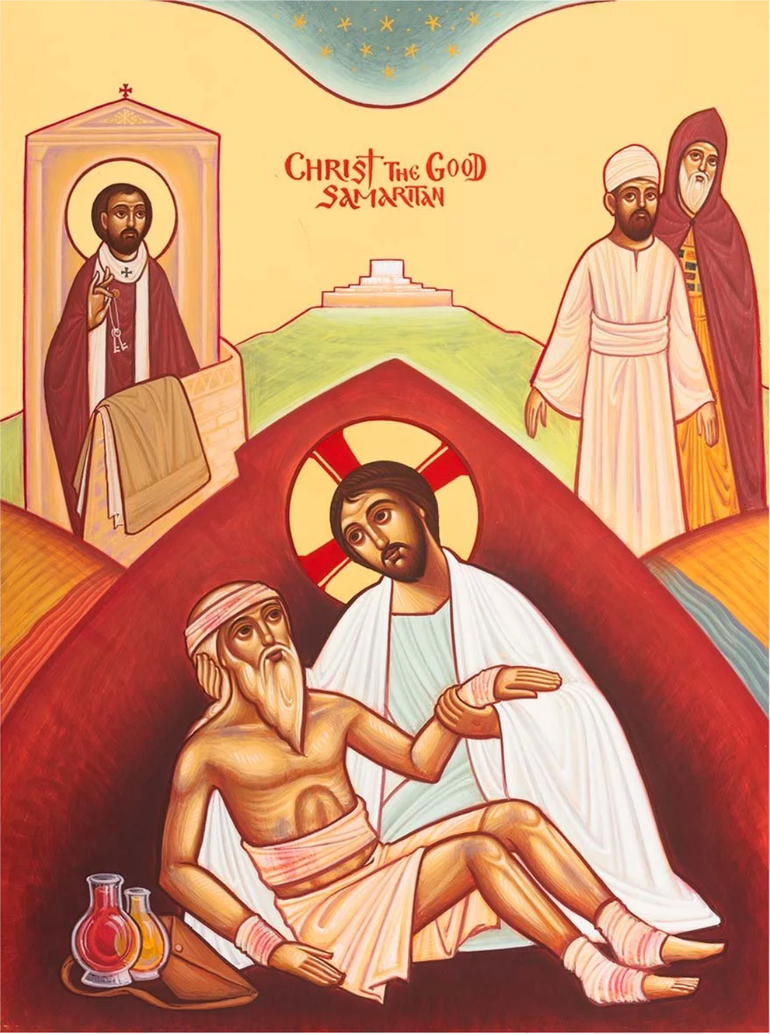
Before any of us stood before a class, a youth group, a home, or a hospital bed as a servant, someone else stood first. The Lord Jesus Christ, the Master of all and the Maker of all, bent Himself down to the dust of this world and became a servant within it. He washed feet with His own hands. He healed with His own touch. He spoke with people the world had long stopped listening to. And when at last He laid down His life for His sheep, He was not departing from His ministry — He was completing it. To enter the life of service, then, is not to take up a new project. It is to take up an old pattern, the oldest pattern there is, and to let the Lord of the sheep re-shape us into a likeness of Himself. In this lesson we will sit with the parable of the Good Shepherd in the tenth chapter of St. John, and we will meet three figures who each want to be near the flock: the door, the thief, and the shepherd. Only one of the three loves the sheep. The work of becoming a servant is the work, over a lifetime, of becoming that one.
The Master Who Came to Serve
The Christian idea of service is not a piece of ethics borrowed from the world’s good manners. It is a revelation. It is the shape our Lord took when He stepped out of glory into history, and it is the shape He has asked every one of His followers to take ever after. The clearest verse in the whole New Testament about what service means does not come from St. Paul and does not come from a Father. It comes from Christ Himself, speaking of Himself:
“Even as the Son of Man did not come to be served, but to serve, and to give His life a ransom for many.” (Matthew 20:28, NKJV)
Every word of that sentence repays attention. He came. He was not compelled, He was not summoned, He did not arrive by accident; He came, freely, in love, because love is what the Father is. He did not come to be served, though He was the only Person in the universe with any right to be. He came to serve, and the word He chose for what He was doing is the word that in the ancient world meant the work of a slave. And He came to give His life a ransom for many — not a token service, not a shift of charitable hours, but a pouring out of Himself to the very end. Everything we will learn about service in this curriculum is a commentary on that one sentence.
On the night before He died, Jesus dramatized the teaching so that no future servant could ever forget it. He rose from supper, laid aside His outer garments, wrapped Himself in a towel, filled a basin with water, and knelt before the men who had been arguing all week about which of them was greatest. One by one He washed their feet. And when He had finished, He turned to them and said:
“You call Me Teacher and Lord, and you say well, for so I am. If I then, your Lord and Teacher, have washed your feet, you also ought to wash one another’s feet. For I have given you an example, that you should do as I have done to you.” (John 13:13–15, NKJV)
St. Cyril of Alexandria, looking at that scene, warns us not to walk past it as though we had understood it already:
“For it is not the knowledge of virtue, but rather the practice of it, that the blessed saint sets before us.” – St. Cyril of Alexandria, on John 13
The servant is not a student of service in the abstract. The servant is a doer. It is possible to know every principle in this book by heart and yet never once kneel, towel in hand, before the actual feet of a tired person. That would be to treat service as an idea, when the Lord gave it to us as a practice. The question the night of the foot-washing puts to us is not, “Do we understand?” The question is, “Are we willing to do as He has done?”
The Parable of the Good Shepherd (John 10)
Of all the parables our Lord spoke, the parable of the Good Shepherd appears only in the Gospel of St. John, and it stands apart from the rest because the central figure is not a farmer or a king or a merchant — it is the Lord Himself, describing His own heart toward us. He paints the scene in a few unforgettable strokes: a sheepfold, a door, a watchful gatekeeper, a flock of sheep who know one voice and no other, and three figures who want to be near that flock. The parable opens like this:
“Most assuredly, I say to you, he who does not enter the sheepfold by the door, but climbs up some other way, the same is a thief and a robber. But he who enters by the door is the shepherd of the sheep. To him the doorkeeper opens, and the sheep hear his voice; and he calls his own sheep by name and leads them out. And when he brings out his own sheep, he goes before them; and the sheep follow him, for they know his voice. Yet they will by no means follow a stranger, but will flee from him, for they do not know the voice of strangers.” (John 10:1–5, NKJV)
The details are not decorations. The door, the gatekeeper, the voice, the name — each of them is going to matter. And the three figures who show up across the rest of the chapter — the thief who climbs in where the shepherd walks, the hireling who flees when the wolf comes, and the Good Shepherd who lays down His life — are the three possible shapes a servant’s life can take. Two of them describe ways that service can go wrong; one of them describes the Lord Himself, and the servant He is slowly forming us to become. Let us take them in turn.
Christ the Door
Before our Lord describes the thief or the hireling or even Himself as the shepherd, He describes Himself as the door. It is an arresting image. A shepherd stands at the entrance of the pen; He is the entrance of the pen. In the world of the parable, the sheepfold of the Lord’s people has exactly one way in and one way out, and that way has a face and a name:
“I am the door. If anyone enters by Me, he will be saved, and will go in and out and find pasture.” (John 10:9, NKJV)
This is not an incidental claim. It is the claim our Lord made of Himself once again in the Upper Room, a few nights before His death: “I am the way, the truth, and the life. No one comes to the Father except through Me” (John 14:6, NKJV). Christ is not a path among paths. He is the only entry, and the exclusivity of that claim is not a gate slammed in the face of the world — it is a gate held wide open in front of it. Everyone who enters by Him is saved. No one is sent away for being the wrong kind of sheep.
And yet the Fathers heard a second meaning in “the door” as well. For St. John Chrysostom, the door through which the shepherd enters — the door that keeps the thieves out — is the Word of God itself. Anyone who comes to teach God’s flock without coming through the door of Holy Scripture, rightly interpreted in the Church, is already climbing the wall. The sheep, for their part, are to be so familiar with the voice of the Lord in the Scriptures that they can tell in an instant when a stranger is speaking. St. Augustine holds the two meanings together in a single sentence:
“Remember that the Lord Jesus Christ is the Door and the Shepherd. He presents Himself as the Door in order to be revealed. He is the Shepherd too, who allows us to enter through Him.” – St. Augustine, on John 10
For the servant, the practical lesson is simple and hard. Our authority to lead anyone anywhere is borrowed, not owned. We enter through the door ourselves — through Christ, through the Scriptures, through the sacramental life of His Church — and we bring the flock in by the same door, and in no other way. A servant who teaches what he did not receive, who leads by his own opinion rather than by the voice of the Lord, has already climbed the wall. He may not notice. The sheep will.
The Thief and the Hireling
Two figures in the parable do not love the sheep. They look different from each other, and they fail in different ways, but they share a single disease: they are in it for themselves. The Lord introduces the first without mincing words:
“The thief does not come except to steal, and to kill, and to destroy. I have come that they may have life, and that they may have it more abundantly.” (John 10:10, NKJV)
The thief climbs in where the shepherd walks in. He enters by the window, the wall, the side gate — anywhere except the one door the Lord has appointed. His aim is the opposite of the shepherd’s in every particular. The shepherd gives life; the thief takes it. The shepherd feeds; the thief plunders. The shepherd protects; the thief kills and destroys. In the ordinary life of the Church the thief rarely announces himself this baldly. He comes instead in the form of a teaching that flatters, a movement that excites, a voice that promises spiritual goods without the Lord’s door — and he lives off the flock while calling himself its friend. The Lord’s warning against him is stark, and the way we are to recognize him is even starker: not by ever-cleverer argument, but by the voice we have grown so used to that the stranger’s voice is immediately foreign.
The hireling is a subtler failure, and closer to home. He is not an enemy of the sheep. He simply does not love them. He has agreed to the job; he may be good at the job in easy weather; but his heart is fixed on what the job gives him rather than on the flock itself. St. John Chrysostom’s summary of the difference cuts cleanly:
“In this the shepherd differs from the hireling: the one always looks to his own safety, caring not for the sheep; the other always seeks that of the sheep, neglecting his own.”
- St. John Chrysostom, Homily on John 10
The hireling is found out when the wolf comes. As long as the sky is clear and the flock is quiet, he is indistinguishable from a true shepherd. But when the pressure arrives — when the defense of the truth costs something, when a wayward sheep needs to be gone after at personal cost, when a difficult conversation has to be had — he is gone. St. Gregory the Great notices that his flight is often not physical at all:
“He flees, not by change of place, but by withdrawing support. He flees, because he saw injustice and held his peace; he flies, because he conceals himself by silence.” – St. Gregory the Great, Homily 14 on the Gospels
This is the warning each of us should take most personally, because we are far more likely to become hirelings than thieves. The hireling does not wake up one morning and decide to abandon the sheep; he simply chooses comfort over love one small decision at a time, until the love that ought to have been his primary fuel is no longer there and he does not remember when it left. St. Paul diagnoses the condition in a single line that we should weigh against our own ministries honestly:
“For all seek their own, not the things which are of Christ Jesus.” (Philippians 2:21, NKJV)
The question the hireling section of the parable puts to us is not, “Am I a bad person?” It is, “Who am I actually serving when I serve?” If the honest answer is our own comfort, our own reputation, our own sense of usefulness — the wolf has already arrived and we have not yet noticed.
The Marks of the Good Shepherd
Against the thief and the hireling the Lord draws His own portrait, and He uses the word “good” twice in a single breath — not because He is repeating Himself, but because He wants us to let the word sink in:
“I am the good shepherd. The good shepherd gives His life for the sheep. But a hireling, he who is not the shepherd, one who does not own the sheep, sees the wolf coming and leaves the sheep and flees; and the wolf catches the sheep and scatters them. The hireling flees because he is a hireling and does not care about the sheep. I am the good shepherd; and I know My sheep, and am known by My own.” (John 10:11–14, NKJV)
The marks that follow from this self-description are the pattern for every Christian servant. The Good Shepherd knows His sheep by name — not as a roster, not as a program attendance list, but as persons whose particular weaknesses and histories and hopes He carries in His heart. He calls His sheep out one by one, and He leads them; He does not drive them from behind with a stick. He goes before them, which means He never asks of them a road He has not already walked Himself. He lays down His life for them. He gathers the weak ones and carries them. The prophet Isaiah had foreseen this tenderness seven hundred years in advance:
“He will feed His flock like a shepherd; He will gather the lambs with His arm, and carry them in His bosom, and gently lead those who are with young.” (Isaiah 40:11, NKJV)
Each of these marks is also a diagnostic for our own service. Do we know the people we serve — their names, their homes, the specific shape of what they are struggling with this season? Do we lead the people we serve or do we push them? Do we go before them in what we are asking of them, or are we giving out a Christian life we have not actually chosen to live? And, hardest of all: are we willing to pay the cost — in time, in sleep, in emotional energy, in reputation — that loving these particular sheep is going to ask? The Old Testament speaks very pointedly to shepherds who answered no to these questions. Through the prophet Ezekiel, the Lord indicts the false shepherds of Israel in words that ought to stop the breath of every servant who reads them:
“The weak you have not strengthened, nor have you healed those who were sick, nor bound up the broken, nor brought back what was driven away, nor sought what was lost; but with force and cruelty you have ruled them.” (Ezekiel 34:4, NKJV)
The contrast with the Good Shepherd is total, and it is meant to be. The Lord has not asked us to manage a flock; He has asked us to love one, in the exact way He loves it.
The Sheep and the Voice They Know
It would be a mistake to read John 10 only as a portrait of the shepherd, because the parable is also about the sheep. We are the sheep. Nothing in Scripture is more humbling about the human condition than the images God chose to describe it: we are clay, we are dust, we are grass that withers, and we are sheep. Sheep are not fierce and they are not clever. They wander. They cannot defend themselves. They panic in the dark. They depend on the voice of a shepherd for everything from where to feed to where to drink to when to rest. St. Peter, writing as one who had once scattered himself at the first sign of a wolf, sums up the whole Christian condition in a line:
“For you were like sheep going astray, but have now returned to the Shepherd and Overseer of your souls.” (1 Peter 2:25, NKJV)
The central discipline of the sheep is listening. The parable says it twice: the sheep hear His voice, and they do not hear the voice of strangers. How does that hearing grow? In the ordinary ways the Church has always taught — by daily Scripture, by the cycle of the Agpeya, by the Divine Liturgy, by Confession, by time with a father of confession, by the hymns of the Church that carry doctrine in their bones. The more the voice of the Lord fills our ears, the more foreign the voice of the stranger sounds when he calls. The servant who wants to lead others to the Shepherd’s voice must first become a sheep who knows that voice himself. There is no shortcut past this.
Our Lord promises His sheep a specific kind of freedom — the freedom to go in and go out and find pasture. The servant who has learned to trust the Shepherd’s voice is not a sheep in a cage; he is a sheep in a field. He is safe because the Shepherd is near, and he is free because the Shepherd is good. St. Gregory of Nyssa turns the whole picture back into a prayer the Church has prayed ever since:
“Show me the green pastures. Lead me to the still waters. Guide me to filling food. Call me by my name, so that I may hear your voice. I am your sheep: grant me eternal life.”
- St. Gregory of Nyssa, on the Song of Songs
Let that be our prayer, and let us carry it into the ministry we have been given. The servants the Lord is forming through this curriculum are sheep who have learned His voice and are beginning, by grace, to sound a little like Him when they call their own sheep by name. Let us go in and go out and find pasture — and let us bring with us every sheep we can, through the one Door, to the one Shepherd who has laid down His life so that there may be one flock and one Shepherd forever.