We have looked at the shepherd-heart our Lord modeled for us, at the long list of expectations the New Testament lays upon the servant, and at the love without which none of those expectations can be met. It remains for us to walk the road on which all of this is tested, which is the road of daily responsibility. Responsibility is not a temperament. Some of us were born neat and others disorderly, some eager and others cautious, but the sense of duty that keeps a servant showing up for the children week after week for ten years is not inherited — it is formed. In this lesson we will watch the Scripture teach us what responsibility looks like in a servant: not as a single virtue, but as a whole posture of the soul that the Holy Spirit shapes in us over a lifetime. We will see it in Adam and in David, in the Samaritan and in Nehemiah, in the Prodigal on the road home and in our Lord Himself on the hillside surrounded by five thousand hungry people. In each place the same truth stands: responsibility is what love looks like when it has work to do.
Responsibility as a Choice: The Two Postures of Adam
Responsibility is not something we catch; it is something we choose. And because it is chosen, every one of us is capable of it on our best days and capable of evading it on our worst. Scripture makes this plain in its very first chapters, where the same man, Adam, is shown to us twice — once in responsibility and once in flight from it.
In the garden, when the Lord brought the woman to him, Adam’s response was not a shrug. It was poetry and covenant:
“This is now bone of my bones and flesh of my flesh; she shall be called Woman, because she was taken out of Man.” (Genesis 2:23, NKJV)
That is what responsibility sounds like when it is whole. She is mine; I am hers; we are one flesh; I will stand for her and she for me. Not a word is wasted on what she owes him; his opening sentence is what he owes her. Responsibility always begins, in its healthy form, with the question, What belongs to me to care for?
But only a chapter later the same man, having sinned, meets his Creator in the cool of the day and gives an answer whose grammar tells the whole story:
“The woman whom You gave to be with me, she gave me of the tree, and I ate.” (Genesis 3:12, NKJV)
“The woman whom You gave.” Three separate arrows of blame in a single sentence: at the woman, at the Lord, at the circumstances. The man who a chapter earlier sang of his covenant bride as bone of his bones now stands at a safe distance from her and from his Creator, and points. Nothing has changed about Adam’s capacity; what has changed is his nearness to God. Responsibility is the natural speech of a soul in communion with its Maker, and blame is the natural speech of a soul in hiding. The servant’s first task, every morning, is to decide which of those two postures the day will be lived in.
Rooted in Godliness: The Two Davids
If Adam shows us the two postures side by side in a single life, David shows us the same truth stretched across a lifetime. When David was a boy with a sling and the Lord’s name on his lips, his sense of responsibility for his father’s sheep was total. He tells Saul exactly how total when the giant is mocking Israel in the valley of Elah:
“Your servant used to keep his father’s sheep, and when a lion or a bear came and took a lamb out of the flock, I went out after it and struck it, and delivered the lamb from its mouth; and when it arose against me, I caught it by its beard, and struck and killed it. Your servant has killed both lion and bear…” (1 Samuel 17:34–36, NKJV)
That is responsibility grown into courage. A single lamb in the jaws of a predator is enough to send him into the fight, because the flock is his to guard. No one would have blamed the boy for letting one lamb go. He blamed himself, and went.
The same David, years later, saunters onto his palace roof one evening when the kings are out at war, sees what he should not be looking at, sends for her, takes her, and when the inconvenient pregnancy threatens to surface, arranges her husband’s death in battle (2 Samuel 11). It is the same man. What changed was not his personality. What changed was his nearness to God. A soul close to the Lord reaches out to protect; a soul at a distance reaches out to consume. St. John Chrysostom, commenting on this terrible collapse, refuses to separate David’s ethics from his prayer life:
“When the soul neglects prayer, even the most righteous will fall; and when the soul keeps watch with God, even the weakest will stand.” – St. John Chrysostom, Homilies on the Statues, XIV
The servant, then, cannot treat responsibility as a skill to be drilled into the will. It has to be watered by the life of prayer, the life of the sacraments, the life of the Scriptures. Cut off from those streams, even a faithful servant will, in time, begin to act like the later David. Fed by those streams, even a shy servant will, in time, begin to act like the younger one.
It Does Not Wait for an Invitation
Responsibility as the Lord shapes it in us does not wait to be asked. A servant whose sense of duty kicks in only after being directly instructed has not yet received the full gift. True responsibility sees the need first, and moves.
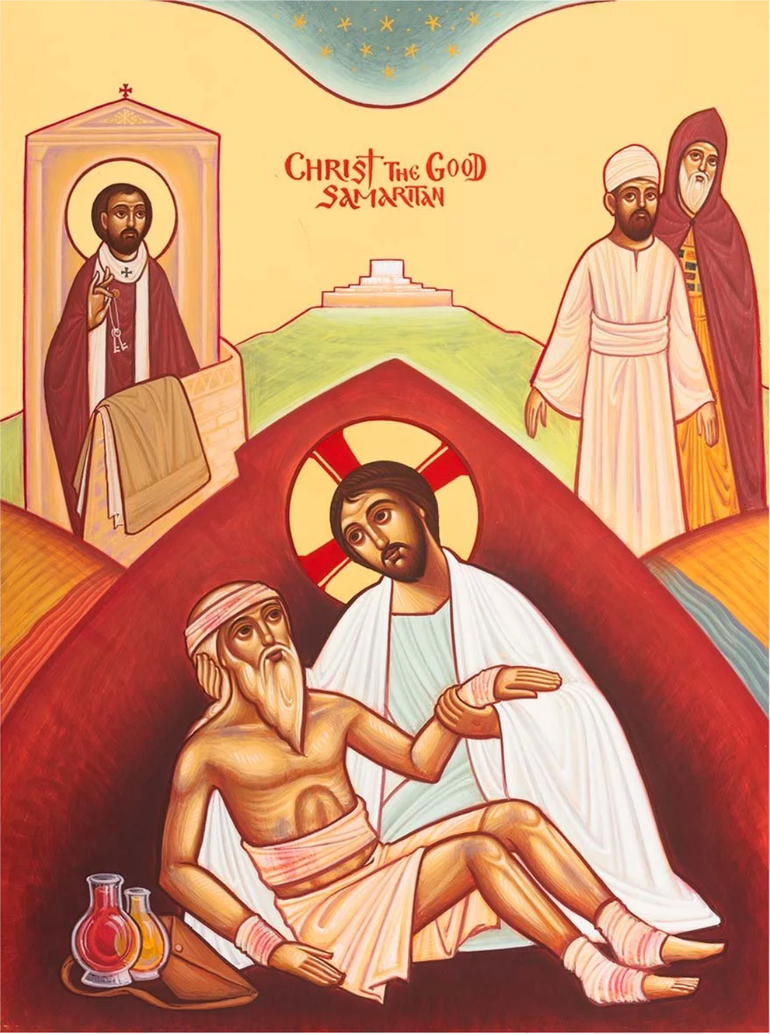
Our Lord told the story most clearly in the parable of the Good Samaritan. A priest passed by on the other side. A Levite passed by on the other side. And then:
“But a certain Samaritan, as he journeyed, came where he was. And when he saw him, he had compassion. So he went to him and bandaged his wounds, pouring on oil and wine; and he set him on his own animal, brought him to an inn, and took care of him.” (Luke 10:33–34, NKJV)
No one gave the Samaritan an assignment. No one stopped him on the Jericho road and said, You are in charge of this man. He saw. He had compassion. He went. The whole parable is an argument that neighborliness is not determined by the roster but by the sight. The Fathers heard the parable and saw in the Samaritan the face of Christ Himself, who found humanity bleeding on the road of this world and stopped and bound up our wounds; and they urged every Christian to read the parable as a calling. St. Cyril of Alexandria put it this way:
“The Samaritan did what neither priest nor Levite did, and showed thereby that the law of love is higher than the letter of office. Whoever has eyes to see a wounded brother has already been made his neighbor.” – St. Cyril of Alexandria, Commentary on the Gospel of Luke, Homily 68
Scripture doubles the lesson for us by giving us Nehemiah, a lay servant with no priestly title, no prophetic office, no political rank above cupbearer in a foreign court. When a brother arrives from Judah and reports that the walls of Jerusalem are broken and the gates are burned, Nehemiah’s first response is this:
“So it was, when I heard these words, that I sat down and wept, and mourned for many days; I was fasting and praying before the God of heaven.” (Nehemiah 1:4, NKJV)
No one had asked Nehemiah to take this on. The king had not sent him. The priests had not summoned him. But a servant whose heart is open to God takes responsibility for what breaks God’s heart. The rebuilding of the walls of Jerusalem begins not with a royal decree but with a layman weeping in Susa. And this is the pattern the servant is called to carry into the parish: when we see something in our ministry that has gone soft — a class that has lost its heart, a family that has dropped away, a visitation that has been neglected — the servant does not shrug and say, “That is the coordinator’s problem.” The servant prays, and weeps, and then acts, within the structures the Church has set, to see it mended. Responsibility does not wait to be asked; it goes looking.
It Takes Ownership
Alongside initiative stands an ugly cousin of it: the temptation, when things have gone wrong, to blame anyone other than ourselves. Responsibility closes that door. It owns what belongs to it, apologizes where apology is due, repents where repentance is due, and gets on with the work.
No parable shows this more tenderly than the one the Church calls the Prodigal. A young son takes his inheritance, spends it, hits the bottom of a foreign field feeding pigs, and finally — in the famous verse — comes to himself:
“But when he came to himself, he said, ‘How many of my father’s hired servants have bread enough and to spare, and I perish with hunger! I will arise and go to my father, and will say to him, “Father, I have sinned against heaven and before you, and I am no longer worthy to be called your son. Make me like one of your hired servants.”’” (Luke 15:17–19, NKJV)
Notice what the son does not say. He does not say, the friends I fell in with ruined me. He does not say, the famine in this country made me desperate. He does not say, my father should have warned me. He says, I have sinned. I am no longer worthy. I will arise. That is the whole of responsibility compressed into three verbs: I have; I am; I will. The servant who can say those three sentences with honesty about his own life is almost already home.
St. Augustine, preaching on this parable again and again, refused to let his hearers miss the miracle buried in the middle of it:
“He came to himself. In his distant country he had been outside himself; in his repentance he came home to himself before he came home to his father.” – St. Augustine of Hippo, Sermon 112A (on Luke 15)
The lesson for the servant is piercing. We will make mistakes in the service. We will misjudge a child, we will prepare badly one week, we will speak too sharply in a meeting, we will drop the ball on a visit we promised to make. The question is not whether this will happen; the question is what we do when it does. The servant without ownership will find a reason. The servant with ownership will come to himself, and arise, and go back to the Father, and also — this matters — to the brother who was wronged, and will begin again. St. James promises us that when this movement is honest, the Lord meets it: “Confess your trespasses to one another, and pray for one another, that you may be healed. The effective, fervent prayer of a righteous man avails much” (James 5:16, NKJV).
It Reaches Beyond the Task
Responsibility in service has a way of quietly expanding if the servant lets it. A lesson to prepare becomes a life to know. A class to teach becomes a family to pray for. A task becomes a person. Our Lord Himself is the supreme teacher of this expansion, and one scene in particular shows it to us.
The crowds had followed Him into a wilderness place. The hour grew late. The disciples — reasonably, one might say — suggested He send them away so they could go and buy food in the villages. But our Lord looked at the crowd and saw more than a congregation:
“And Jesus, when He came out, saw a great multitude and was moved with compassion for them, because they were like sheep not having a shepherd. So He began to teach them many things… Then He said to them, “You give them something to eat.”” (Mark 6:34, 37, NKJV)
Notice the movement. He taught them, because they were hungry for the Word. But He also fed them, because they were hungry for bread. And on other days He healed them, because they were sick, and forgave them, because they were burdened with guilt, and touched them, because they were lonely. The Master of every servant did not limit His responsibility to a single dimension of the people He had come to save. He took the whole person seriously. St. Gregory the Great, writing for every future pastor, made this the heart of the matter:
“He who has undertaken the care of souls must not think that by one kind of care he can discharge his whole office. The shepherd owes bread to the hungry, correction to the erring, encouragement to the faint-hearted, and a listening ear to the grieving — and to know which is owed to whom is itself a great part of the work.” – St. Gregory the Great, The Pastoral Rule, Book III, Prologue (paraphrased)
For us this means that our service is not discharged the moment the Sunday class ends. It is discharged slowly, across visits and phone calls and remembered birthdays and quiet follow-ups when a child is suddenly absent. Twenty years from now, the children we teach today will not remember the outline of most of our lessons. They will remember whether we knew their names. They will remember whether we called when a grandparent died. They will remember whether we noticed, on a bad Wednesday, that something was wrong and sat down with them for ten minutes. The content of the lesson is important. The relationship carries the lesson. Let us not serve one without serving the other.
This also means that when we encounter things we cannot fix — a home in crisis, a marriage in trouble, a child in danger — responsibility does not require us to do what is not ours to do. It requires us to pray, and to bring the concern faithfully to Abouna or to the proper coordinator, so that the shepherds of the flock can do what the Lord has appointed them to do. Responsibility is not the arrogance of thinking everything is ours to solve; responsibility is the humility of refusing to pretend that anything the Lord has put in front of us is someone else’s problem.
It Does Not Bow to Feelings or Circumstances
Finally, responsibility outlasts moods. If our service were governed by how we happened to feel on Saturday night, none of us would teach very long. A parent does not wake up on Tuesday and decide not to be a parent that day because the mood is not right. A priest does not cancel the liturgy because he is tired. In the same way, a servant who has accepted the call to feed the Lord’s lambs does not arrive or not arrive based on the weather of his heart. The work is too important, and the Lord to whom it is rendered is too faithful, for that kind of flickering.
St. Paul gave his young disciple St. Timothy the clearest possible charge on this:
“Preach the word! Be ready in season and out of season. Convince, rebuke, exhort, with all longsuffering and teaching.” (2 Timothy 4:2, NKJV)
In season, when everything is going well. Out of season, when the class is small and the preparation felt dry and the week has been hard. Longsuffering — a word that means, literally, long-tempered, slow to give up on people or on the work itself. The Lord did not promise us that the service would always feel rewarding; He promised us that the service would always matter.
And lest we treat this lightly, He Himself drew the line between the two kinds of servants, in a parable we should never forget:
“His lord said to him, ‘Well done, good and faithful servant; you were faithful over a few things, I will make you ruler over many things. Enter into the joy of your lord.’” (Matthew 25:21, NKJV)
The adjective is not successful. It is not talented. It is not popular. It is faithful. Faithfulness is what responsibility looks like when it has lasted. And the reward the Lord has in mind is not a badge or a thank-you; it is entry into His own joy. The servant who has learned to show up in season and out of season, who has taken ownership of mistakes, who has not waited for invitations, who has reached past the task to the person, who is daily renewing the choice Adam’s first word made and David’s later life unmade — that servant is being trained, over decades of small faithful acts, to hear those words. May the Lord who called us keep us faithful to the end, and may we find, when we arrive, that the children we served so imperfectly have arrived with us, and that the joy of the Lord is large enough for us all.