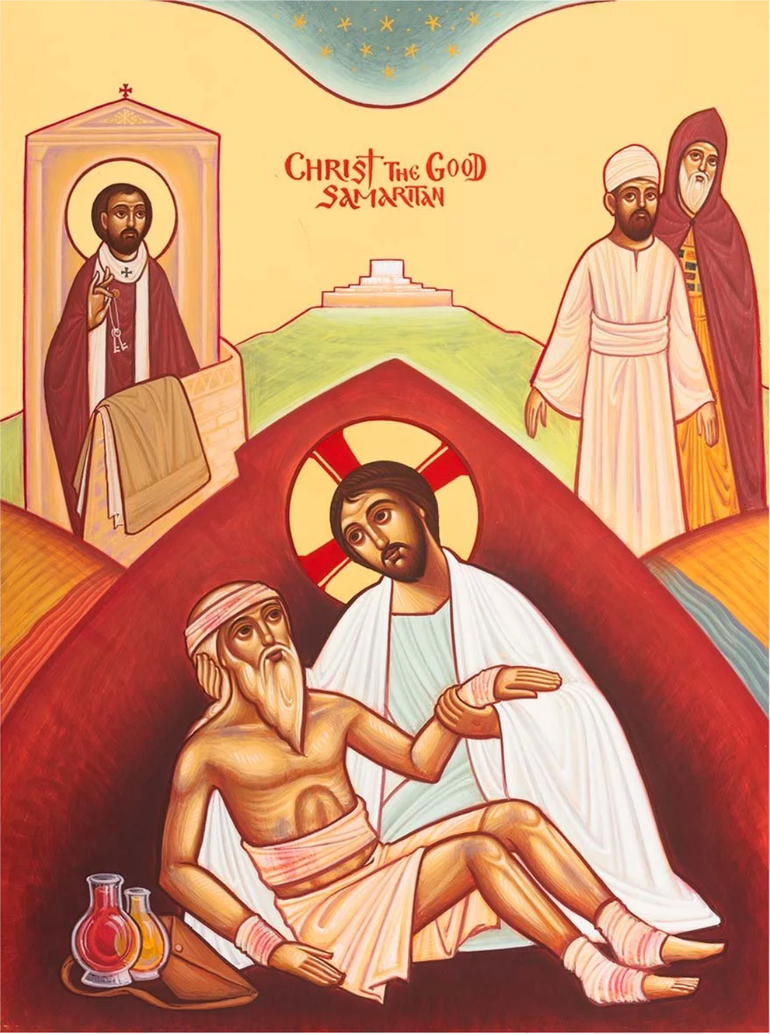
Everything we have learned so far about the servant — the Good Shepherd pattern, the expectations of Scripture and wisdom and integrity — rests upon one foundation, and without that foundation every other stone we lay will slide. St. Paul called that foundation love, and he devoted the thirteenth chapter of his first letter to the Corinthians to describing it in words the Church has never gotten over. In this lesson we will walk through that chapter with him, and we will let him ask us the question he asked them: not “What gifts do we have?” but “Have we love?” For if we serve without love, St. Paul says we are nothing — even with tongues of angels in our mouths and all the faith that can move mountains in our hearts. And if we serve with love, even the smallest ministry is a participation in what the Father, the Son, and the Holy Spirit have been doing from before the foundation of the world.
The Question the Service Puts to Us
Before we open 1 Corinthians 13, we should notice the question the New Testament keeps pressing on anyone who would serve. It is not, “Are we qualified?” and it is not, “Are we talented?” It is, “Can we love someone who is not our flesh and blood?” St. John, in his first epistle, refuses to let a disciple of Christ escape that question:
“For this is the message that you heard from the beginning, that we should love one another… He who does not love his brother abides in death.” (1 John 3:11, 14, NKJV)
The language is stark. Not hindered, not weakened, not diminished — abides in death. For St. John there is no middle country between love and death, because love is the life of God and those who refuse it refuse Him. And when St. John fills out what this love actually looks like, he does not reach for emotions. He reaches for the cross:
“By this we know love, because He laid down His life for us. And we also ought to lay down our lives for the brethren. But whoever has this world’s goods, and sees his brother in need, and shuts up his heart from him, how does the love of God abide in him? My little children, let us not love in word or in tongue, but in deed and in truth.” (1 John 3:16–18, NKJV)
The Greek word behind “love” in these verses is the word the whole New Testament reserves for the highest love there is: agapé. It is not romantic feeling, not friendly affection, not natural kinship. It is the love that the Father has for the Son and the Son for the Father, the love the Trinity has poured out upon a world that did not deserve it. The Fathers summarize its character in four marks: it is unconditional, it is sacrificial, it is willful, and it is limitless. That is the love to which every servant is called.
And when our Lord redefines who counts as a “brother” for whom this love is owed, He does not draw the circle narrowly:
“For whoever does the will of My Father in heaven is My brother and sister and mother.” (Matthew 12:50, NKJV)
The servant, then, is not merely asked to love the family members easy to love. The servant is asked to love every child of God the Lord entrusts to the service, and to do it in deed and in truth — not in warm feelings unaccompanied by action, but in action that may cost us something.
Ruth and the Shape of Love-in-Deed
Because love in deed is so easy to describe and so hard to recognize, the Lord has given us a short book at the hinge of the Old Testament almost entirely to show us what it looks like. Naomi has lost her husband and both her sons. She is old, she is a widow, she is emptied out. She sets her face back toward Bethlehem and tells her two daughters-in-law to return to their mothers’ houses. Orpah, after some tears, does exactly that; it is the rational choice. But Ruth — a Moabite, a foreigner, a woman with every reason to go home to her own people — says this:
“Entreat me not to leave you, or to turn back from following after you; for wherever you go, I will go; and wherever you lodge, I will lodge; your people shall be my people, and your God, my God. Where you die, I will die, and there will I be buried. The Lord do so to me, and more also, if anything but death parts you and me.” (Ruth 1:16–17, NKJV)
Notice that Ruth does not call this love. She does not have to. She lives it. She binds her future to Naomi’s; she leaves her country; she adopts Naomi’s God as her own. And the Lord honors her loyalty so fully that He threads her into the genealogy of His own Son: a Moabite widow becomes the great-grandmother of David, and through David, of Christ. Love in deed has this way of working forward through generations the lover cannot see.
The lesson for the servant is plain. We cannot love from a safe distance, and we cannot love abstractly. St. Augustine captured the principle in a single line that the Church has been quoting for sixteen centuries:
“Love cannot be idle; it is the most restless of all things.” – St. Augustine of Hippo, Homilies on the First Epistle of John, Homily 7
If the service has gone cold, if the preparation has become mechanical, if the children’s faces have blurred into an undifferentiated crowd, the diagnosis is almost always the same: love has gone to sleep. Love cannot be idle. Wake it, and the whole ministry wakes with it.
Gifts Without Love: What 1 Corinthians 13 Strips Away
Now we are ready for 1 Corinthians 13, and for the shock St. Paul wants to deliver to the Corinthian church — and to us. The Corinthians were richly gifted. They had tongues, they had prophecy, they had knowledge, they had faith. They were, by almost any measure we now use to evaluate a ministry, a successful church. And in the middle of his first letter to them, St. Paul stops the music and says this:
“Though I speak with the tongues of men and of angels, but have not love, I have become sounding brass or a clanging cymbal. And though I have the gift of prophecy, and understand all mysteries and all knowledge, and though I have all faith, so that I could remove mountains, but have not love, I am nothing. And though I bestow all my goods to feed the poor, and though I give my body to be burned, but have not love, it profits me nothing.” (1 Corinthians 13:1–3, NKJV)
Let us not soften what he has said. Three times in three verses the same structure falls: a magnificent gift — and nothing. Eloquence without love is noise. Knowledge without love is zero. Even the martyr’s fire, without love, profits the martyr nothing. Gifts by themselves do not sanctify. Gifts by themselves do not save. St. Paul even warns, in his second letter to the same church, that gifts can be distributed on the other side of the battle line altogether: “even Satan transforms himself into an angel of light. Therefore it is no great thing if his ministers also transform themselves into ministers of righteousness” (2 Corinthians 11:14–15, NKJV). The presence of a gift is no proof that the Giver is present. Only love bears that witness.
St. John Chrysostom, preaching on this very chapter, will not let his congregation escape the implication:
“Though one work ten thousand miracles, if he have not love, he shall profit nothing. For neither is there any gift so great as love; nor any, again, which abideth when love is not.” – St. John Chrysostom, Homilies on First Corinthians, Homily 32
This is the hinge on which the whole lesson turns. The work the Lord is doing in the servant is not, first of all, the multiplication of gifts. It is the formation of a loving heart. Gifts without that heart are a chandelier with no current running through it — all glass and brass, no light.
The First Love: Loving God Before We Serve
If love is the one indispensable thing, where is it to be found? Not in ourselves, first. We do not generate agapé out of our own natural kindness, because our natural kindness has limits and agapé does not. Love begins in God, and it reaches us because He reached us first:
“For God so loved the world that He gave His only begotten Son, that whoever believes in Him should not perish but have everlasting life.” (John 3:16, NKJV)
That sentence is not decoration. It is the source code of Christian service. The Father loved; the Father gave; the Son came. Our ministry is a downstream current of that original giving. This is why the Lord, when He restored St. Peter to the service after the three denials, did not begin by asking, “Have you prepared?” or “Are you ready?” He began with a single question, asked three times beside the Sea of Tiberias:
“So when they had eaten breakfast, Jesus said to Simon Peter, “Simon, son of Jonah, do you love Me more than these?” He said to Him, “Yes, Lord; You know that I love You.” He said to him, “Feed My lambs.” He said to him again a second time, “Simon, son of Jonah, do you love Me?” He said to Him, “Yes, Lord; You know that I love You.” He said to him, “Tend My sheep.” He said to him the third time, “Simon, son of Jonah, do you love Me?” Peter was grieved because He said to him the third time, “Do you love Me?” And he said to Him, “Lord, You know all things; You know that I love You.” Jesus said to him, “Feed My sheep.”” (John 21:15–17, NKJV)
The Fathers have long drawn attention to a detail hidden in the Greek. The first two times the Lord asks, He uses the verb agapáo — do you love Me with sacrificial, limitless love? Peter, still chastened by his denials, cannot claim so much; he answers with the gentler verb philéo — Lord, You know I have affection for You. The third time, the Lord descends to Peter’s own word: do you at least have affection for Me? And Peter is grieved, because the Master has reached the floor of his capacity. Yet the Lord does not wait until Peter’s love has grown to agapé before He entrusts him with the sheep. Three times over, the answer is the same: Feed My lambs. Tend My sheep. Feed My sheep. The Lord accepts the love the servant can give, and He uses the service itself to grow the servant into the higher love He has prepared for him.
There is great comfort in that scene. The Lord does not demand perfect love before He gives us perfect work. He calls us at whatever register our hearts can presently sustain, and He teaches us, through the actual labor of feeding His lambs, to love Him and them with a fuller love. The precondition of service is not that we love God perfectly. The precondition is that we turn our face toward Him and begin.
Love as a Choice, Love as a Road
Because love does not begin at its full height, the servant has to understand it as both a choice and a road. It is a choice because it begins with an act of the will; it is a road because that act has to be renewed every day, and because along the way love is shaped by the Holy Spirit into something the servant could not have produced on the first day.
Our Lord made love a commandment at the Last Supper, which tells us immediately that love is something we can choose to obey:
“A new commandment I give to you, that you love one another; as I have loved you, that you also love one another. By this all will know that you are My disciples, if you have love for one another.” (John 13:34–35, NKJV)
A commandment is not addressed to feelings. Feelings cannot be commanded; they can only be noticed. A commandment is addressed to the will. Our Lord is telling His disciples that love, for them, is a decision to be made and re-made — a decision to wash one another’s feet when they would rather argue about greatness, a decision to forgive when the tongue is sharp, a decision to stay at the side of a tired person when every other instinct is pulling toward the door.
And what does that decision, made day by day, actually look like? St. Paul draws the portrait — perhaps the most famous portrait in the whole Bible:
“Love suffers long and is kind; love does not envy; love does not parade itself, is not puffed up; does not behave rudely, does not seek its own, is not provoked, thinks no evil; does not rejoice in iniquity, but rejoices in the truth; bears all things, believes all things, hopes all things, endures all things.” (1 Corinthians 13:4–7, NKJV)
Every line of that paragraph is a picture of Christ, and every line is also an examen for the servant. Suffering long: do we still have patience for the child who disrupts every class? Kind: are we gentle at the end of a long day or only at the beginning? Not envious: can we rejoice when a younger servant teaches better than we do? Not parading itself, not puffed up: is our service quiet enough for God to see? Not seeking its own: whose kingdom are we actually building? Bears all things, believes all things, hopes all things, endures all things: have we given up on anyone the Lord has not yet given up on?
This is why the Fathers call love a road and not a single moment. It is not reached all at once. St. John Cassian, gathering the wisdom of the desert in his Conferences, fixes the servant’s eye on this gradual ascent:
“Whatever can help to guide us to this scope, namely, purity of heart, we must follow with all our might; but whatever hinders us from it, we must shun as a dangerous and hurtful thing. For it is for this that we do and endure all things.” – St. John Cassian, Conferences I (Abba Moses), ch. 5
Purity of heart is the name Cassian gives to the ground in which love finally grows, and he insists that the whole of the Christian life — reading, fasting, prayer, silence, service — exists to clear that ground of weeds. Love is not a feeling we either have or do not have; love is the high country the servant climbs toward, one chosen step at a time, while the Holy Spirit cuts the path and makes the slope bearable.
The One Thing That Does Not Pass Away
St. Paul ends the thirteenth chapter with a verdict that the servant should carry into every lesson prepared and every visit paid:
“Love never fails. But whether there are prophecies, they will fail; whether there are tongues, they will cease; whether there is knowledge, it will vanish away… And now abide faith, hope, love, these three; but the greatest of these is love.” (1 Corinthians 13:8, 13, NKJV)
The Corinthians treasured the spectacular gifts — tongues and prophecy and healing. St. Paul tells them, without contempt, that those gifts have an expiration date. They belong to this age, the age of the partial and the fragmentary, the age in which we know in part and prophesy in part. When the Lord comes and all things are made new, most of what we now take pride in will simply no longer be needed. There will be no more tongues because there will be no more language barrier between the saints. There will be no more prophecy because all things will be open and seen. There will be no more teaching as we now know it, because “they shall all be taught by God” (John 6:45, NKJV).
But love — love does not expire, because love is what God is. St. John, the apostle of love, says so plainly: “God is love, and he who abides in love abides in God, and God in him” (1 John 4:16, NKJV). Love is not one of God’s many activities; love is His life, the eternal self-giving of the Father to the Son, of the Son to the Father, of both in the Holy Spirit. Everything we do that is done in love is therefore a participation, however small, in the inner life of the Trinity. That is why love alone crosses the bridge into eternity. The rest of what we carry will be left at the riverbank.
Let this be the lens through which we measure our service. Not: how many children came this year? Not: how many lessons did we teach? Not: how many compliments did we collect? But: did the children encounter the love of Christ through us? Did the lesson carry love in every line? Did our life bear witness, in deed and in truth, that we abide in the Love that laid down its life for us?
If the answer is yes — however haltingly, however imperfectly — then the service has done what the Lord asked it to do. And the love we have tried, with trembling, to give, will outlast us and outlast the children we served and outlast even the building in which we served them. It will enter the Kingdom with us, because it is the one thing in us that already belongs there. May the Lord, who is love, fill us with Himself, so that the service we have been given may be full of Him — and may we, with Ruth and Peter and Paul and all the servants who have gone before us, abide in that love forever.