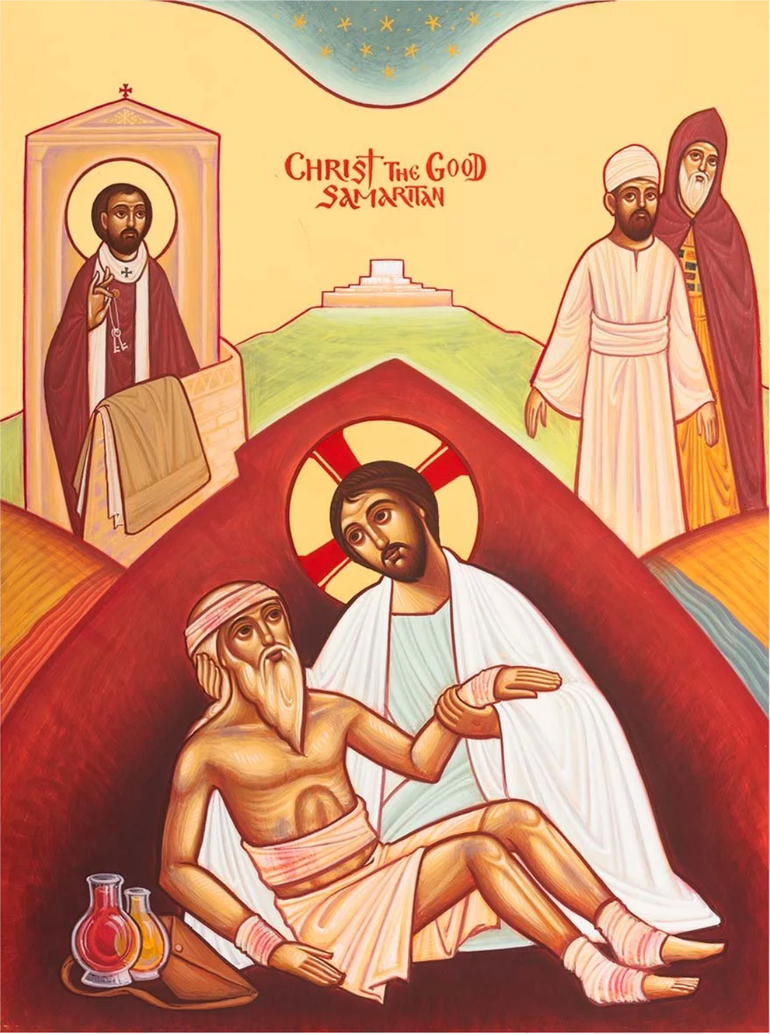
This final lesson of Unit 3 gathers up the whole curriculum into a single, central truth: that the Christian life, and therefore the servant's life, is not our own striving decorated with religion but the very life of the incarnate Son of God made our own by grace. Christology — who our Lord Jesus Christ is — is not an abstract subject for scholars. It is the ground on which every servant stands. Because He became what we are, we may become, by grace, what He is. Because He joined our flesh to His Godhead, the means of grace that He has placed in the Church are not symbolic gestures but the very channels of His life into ours. In this lesson we look at what it means to cooperate, day by day, with the grace that flows from our incarnate Lord — how to open our lives to it, how to receive it through the channels He has given us, and how to let it bear fruit in our service.
Why Christology Is for the Servant
There is a temptation, in the daily rush of service, to think of theology as a separate room — a place scholars visit — and of our own work as being out here, among real people, with real problems. The early Church did not think this way, and the Fathers will not let us think this way either. Every great pastoral teacher of the Church has been, first, a theologian of the Person of Christ, because every pastoral act — a sermon, an absolution, a Eucharist, a visit to the sick — draws its power from who He is.
“He became what we are, that He might make us what He Himself is.” St. Irenaeus of Lyons, Against Heresies V, Preface
That single sentence is perhaps the most condensed statement of Christology for us that the early Church ever made. The Son of God did not come merely to teach us, correct us, or inspire us. He came to take on our nature — genuinely, without shortcut, body and soul and history and death — so that our nature, united to Him, might be drawn into the life He has eternally with the Father. The technical name for this is theosis, participation in the divine life. It is what the Church has always believed the gospel to be about. It is also the reason the servant's work has any weight at all. When we teach, we are not imparting information to minds; we are, in some real way, bringing the incarnate Lord closer to a brother so that his nature too may be drawn into the life of the Trinity.
“He was made man that we might be made God; He revealed Himself through a body that we might receive the idea of the unseen Father; He endured the insolence of men that we might inherit immortality.” St. Athanasius, On the Incarnation §54
Notice the register of Athanasius's 'that we might.' The incarnation is not an end in itself; it is for us. Everything Christ is, He is on our behalf. This is why every servant must know, in his bones, that the Person he is serving from is not only at the right hand of the Father but also joined to him by grace. We are not acting for an absent God. We are being acted through by a present Lord who has taken our very flesh and refused to put it off again.
Grace Is Not a Thing; It Is His Life in Us
The word 'grace' is used so often in our churches that it can lose its edge. We say it before meals, we sing it in hymns, we recite it in the Lord's letters. It is important, therefore, to recover its real meaning. Grace, in the Scriptures and the Fathers, is not chiefly a substance dispensed by God; it is the very life of God reaching us. It is not a thing He gives; it is His giving of Himself.
“Of His fullness we have all received, and grace for grace. For the law was given through Moses, but grace and truth came through Jesus Christ.” John 1:16–17, NKJV
'Grace and truth came through Jesus Christ.' Grace is not general; it has a personal shape. It comes through Him, because it is Him — His life, His holiness, His Spirit, poured out into the creatures He has taken on Himself. When the Church later speaks of 'divine grace,' she means the very uncreated energies of God, reaching us through the humanity He has assumed.
“The grace of God is not a created thing, nor is it one of His gifts like the other gifts He bestows on creatures. It is God Himself, communicating Himself to the soul that receives Him, as light is communicated from the sun without the sun being lessened thereby.” St. Gregory Palamas, Triads III.1.34 (paraphrased)
For the servant, this matters in the most practical way. When we sit beside a suffering child and pray, we are not rubbing a religious word over a wound and hoping for the best. We are asking the incarnate Lord — who has taken children into His arms, who has wept beside graves, who has Himself suffered — to communicate Himself to that child. Grace is the Lord coming close. The channels of grace that we will examine next are the places He has promised to be close in a particular, knowable way.
The Means of Grace — Where the Lord Has Promised to Meet Us
The Church has always spoken of 'means of grace' — the places where, by His promise, the Lord meets us with His life. These are not the only places He meets us; He is free, and He visits His servants often in ways that surprise us. But the means of grace are the places He has said He will be, and so they are the places the servant returns to, day after day, as reliably as a sick man returns to the medicine that has kept him alive.
The first means of grace is the Word of God. The Lord speaks, and the soul is fed. When we open the Gospels in the morning, we are not performing a ritual; we are being addressed by the same voice that said 'Come and see' by the Jordan. A servant who does not eat the Word daily will find his own words quickly becoming thin in his mouth. The Word is food.
“It is written, 'Man shall not live by bread alone, but by every word that proceeds from the mouth of God.'” Matthew 4:4, NKJV
The second and crowning means of grace is the Holy Eucharist. Here, the Lord does not only speak to us; He gives us Himself. The bread that we break is truly a partaking of the Body of Christ; the cup of blessing is truly the blood of the New Covenant. St. Cyril of Alexandria speaks of the Eucharist with a bluntness the modern world has forgotten how to say:
“When therefore we eat the holy flesh of Christ, the Saviour of us all, and drink His precious Blood, we have life in us, being made, as it were, one with Him, and dwelling in Him, and having Him dwelling in us.” St. Cyril of Alexandria, Commentary on the Gospel of John X (on John 6:53)
The third means of grace is prayer — both the formal prayer of the Church and the continual turning of the heart to God that the Fathers call the 'prayer of the heart.' In prayer, grace is not earned; it is received. The servant who prays little receives little, not because the Lord is stingy but because his soul has not opened the channel.
The fourth means of grace is the sacramental life of the Church taken as a whole — baptism, chrismation, confession, unction, matrimony, ordination. Each is a place where the incarnate Lord has promised to be in a particular way. Confession especially, as the previous unit has stressed, is the servant's recurring bath: the place where the grace of baptism is renewed and the conscience is restored.
The fifth means of grace, less often named but indispensable, is the communion of the saints. By the prayers of those who have gone before us — above all by the prayers of the Theotokos — grace reaches us along ancient channels. No servant is alone. No servant's labor is unsupported. We are held up by a cloud of witnesses who love the work the Lord is doing in us and pray for it as though it were their own.
Synergy — The Cooperation of Grace and Freedom
The Orthodox understanding of the Christian life has always been one of synergy — a 'working together' of divine grace and human freedom. The two do not compete. The grace of the Lord does not overwhelm our will; it awakens and heals it. Our cooperation does not earn His grace; it opens us to receive what He is already, of His own love, pouring out.
“For we are God's fellow workers.” 1 Corinthians 3:9, NKJV
That phrase, 'fellow workers,' is startling. The God who made the heavens has chosen to do His work in the world together with His creatures. The Lord who could speak new stars into being allows Himself to speak new disciples into being by means of a catechist's patient sentence. This is not a lowering of His glory; it is the very shape of His glory — a love that makes room for the beloved to participate.
For the servant, synergy has a concrete application. It means that we neither collapse into fatalism ('whatever God wills will happen with or without me') nor into activism ('it all depends on me and my effort'). We labor fully, and we trust fully. We work as though everything depended on our fidelity. We pray as though everything depended on Him. And we discover, over time, that both sentences are true at once, because we are dealing with a Lord who has made us His fellow workers.
“God's grace goeth before, and man's will followeth; grace reneweth the will, and the renewed will worketh together with grace. Thus is our salvation accomplished — not by us without Him, lest we grow proud; and not by Him without us, lest we despair of our dignity as persons made for fellowship with Him.” St. Augustine, On Grace and Free Will XV.33 (paraphrased)
A servant who has understood synergy will be a quietly confident servant. He will not take credit for the Lord's work, but he will not hide from the labor either. He will plant, and water, and leave the giving of the growth to the One whose field it actually is.
Obstacles to Grace
Grace is freely given, but it can be blocked. The Lord does not force Himself on any soul. This is important for the servant to understand, both in his own life and in the lives of those he serves. When grace seems not to be flowing, the question is almost never whether the Lord is giving; it is almost always whether we are receiving.
A first obstacle is unrepented sin. Grace cannot fill a vessel whose mouth we have turned to the floor. Confession — honest, specific, regular — is not an act of self-flagellation; it is simply the turning of the vessel upright again.
A second obstacle is distraction. The Lord comes softly. The soul that is perpetually loud with phones and screens and chatter may not be in a condition to hear Him. Silence is not an optional refinement of the spiritual life; it is the condition under which grace makes itself most audible. Every servant needs a daily quarter-hour in which the world is quieted enough for the Lord to speak.
A third obstacle is self-reliance. 'I can handle this' is the most polite way we push the Lord's hand away. The servant who sets out each morning with his own plan, his own wisdom, his own strength, may accomplish much in his own eyes and very little in the eyes of heaven. Humility is not only a private virtue; it is the doorway of grace.
“But He gives more grace. Therefore He says: 'God resists the proud, but gives grace to the humble.'” James 4:6, NKJV
A fourth obstacle is bitterness against a brother. Our Lord Himself has spoken to this with unusual severity: if we come to the altar and remember that a brother has something against us, we are to leave our gift, go, be reconciled, and then come (Matthew 5:23–24). Bitterness is a clogged pipe. No amount of prayer will open it except the prayer that includes a willingness to forgive.
Living the Fruit — Christ Formed in Us
The test of whether grace is actually flowing in a servant's life is not the intensity of his emotions in prayer or the eloquence of his speech. The test St. Paul gives us is more modest and more honest. It is whether Christ is being formed in us.
“My little children, for whom I labor in birth again until Christ is formed in you.” Galatians 4:19, NKJV
That is the shape of fruitfulness. Over the long years of a servant's life, the Lord who was born in Bethlehem and lived in Nazareth is slowly formed inside the servant. His patience becomes ours. His kindness becomes ours. His willingness to be interrupted becomes ours. His tears for Jerusalem become ours. This forming is so gradual that we hardly notice it in ourselves; others, however, begin to notice it, and they come to us because they sense Him in us, even when we do not sense Him there.
The fruit, when it appears, has the unmistakable shape the Apostle sketched for the Galatians.
“But the fruit of the Spirit is love, joy, peace, longsuffering, kindness, goodness, faithfulness, gentleness, self-control.” Galatians 5:22–23, NKJV
This is how Christology becomes concrete in our lives. The same Lord who was incarnate in Galilee is now, by grace, being incarnate, in a more modest way, in every servant's small daily yes. We are becoming the means by which His gentleness touches a restless classroom, His longsuffering endures a difficult parish meeting, His kindness reaches a weary old mother in the back pew. This is what the end of the curriculum has been aiming at all along.
May the Lord who took flesh for us never withdraw from us the life He has joined to ours. May He keep us close to the means He has given: His Word, His Table, His prayer, His sacraments, the company of His saints. May He make us faithful in the small daily act of cooperation with His grace, and may He one day find us, at the end of our race, not only serving Him, but bearing within us His own face, traced in us by the slow and patient work of His own Spirit. To Him be the glory, with the Father and the Holy Spirit, one God, now and ever and unto the ages of ages. Amen.