- 1 Leadership
What is Leadership?
Leadership has gathered several meanings to different individuals. Many successful leaders have evoked their understanding of good leadership. Peter Drucker, a management consultant whose writings shaped modern business corporations, stated that, “The only definition of a leader is someone who has followers.” Yet, limiting the definition to being relative to followers seems incomplete. When a new army captain is put in the command of 200 soldiers, he never leaves his room, or utters a word to the men and women in his unit. Perhaps routine orders are given through a subordinate. By default his troops have to “follow” orders. Is the Captain really a leader? Commander yes, leader no.
Similarly, Warren Bennis, a scholar, author and consultant in organizational structures believes that "Leadership is the capacity to translate vision into reality.” Yet, if every spring you have a vision for a garden, and with lots of work carrots and tomatoes that becomes a reality. Are you a leader? No, you’re a gardener. Another leader, Bill Gates, Microsoft innovator, defines leadership saying, “As we look ahead into the next century, leaders will be those who empower others.” This definition includes “others” and empowerment is a good thing. But to what end? We can see many empower “others” in life, from rioting hooligans to Google workers who were so misaligned with the rest of the company finding themselves unemployed. Gates’ definition lacks the parts about goal or vision.
John Maxwell, an American pastor & author primarily focusing on leadership, states that “Leadership is influence - nothing more, nothing less.” However, restricting leadership to only influence lacks context. A robber with a gun has “influence” over his victim. A manager has the power to fire team members which provides a lot of influence. But does this influence make a robber or a manager a leader? Maxwell’s definition omits the source of influence.
Defining Leadership
Each of the previous innovators and leaders bring about very valid points about leadership. Yet, each one seems incomplete. Nevertheless, if one were to attempt to consolidate each interpretation, a full definition can be formed. Ducker speaks about followers, Bennis focuses on vision, Gates emphasizes empowerment and Maxwell, influence. What is leadership all about then? Leadership is composed of vision, influence, empowerment and followers. Leadership can then be defined as a process of social influence (influence), which maximizes (empowerment) the efforts of others (followers), towards the achievement of a goal (vision). Again, leadership can then be defined as a process of social influence, which maximizes the efforts of others, towards the achievement of a goal.
Who Are Leaders?
Think of someone who you would consider a great leader. What makes him a leader in your eyes? Is it his position? His hierarchical responsibility? His personal achievements? When looking at the definition constructed, none of it involves hierarchy or traditional pyramid structure hierarchy. In fact, more often than not, the leaders that solely rely on their positions are rarely considered as a personally influential leader. Rather, it is rooted in the relationship between two individuals.
In today's interconnected world, where our actions and words can have far-reaching consequences, it is essential to recognize that everyone possesses the potential to influence others. This influence may not always be overt or intentional, but it is nonetheless present. Whether we realize it or not, we are all leaders of some sort, guiding and inspiring those around us.
However, leadership is not limited to positions of authority or formal titles. It is also embodied in the countless servants who take on responsibilities and are held in high esteem. These servants may be teachers, mentors, parents, community leaders, or anyone who selflessly dedicates their time and energy to making a positive difference in the lives of others.
Every individual is unique, and being a servant allows us to showcase our uniqueness in a profound way. Our passions, talents, and perspectives are all valuable contributions to the world, and when we share them through service, they are bound to be noticed by someone. This recognition, in turn, creates an opportunity for influence.
When we influence others, we have the power to empower them. We can inspire them to reach their full potential, to make a positive impact on their own lives and the lives of those around them. This is the true power of influence: the ability to ignite change and transformation.
Therefore, let us all embrace our role as servants and leaders. Let us use our influence to create a better world, one person at a time. By empowering others, we empower ourselves and build a stronger, more resilient community for all.
Servant Leadership
There are two primary leadership styles that have been identified and studied: traditional leadership and servant leadership. Each style has its own distinct characteristics, strengths, and weaknesses.
Traditional leadership, also known as authoritarian or directive leadership, is characterized by a clear hierarchy and a top-down approach. In this style, the leader has the most power and makes all the decisions. Traditional leaders tend to be more directive and controlling, and they may expect their followers to obey their orders without question.
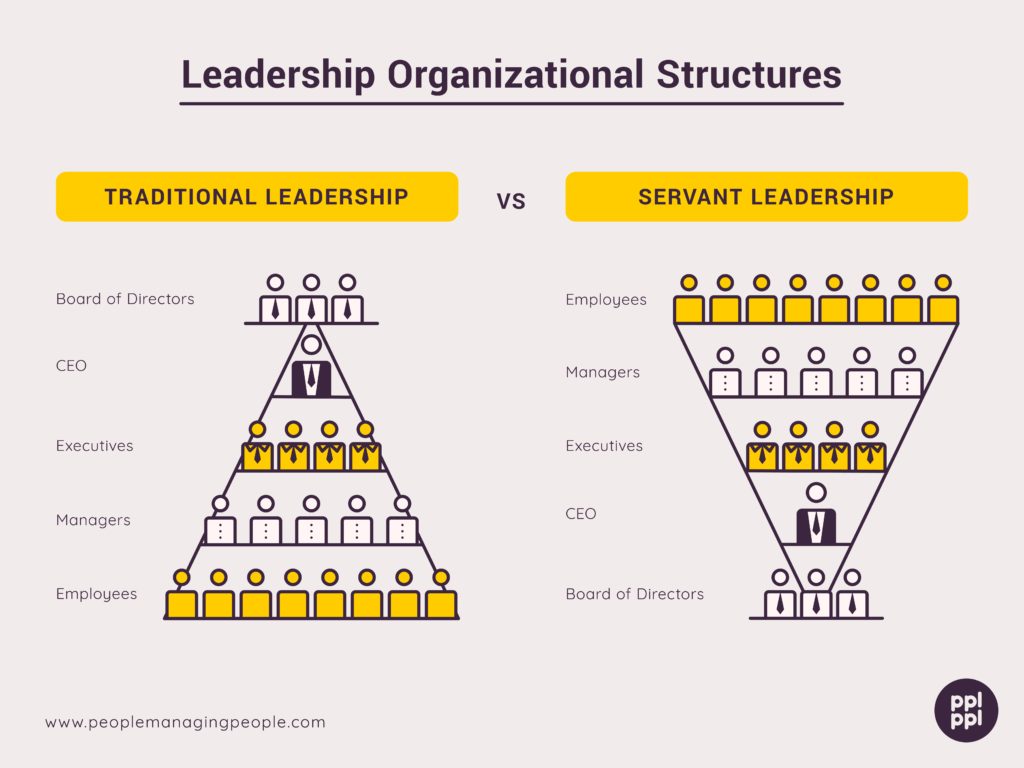
Servant leadership, on the other hand, is a more collaborative and empowering style. Servant leaders focus on serving their followers and helping them reach their full potential. They are more likely to listen to their followers' ideas and concerns, and they may involve them in the decision-making process. Servant leaders are also more likely to be humble and self-aware, and they may be more focused on the long-term success of the organization rather than their own personal gain.
Both traditional and servant leadership styles can be effective in different situations. Traditional leadership may be more appropriate when there is a need for quick decision-making and a clear chain of command. Servant leadership may be more appropriate when there is a need for collaboration and innovation.
Here is a table summarizing the key differences between traditional and servant leadership styles:
| Characteristic | Traditional Leadership | Servant Leadership |
|---|---|---|
| Power structure | Hierarchical | Collaborative |
| Decision-making | Top-down | Shared |
| Focus of the leader | Self | Others |
| Communication style | Directive | Persuasive |
| Motivation of followers | Fear or reward | Inspiration and empowerment |
The servant leadership model is thus a renowned organizational structure with a leadership philosophy in which the main goal of the leader is to serve. This model is indeed a model Christ created by His self since He emptied Himself for our sakes. Everything He did was for us, such that we might imitate Him. We will see that it is the pinnacle of true leadership and influence. Servant leadership was truly initiated by the life of Christ.
In servant leadership, there is a power of influence in which everyone influences someone, we never know who or how much we influence, and the best investment in the future is a proper influence today. Growing as a leader equates to reflection and sacrificing of the self. It is important to serve with positive influence doing all that you can to maximize the potential in those whom you serve.
The world’s idea is that those who lead are in some way better than the people whom they lead. They gain status because they exercise power over others to achieve their goals. All of which leads to rewards, benefits, and preferential treatment. This is not the model Christ set out for mankind. Jesus' leadership style is entirely contrasted to that of the world. He declared that in the Kingdom, greatness belongs to the servant and that distinction grows from child-like humility (Matthew 18:4). He taught that leaders were to serve others, not to be served by them.
Jesus' heart was a servant heart (Philippians 2:5-11). This heart led Him to act for the benefit and growth of others. One of the most powerful images in the life of Jesus is when He washes His disciples’ feet in John 13. When He is finished, he says to them, “You call Me Teacher and Lord, and you say well, for so I am. If I then, your Lord and Teacher, have washed your feet, you also ought to wash one another’s feet. For I have given you an example, that you should do as I have done to you.”
Jesus, of course, isn’t talking about feet. He’s talking about servant-leadership. Great leaders focus on serving those who follow them. Great leaders wash their people’s feet.
Jesus calls us, as His leaders, or disciples and servants, to grow a servant heart. He calls us to follow His example with humility, serving those whom we lead; enabling them to achieve the purpose to which God calls them is our goal.
Knowing that one is valued is an important encouragement for everyone. Ask yourself, “How can I publicly and genuinely recognize the value of individuals and their achievements?”
Defining Servant Leadership
The word servant may prompt an initial negative connotation and the word leader may carry a great deal of honor and respect. So, the term servant-leader offers new insights. leadership is really about serving.
In The Servant as Leader’s essay, Robert K. Greenleaf says, “The servant-leader is servant first… It begins with the natural feeling that one wants to serve, to serve first. Then conscious choice brings one to aspire to lead. That person is sharply different from one who is leader first, perhaps because of the need to assuage an unusual power drive or to acquire material possessions… A servant-leader focuses primarily on the growth and well-being of people and the communities to which they belong. While traditional leadership generally involves the accumulation and exercise of power by one at the “top of the pyramid,” servant leadership is different. The servant-leader shares power, puts the needs of others first and helps people develop and perform as highly as possible.” A definition oddly similar to the one we established when defining leadership.
Servant leadership is best defined by Jesus Himself: “whoever desires to become great among you, let him be your servant. And whoever desires to be first among you, let him be your slave— just as the Son of Man did not come to be served, but to serve, and to give His life a ransom for many.” (Matthew 20:26-28). In the Christian realm, all leadership should be servant leadership.
Power of Influence
There are three aspects to power of influence which include speech, time, and exemplary life. In terms of speech, what you say (in church and outside) matters because a few sentences can change the direction of a nation. For example, Nehemiah used his words for good while Herod used his words for destruction. We need to learn to give words of comfort to those that are afflicted, healing through words of kindness to those in emotional pain, guidance to those that are lost or confused, and simplification to make that which is difficult to understand be understood in simple terms. Don’t over-complicate or over-simplify things. In terms of time, the importance of being present and available to anyone you serve, has served. Once assigned a service, forever the impact – there is no checking out. We see this in the Bible with Abraham and Lot. Though Lot left Abraham, while under his care, Abraham never left Lot from his heart and continuously cared for him. He ran after him and sought to protect him from God’s destruction in Sodom and Gomorrah, even though Lot had left him and denied his leadership. Abraham was always seeking to serve and influence those around him. Thus, let us say with Isaiah 6:8, who calls us to be ready at any time for any needs: “Also I heard the voice of the Lord, saying: ‘Whom shall I send, And who will go for Us?’ Then I said, ‘Here am I! Send me.’”
In terms of living an exemplary life, we never know who or how much we influence. Our life will influence others, so it’s important to choose your influence. Accordingly, in the diocese of the Southern United States, the servant commit themselves to a level of sacrifice from worldly matters and vow to keep themselves from actions that may negatively impact the influence of the servant.
- Using profanity in any kind of communication whether via texting, Facebook, Twitter, Snapchat, or Instagram posts, or any social media posts
- Displaying pictures of themselves, friends, or relatives on Facebook or any social media site that are not fitting for a Sunday School Servant (e.g., improper clothing, dancing, drinking, etc.)
- Smoking cigarettes or hookah, vaping, drinking alcohol or using drugs
- Spending leisure time at a night club, bar, or hookah lounge
- Dancing or drinking such as at wedding receptions or gatherings
- Maintaining an inappropriate relationship such as a boyfriend or girlfriend relationship in secret and without the knowledge of family or the guidance of a confession father
- Dressing in a way that is not befitting the modesty of a Christian servant and not in accordance with the dress code of the diocese
- Showing direct or indirect approval of any of the above behaviors
Characteristics of Servant Leadership
| Attribute | Description |
|---|---|
| Listening | The motivation to actively listen to others and support them in appropriate ways. |
| Empathy | The ability to understand others while going on a deeper level by showing respect and unconditional love. |
| Awareness | The ability to step back from immediate reactions and emotions to assess the bigger picture and identify the underlying causes and potential consequences of actions viewing situations from a more integrated and holistic position. |
| Relational Persuasion | The refusal to use power or position in a coercive or forced manner, but rather seeks the path of genuine relationship. |
| Insight | The ability to learn from the past, anticipate potential outcomes, and make needed adjustments and course corrections. |
| Stewardship | Looking at service as being a caretaker of the gifst entrusted by God. |
| Commitment | The willingness to focus on and attend to the personal, professional, and spiritual growth of others. |
Biblical Base for Understanding Leadership
Leaders of God's people were most often described as servants of God anointed to do various tasks. Moses was the first to practice servant-leadership (Ex. 32:11-14, 30-35). Servant leaders strengthen the weak and empower those entrusted to their care, and show compassion towards the disadvantaged and the lost (Eze. 34:2-10). God wants leaders who will listen to His will and execute it faithfully with divinely appointed authority.
Obedient and courageous Joshua had a powerful impact on Israel. David, while sinful, was a leader after God's own heart; his deep spirituality led to great accomplishments.
Servants ought not to do anything out of selfish ambition or vain conceit, but in humility considering others better than oneself. “Let nothing be done through selfish ambition or conceit, but in lowliness of mind let each esteem others better than himself. Let each of you look out not only for his own interests, but also for the interests of others.” (Philippians 2:3-4)
James and John asked Jesus if He would grant to them the privilege of sitting on His right and left in positions of leadership in His kingdom. But Jesus explained to them that their philosophy of leadership was not to be modeled after that of the "Gentiles" and "great men" of the world: “Whoever of you desires to be first shall be slave of all.” (Mk 10:42-44; Mt 20: 25-28).
Attitude of Servant-Leadership
The essence, style and attitude of servant leadership is found in Philippians 2:3-5. “Let nothing be done through selfish ambition or conceit, but in lowliness of mind let each esteem others better than himself. Let each of you look out not only for his own interests, but also for the interests of others. Let this mind be in you which was also in Christ Jesus, who, being in the form of God, did not consider it robbery to be equal with God, but made Himself of no reputation, taking the form of a bondservant, and coming in the likeness of men. And being found in appearance as a man, He humbled Himself and became obedient to the point of death, even the death of the cross.”
The focus of servant leadership is on the growth, success and welfare of the followers. The primary focus of a servant-leader is on his or her followers rather than on self. It is this singular characteristic which defines servant-leadership. A good reflective question to ask oneself, do I serve because I am a leader, or do am I a leader because I serve? The goal of service is not to be leaders or achieve some type of ambition, but rather is to offer Christ a sweet smelling aroma in our sacrificial service.
The servant-leader Jesus served best at times by saying “no” to some who wanted to follow Him, denied the requests of others (James and John in Mark 10:36-40) and even “turned away” some who weren’t going where He was going (John 6:66, Luke 14:25-35).
Sometimes servant leaders wash others’ feet, (John 13:1-17), but other times they rebuke, (Matthew 16:23), and even discipline, (Matthew 18:15-20). Sometimes they serve at their own expense, (1 Corinthians 9:7), but other times they issue strong imperatives (1 Corinthians 5:2; 11:16).
Attitude is everything: A servant leader seeks the glory of his Master, “He who speaks from himself seeks his own glory; but He who seeks the glory of the One who sent Him is true, and no unrighteousness is in Him.” A Christlike leader is a bondservant of Christ (Ephesians 6:6), and always demonstrates that Christ — not public approval, position, or financial security — has his primary loyalty.
In Christian service and ministry the most powerful style and attitude of leadership is that of servant-leadership. Any other style which is not like the one Christ modeled for us, cannot be called “Christian.” There is no room for king-leadership, selfish-leadership, ruler-leadership and self-serving leadership. Servant-leadership is a powerful and transformative lifestyle.