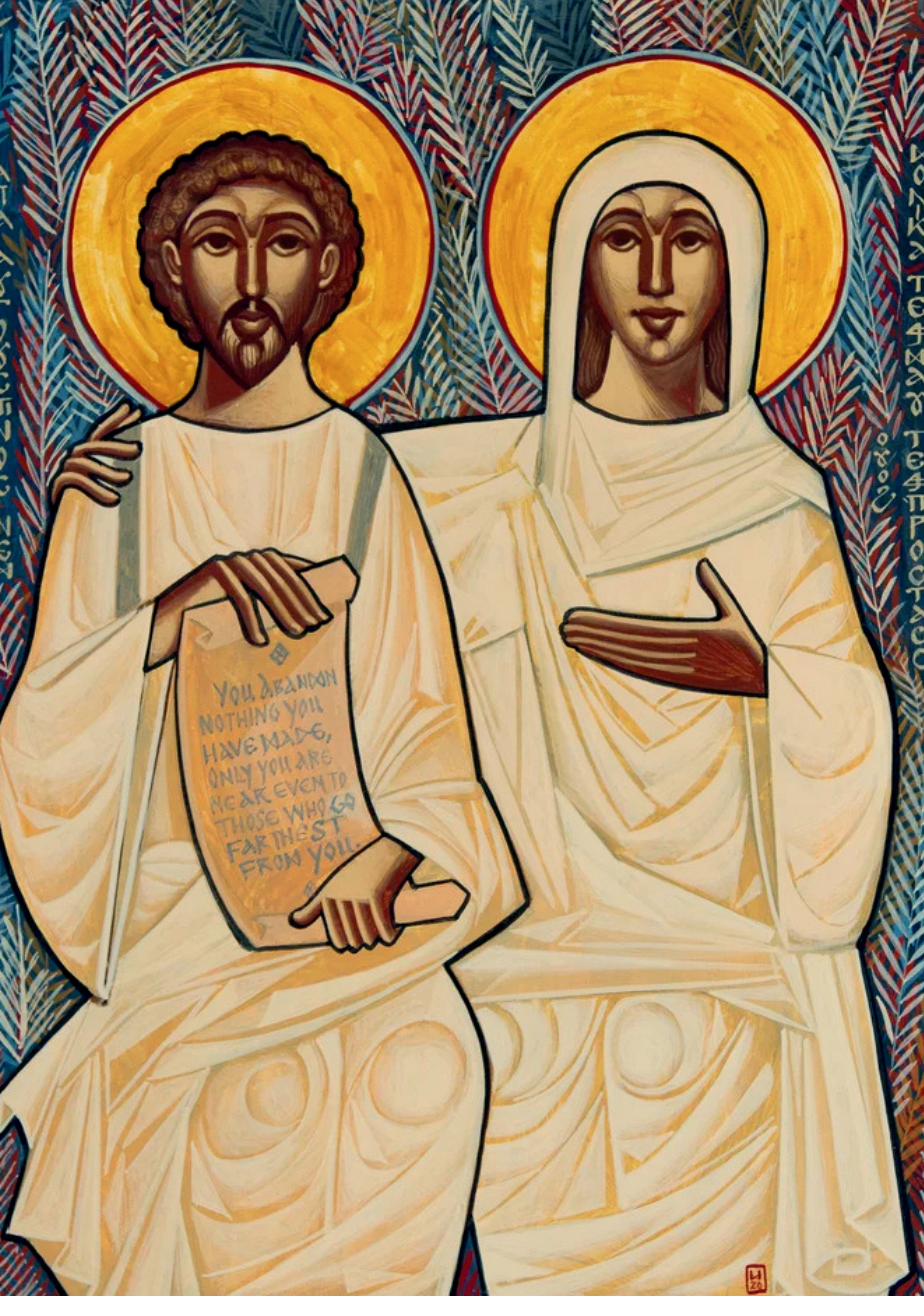
St Augustine accompanied by St Monica
“We love Him because He first loved us.”
— 1 John 4:19
Of all the fathers of the early Church, perhaps none understood the transforming power of divine love more personally than St Augustine. Before he was a bishop, before he was a theologian, before he wrote the words that would shape Christian thought for centuries, he was a man running from God — and God was running after him.
St Augustine spent his youth chasing every form of love the world could offer. He pursued pleasure, ambition, intellectual prestige, and human relationships with a desperate hunger that nothing could satisfy. He was brilliant, restless, and deeply unhappy. He tried philosophy and found it hollow. He tried worldly success and found it empty. He gathered admirers and companions, yet felt profoundly alone. In his own words, he was a question to himself — a man who could not understand why everything he grasped turned to dust in his hands.
What St Augustine did not yet understand was that his restlessness was not a curse but a gift. It was the voice of God calling him home. Every ache of loneliness, every moment of dissatisfaction with lesser loves, was the Beloved whispering: “You were made for more than this. You were made for Me.”
The turning point came in a garden in Milan, where St Augustine, weeping with the weight of his own brokenness, heard a child’s voice singing: “Take and read, take and read.” He opened the Scriptures and his eyes fell upon the words of St Paul. In that moment, the love of God — which had been pursuing him through every wrong turn, every failed relationship, every restless night — finally broke through. St Augustine did not find God; God found St Augustine. The Beloved claimed His beloved.
After his conversion, St Augustine wrote the words that have echoed through the centuries and speak directly to every servant gathered here today: “You have made us for Yourself, O Lord, and our hearts are restless until they rest in You.” This is the foundation of all service. We serve not to earn God’s love but because we have been found by it. Every programme we run, every child we teach, every soul we counsel — all of it must flow from a heart that has been captured and claimed by the love of God.
In his commentary on the Song of Songs, St Augustine offers a striking image: the human soul before her unity with Christ is as black as coal. But after her unity with Christ and becoming inflamed with His holy fire, she becomes hot and radiant — transformed not by her own effort but by the fire of divine love. This is the mystery of the servant’s life: we come to God as coal, dark and cold, but when we abide in His love, He sets us ablaze. And a heart on fire with God’s love cannot help but ignite every soul it touches.
Thomas à Kempis echoes this same truth with another image: “As iron cast into fire loses its rust and becomes glowing white, so he who turns completely to God is stripped of his sluggishness and changed into a new man.” Coal into flame. Iron into radiance. The consistent testimony across the centuries is the same: God does not merely improve us — He transforms us utterly. The love of God transforms everything; it sanctifies, amends, and changes the very nature of everything. The servant who abides in this fire no longer fears weakness, for it is God’s strength working through human frailty. When we find Christ, we are satisfied. We desire nothing else. We find peace. We become different people. We live everywhere, wherever Christ is — in the stars, in infinity, in heaven with the angels, with the saints, on earth with people. Neither melancholy, nor illness, nor pressure, nor anxiety, nor depression — for where there is love for Christ, loneliness disappears.
St Augustine also wrote: “We cannot love unless someone has loved us first.” This is the mystery at the heart of our theme today. We did not initiate this love. We did not choose God; He chose us. And it is precisely this — knowing that we are chosen, that we are beloved, that nothing in all creation can separate us from His love — that gives our service its power and its joy.
Consider your own story for a moment. Can you trace the hand of God pursuing you? Can you see, looking back, how He was present even in the seasons when you felt most distant from Him? The love of God is not a reward for arriving at the right destination. It is the force that carried you there, even when you did not know the way.
St Augustine spent the rest of his life pouring out for others the love he had received. He became a bishop not because he sought honour, but because the love of Christ compelled him. He wrote, he preached, he counselled, he wept over the struggles of his flock. And through it all, his message was simple: love God, and everything else will find its rightful place. For the soul trained in love will do nothing to offend the One who is Beloved.
Beloved servants, let the restless St Augustine remind you: if your heart feels weary today, if service has become a burden, it may be because you have drifted from the Source. Return to the garden. Take and read. Let the Beloved find you again.