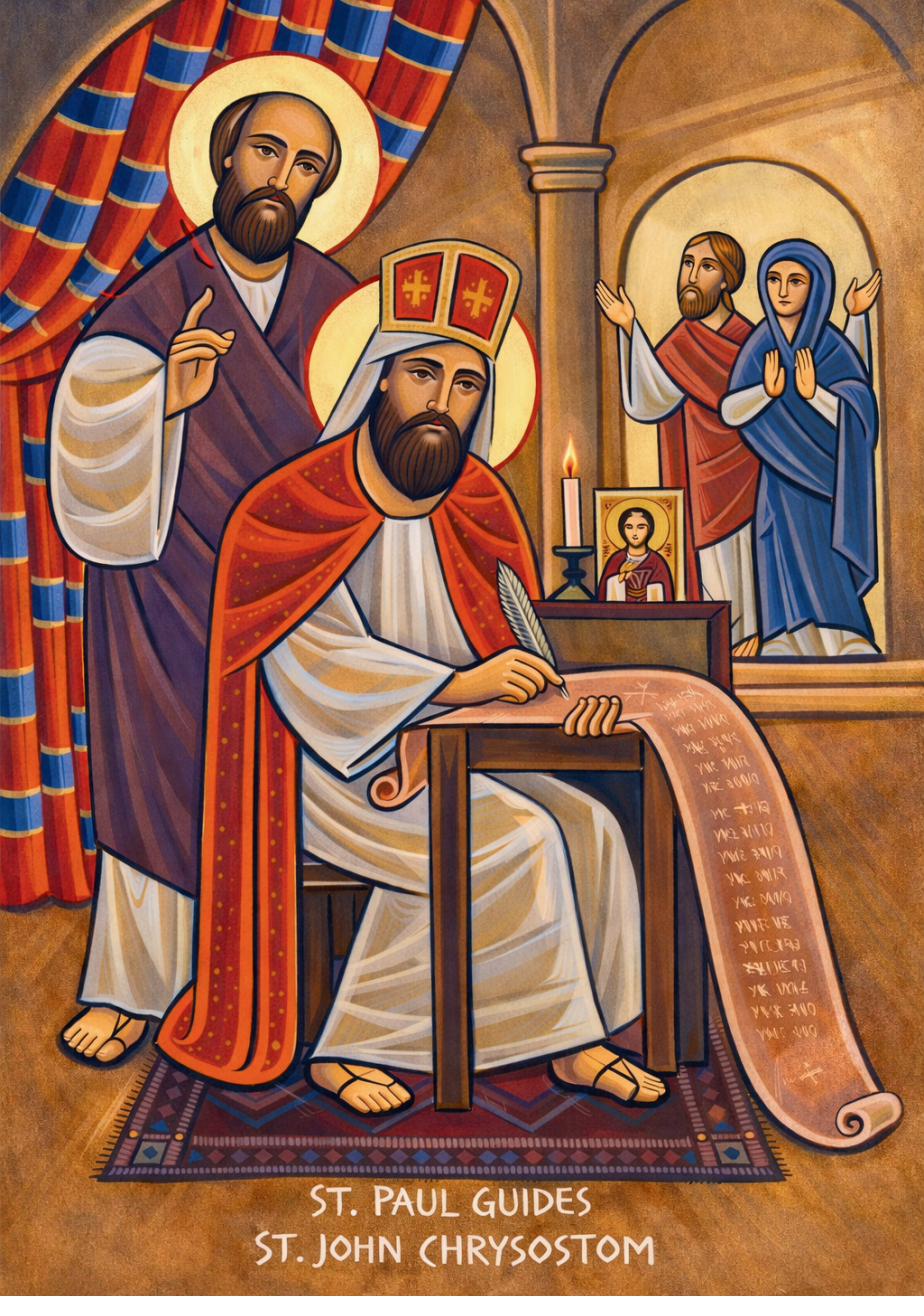
St John Chrysostom
“As heat makes things expand, so it is the work of love to expand the heart, for its power is to heat and make fervent.”
— St John Chrysostom
They called him “Golden Mouth” — Chrysostomos — because when he spoke, the words seemed to shimmer with light. But what made St John Chrysostom’s preaching unforgettable was not eloquence alone. It was the fire of love burning behind every word. He did not speak to impress; he spoke to set hearts ablaze. In his homilies on the Gospel of St John, Chrysostom describes the beloved disciple standing on a heavenly platform, armed not with rhetoric but with the Grace of God, presenting the joyful message of the Lord Jesus Christ to listeners whom he yearned would be transformed into angels.
Born in Antioch in the fourth century, St Chrysostom was raised by a widowed mother, Anthusa, who poured into him such love and faith that even the pagan philosopher Libanius remarked: “What wonderful women these Christians have.” From his earliest years, St Chrysostom learned that love is not an abstract doctrine — it is a life poured out for others. His mother’s sacrifice became the first sermon he ever heard, preached not with words but with a lifetime of self-giving.
After years of monastic solitude in the mountains outside Antioch, where he nearly destroyed his health through extreme asceticism, St Chrysostom returned to the city. He had gone into the desert seeking God and found Him. But God sent him back to find Him again — this time in the faces of the poor, the sick, the forgotten, and the struggling faithful of Antioch. It was there, in the busy streets and crowded churches, that St Chrysostom discovered the deepest truth about love: it cannot remain hidden. Like heat, it expands. Like fire, it spreads. A heart truly touched by the love of God cannot help but pour itself out for others.
As a preacher and later as Archbishop of Constantinople, St Chrysostom was fearless in his insistence that love must be practical. He thundered against the wealthy who decorated churches with gold while ignoring the hungry at their gates. “What is the use of loading Christ’s table with golden cups,” he asked, “when He Himself is starving? Feed the hungry, and then if you have anything left over, decorate the altar.” For St Chrysostom, love was not a feeling or a sentiment — it was bread broken and shared, a coat given away, a hand extended to someone the world had discarded.
Yet for all his boldness, St Chrysostom’s heart was tender. His homilies on the letters of St Paul overflow with warmth, encouragement, and a pastor’s deep affection for his flock. He understood that people do not change because they are scolded into submission. They change because they are loved into transformation. “Nothing so much wins love,” he wrote, “as the knowledge that one’s lover desires most of all to be himself loved.” God does not merely tolerate us. He longs for our love. And when we grasp this — that the God of the universe desires us — everything changes. We must become filled, replete with the Holy Spirit. This is where the essence of the spiritual life lies. This is an art — the art of arts. Let us open our arms and throw ourselves into Christ’s embrace, like a loved one who approaches us with open arms. It is a self-giving, a surrender, a joy-filled submission to His love.
St John Climacus, in the final step of The Ladder of Divine Ascent, uses an image that St Chrysostom himself would have loved: “Even a mother does not so cling to the babe at her breast as a son of love clings to the Lord at all times.” This is the kind of love St Chrysostom spent his life preaching — not a distant reverence, but a clinging, intimate, unbreakable attachment to the Beloved. The servant who serves from this place of clinging love will never serve in vain.
St Chrysostom’s life ended in exile, betrayed by those he had served, marched through brutal conditions by soldiers who had no regard for his failing health. His final words, spoken from a place of utter desolation, were these: “Glory be to God for all things.” Even in suffering, even when love seemed to have been defeated, the golden-mouthed preacher chose gratitude. He chose love. He chose to trust that the Beloved had not abandoned him.
Beloved servants, St Chrysostom’s life asks us a searching question: Is our love practical? Do the people we serve encounter Christ not just in our words but in our actions — in our patience when they are difficult, in our generosity when it costs us something, in our presence when they feel alone? Love is not a topic for our next Bible study. It is the very air our service must breathe.
And when service is hard — when we feel overlooked, exhausted, or even betrayed — may we echo the golden voice: “Glory be to God for all things.” For the Beloved is with us still, even in the exile of our weariest days.