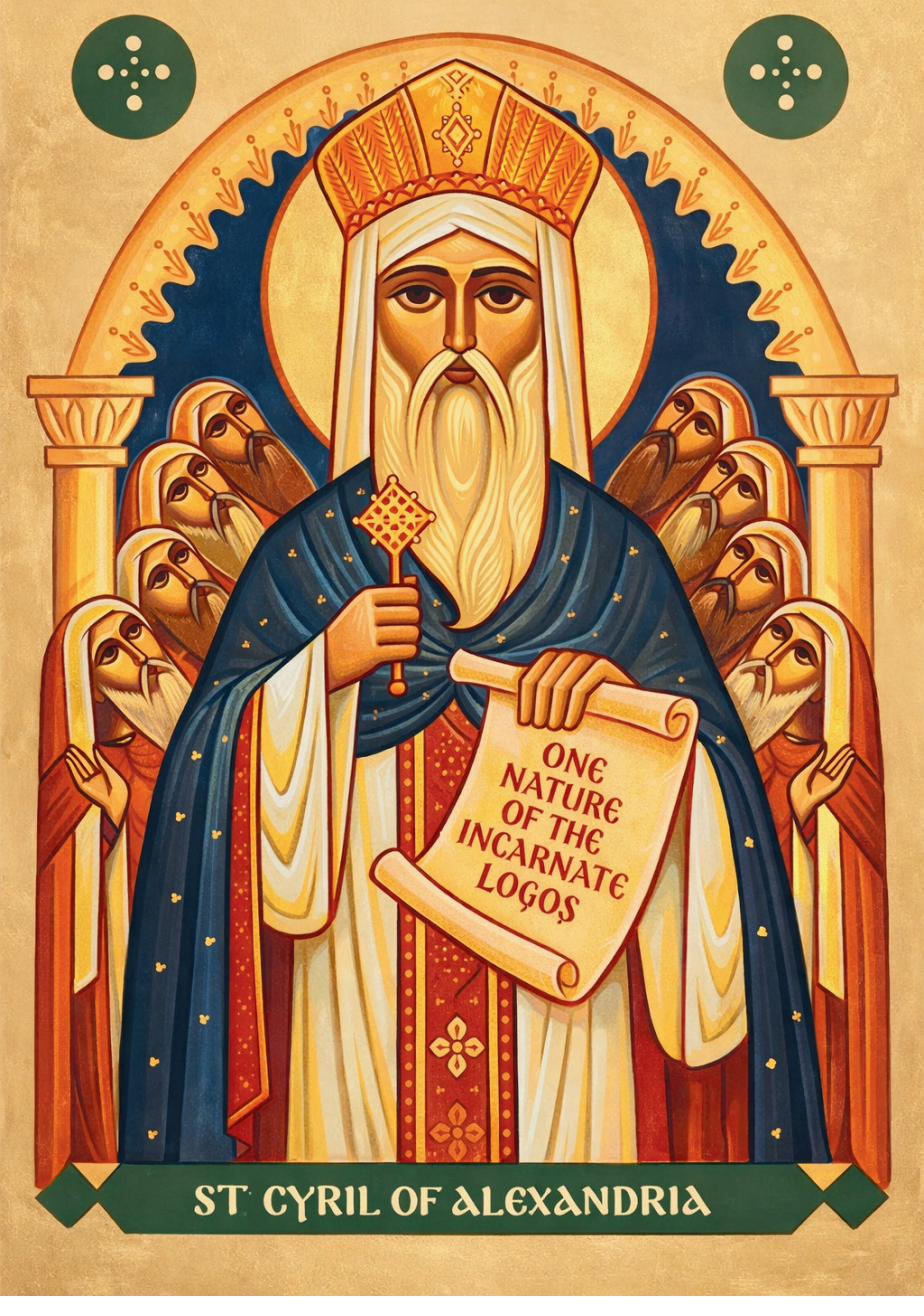
St Cyril of Alexandria — Pillar of Faith, Seal of the Fathers
“For God so loved the world that He gave His only begotten Son, that whoever believes in Him should not perish but have everlasting life.”
— John 3:16
In the fifth century, when the very identity of Christ was under threat, God raised up a champion from the land of Egypt — St Cyril of Alexandria, the Pillar of Faith. He is remembered as a fierce defender of Orthodox doctrine, but beneath his theological brilliance beat a heart consumed by one truth: God became man because He loved us too much to leave us in our brokenness.
St Cyril understood something that every servant must grasp: theology is not an intellectual exercise. It is a love story. When he fought to preserve the truth that Jesus Christ is one Person — fully God and fully man, united without confusion or separation — he was not fighting over words. He was fighting for the reality of God’s love. For if God did not truly become one of us, then He has not truly reached us. If the Word did not truly take flesh, then love remained at a distance, and salvation is an illusion. St Cyril understood that the features of the Divine Nature exceed our understanding and comprehension, yet through the Incarnation, God made His unfathomable love accessible to every human heart. As St John Climacus declares: “God is love. So he who wishes to define this, tries with bleary eyes to measure the sand in the ocean.” St Cyril spent his life not trying to measure that love, but defending its reality so that every soul might plunge into its depths.
But St Cyril proclaimed what the Church has always believed: that in the Incarnation, the Beloved crossed every boundary to reach His beloved. The infinite God became a tiny infant. The Almighty took on our weakness. The Immortal embraced mortality. Why? Not because He was obligated, not because we deserved it, but because love cannot bear to be separated from the one it loves. This is the love that St John describes: “Not that we loved God, but that He loved us and sent His Son to be the propitiation for our sins” (1 John 4:10).
For St Cyril, the Incarnation was not merely a historical event but a living reality that shapes every moment of the Christian life. When we receive the Holy Eucharist, we receive Christ Himself — the same Word who took flesh from the Virgin Mary. When we serve others, we serve in the power of the same love that drove God to become man. St Cyril of Jerusalem, in words that the Alexandrian tradition embraces, teaches that through baptism, the believer meets the Lord Jesus as the Bridegroom, puts on the new man, and enjoys the divine kingdom. The soul puts on Christ as a white robe for the wedding, wearing Him as her righteousness and the source of her holiness. The Incarnation tells us that God does not love us from a safe distance. He enters our mess, our pain, our confusion, our daily struggles. He sits beside us in the classroom, stands with us in the meeting, walks with us to the hospital visit. The Beloved is never absent.
St Cyril’s commentary on the Gospel of St John is filled with breathtaking reflections on divine love. He writes that when Christ washed the disciples’ feet, He was showing us the shape of love — not lordship from above, but service from below. The Creator of the universe knelt before fishermen and tax collectors, took a towel and a basin, and performed the work of the lowest household servant. This is the love that must animate every act of our service. Not love that condescends, but love that kneels.
St Cyril also understood that defending the truth is itself an act of love. He fought for right doctrine not because he enjoyed controversy, but because false teaching about Christ robs people of the fullness of God’s love. If we teach a diminished Christ, we offer a diminished love. If we present a God who did not truly come near, we rob our people of the God who is near. Beloved servants, the content of our teaching matters because the people we serve deserve the full, undiminished, world-shattering love of the Incarnate God.
As servants of the Coptic Orthodox Church, we stand in the spiritual lineage of St Cyril. His throne is our inheritance. His faith is our confession. And his conviction must be our own: that the God we serve is not distant, not indifferent, not waiting for us to perform well enough to earn His attention. He is Emmanuel — God with us — the Beloved who crossed the infinite divide to hold us close. All things in creation are little loves through which we attain to the great Love that is Christ. Flowers, for example, have their own grace: they teach us of the love of God. They scatter their fragrance and their beauty on sinners and on the righteous alike. In the same way, the servant who has truly grasped the Incarnation scatters the fragrance of Christ’s love on all whom they serve, without partiality. Let this truth fuel your service today and every day.