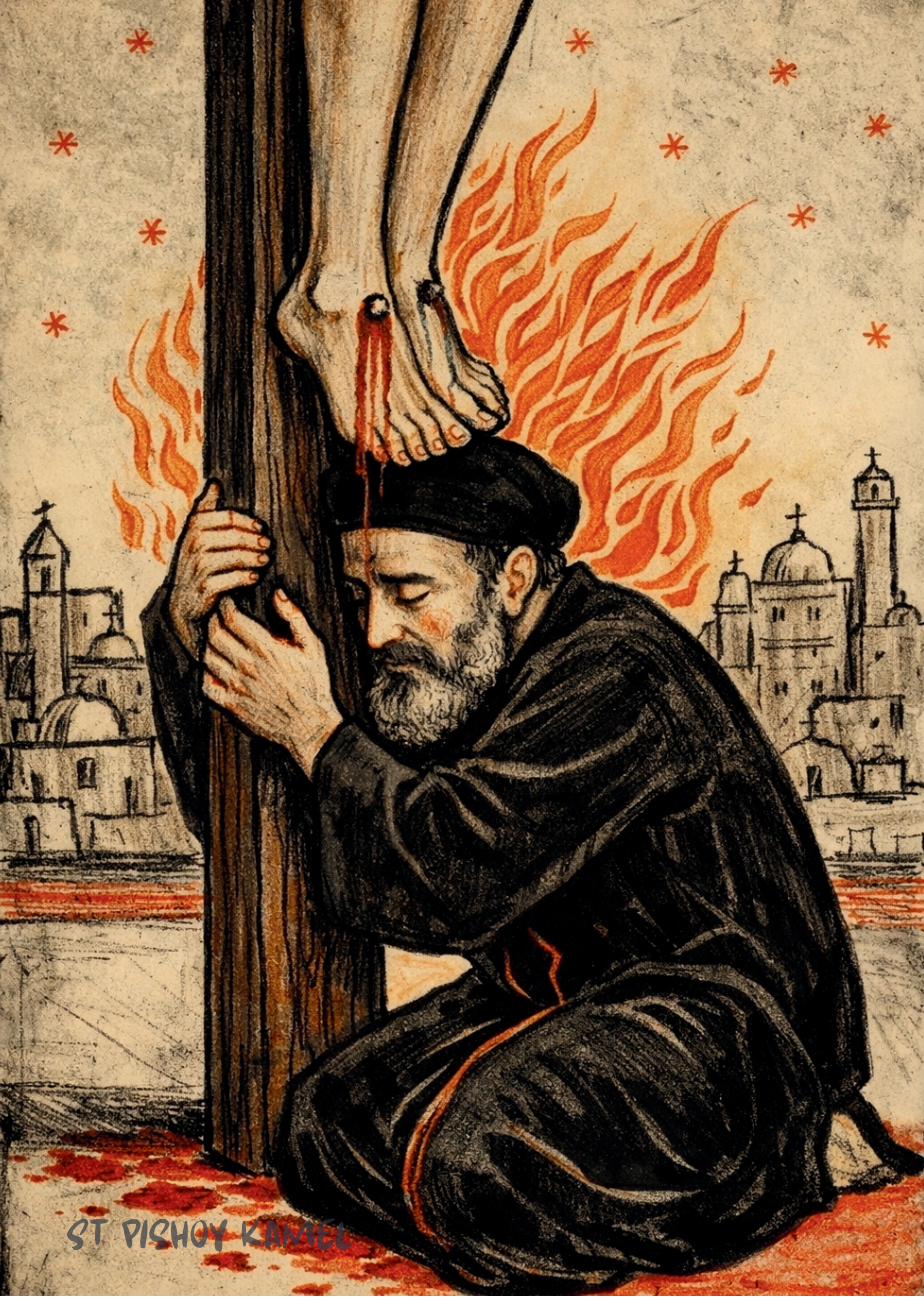
The Hegumen Fr Pishoy Kamel (1931–1979) · Glorified June 2022
“Greater love has no one than this, than to lay down one’s life for his friends.”
— John 15:13
If you want to see what it looks like when a human life becomes a living sermon on love, look no further than the Hegumen Fr Pishoy Kamel of Alexandria. He did not write lengthy treatises on the theology of love. He did something far more difficult and far more beautiful: he lived it, completely and without reserve, until there was nothing left to give. His fellow priest and close friend Fr Tadros Malaty, who met him as “brother Sami Kamel” during their university days in Alexandria in 1953, testified that from their very first meeting, Samy Kamel was characterised by “an open, loving heart with wisdom, accompanied by a simple life” — a personality attractive to believers and unbelievers alike.
Samy Kamel was a young science professor in Alexandria when Pope Kyrillos VI, in a moment of divine inspiration, laid his hand on a man he had never met and declared him chosen for the priesthood. Samy had not sought this calling. He had not applied or campaigned. He was simply going about his life when the Beloved interrupted it. And from that moment, Fr Pishoy understood something that would define his entire ministry: he did not choose this path. God chose him. He was beloved before he was a servant.
What followed was a life of service so extravagant, so self-emptying, that those who witnessed it could only describe it as Christ walking among them again. Fr Pishoy founded churches across Alexandria and helped establish Coptic congregations as far away as Los Angeles and New Jersey. But he was not a builder of buildings. He was a builder of souls. Every person who came to him — whether a struggling youth, a grieving widow, a confused intellectual, or a wayward sheep about to abandon the faith — encountered not a priest performing his duties, but a father whose heart physically ached with love for them.
His love was never abstract. When a young servant needed books for a new parish bookshop, Fr Pishoy gave away his own church’s entire stock without hesitation, asking only: “How much can you carry?” When a young man, exhausted from physical labour, came to him discouraged, Fr Pishoy did not offer platitudes. He helped him see Christ in his suffering, transforming an ordinary workday into a moment of sacred communion. For him, there was no separation between the life of faith and the life of daily struggle. Every moment was an opportunity for love.
He loved those he served so deeply that their pain became his own. When he heard that a soul was drifting from the faith, his heart broke. He would pursue that lost sheep with everything he had, pouring himself out as a sacrifice, just as Christ did. This was not professional pastoral care. This was a father’s love — fierce, tender, relentless, and completely unconcerned with self-preservation.
And then came the cancer. In 1976, Fr Pishoy was diagnosed with the illness that would take his life three years later. What happened during those final years is perhaps the most powerful testimony to the theme of our Spiritual Day. Many people found greater comfort visiting him in his sickness than they had received in years of sermons. Fr Tadros Malaty wrote of those days: “God had hidden from his eyes the power of his service during his sickness. Many people found comfort in their sickness or troubles merely seeing him in pain or hearing about his patience and joy!” Fr Tadros recorded these memories not to praise — “for with heaven and its glory you are in no need of the earthly” — but because they represent “a living image of dedicated pastoral work and the constitution of faithful spiritual service.”
He slept on a thin cotton mattress on the floor. He fasted strictly even as his body wasted. He never sought praise and genuinely wondered why people loved him so much. When he could no longer stand to preach, his very presence preached. When he could no longer visit the sick, his sickbed became the most powerful pulpit in Alexandria. He taught that the Cross should be a daily desire, not a punishment to endure. “Carrying the Cross,” he would say, “is carrying the Throne of our King.” A person can become a saint anywhere — at your work, whatever it may be, through meekness, patience, and love. Make a new start every day, with new resolution, with enthusiasm and love, prayer and silence — not with anxiety. This was Fr Pishoy’s way: each morning a fresh beginning, each encounter a new opportunity for Christ to love through him.
Thomas à Kempis, centuries earlier, had written the same truth: “If you carry the cross willingly, it will carry and lead you to the desired goal.” Fr Pishoy did not merely endure his cross — he embraced it as the royal road of love. And the Cross, in return, carried him into a radiance that no amount of health or activity could have produced.
Fr Pishoy departed on 21 March 1979 — two days after the Feast of the Cross — as if God Himself was writing the final chapter: this servant, who had carried the cross with joy his entire life, was now risen on the third day into eternal glory. In the days following his departure, Fr Tadros wrote to him: “I can’t say that you have left your church and that you do not stand with us at God’s altar, at which you were ordained. I can’t say that your people have lost your care and strive for their salvation. Today you are closer to your church’s altar and your people than before.”
His wife, Tasoni Angel, honoured the last words he spoke to her: “Never stop serving.” She served faithfully for forty more years, departing on 24 November 2019 — their sixtieth wedding anniversary. Two lives, one love, poured out completely.
In the desert of Scetis, a spiritual father once wrote to his monks: “We should always feel that we are sojourners, pilgrims seeking our eternal homeland. This feeling should not disappear from our heart, mind, or body for a single moment. We should cherish it both inwardly and outwardly, lest we inadvertently forget the state of our exile, an exile in which we feed on the inextinguishable love of God.” Fr Pishoy understood this perfectly. He was a sojourner whose homeland was Christ. Fire can be quenched with a little water, but love, if it really burns within one’s heart, nothing can quench it — neither disdain, nor contempt, nor hostility, nor humiliation, nor indifference. Not even death itself can quench love. Fr Pishoy’s love was of this kind: inextinguishable.
Beloved servants, as we celebrate the feast of this holy father, let his life be our mirror. He did not serve to be noticed. He did not love to be loved in return. He served because the love of Christ had so completely overtaken him that there was simply nothing else he could do. May we, through his prayers and the grace of Christ, learn to love with the same reckless, self-forgetting, cross-bearing abandon. For this is what it means to be beloved: not to hold love, but to pour it out, to the last drop, and to trust that the Beloved will fill us again.