BIBL103 - Introduction to the New Testament
Who is St. Paul?
Saint Paul, born Saul of Tarsus, holds a prominent place in Christian history as an apostle who spread the teachings of Jesus Christ throughout the Roman Empire. His journey from a persecutor of Christians to a passionate advocate for the faith is a testament to the transformative power of divine intervention. Born into the tribe of Benjamin in Tarsus, Cilicia (modern-day Turkey), St. Paul was a Hebrew and an Israelite of the lineage of Abraham. He embraced the Pharisaic tradition, strictly adhering to Jewish law and customs. Alongside his religious pursuits, St. Paul pursued practical skills, becoming a tent-maker by trade (Acts 18:3) .
St. Paul's Roman citizenship, acquired by birth through his father's wealth, granted him privileges and connections within the empire. His education in Jerusalem under Gamaliel, a renowned scholar in the Sanhedrin and member of the Jewish high council, further enriched his knowledge of Jewish theology and the Old Testament. Gamaliel had a place in the Temple, his disciples would all gather in a specific area in the Temple to study and learn. St. Paul had studied and mastered Greek, which was the language of the time, all the Philosophy and contemporary teachings of the time. St. Paul described himself as a Hebrew, an Israelite of the seed of Abraham (2 Cor. 11:22)
In his early twenties, St. Paul witnessed the persecution of Christians by Jewish authorities. While the exact location of St. Paul during Christ's crucifixion is unknown, he was aware of the Christian movement and the identity of Jesus. St. Paul's zeal for the Jewish faith led him to join in the persecution of Christians. He actively participated in public beatings and trials, even overseeing the stoning of St. Stephen, the first Christian martyr: “And the witnesses laid down their clothes at the feet of a young man named Saul.” – Acts 7:58
However, a life-changing encounter on the road to Damascus transformed St. Paul's life. As he journeyed to Damascus, seeking permission to apprehend Christians who had fled Jerusalem, a blinding light enveloped him, and he heard the voice of Jesus, "Saul, Saul, why are you persecuting Me?" … “I am Jesus, whom you are persecuting. It is hard for you to kick against the goads.” (Acts 9:4-5) Overwhelmed, St. Paul fell to the ground and asked Jesus what he should do. Instructed to enter Damascus (Acts 9:5-6) , St. Paul was led by hand, blind, to the house of Ananias, a Christian leader.
Ananias, initially hesitant due to St. Paul's reputation as a persecutor, was reassured by Jesus that Paul was chosen to bear His name before Gentiles, kings, and the children of Israel: “Go, for he is a chosen vessel of Mine to bear My name before Gentiles, kings, and the children of Israel. For I will show him how many things he must suffer for My name’s sake.” (Acts 9:15-16). With the laying on of hands, Paul regained his sight, was baptized, and accepted the Christian faith. St. Paul's understanding of the Old Testament prophecies and his knowledge of the Jewish faith made him receptive to Christianity. He recognized Jesus as the long-awaited Messiah and embraced his teachings with unwavering devotion. As a devout and religious Jew he was closer to Christianity than anybody else because he knew what to look for, all their hope was waiting for the Messiah, he just needed a little push and he would easily become a Christian. “You search the Scriptures, for in them you think you have eternal life; and these are they which testify of Me.” – John 5:39.
St. Paul’s Ministry
From Damascus, St. Paul began his ministry, focusing initially on preaching to the Jewish population. However, his message and success in converting many Jews angered the Jewish leaders, who plotted to kill him. St. Paul escaped to Jerusalem, where he was initially met with suspicion by the Christian leaders due to his past actions. Barnabas, a fellow apostle, vouched for St. Paul, and he was accepted into the Christian community. Yet, the Jewish authorities remained hostile, forcing St. Paul to flee Jerusalem once again.
St. Paul spent the next three years in the Arabian desert, reflecting on his life and divine calling. During this time, he contemplated the profound implications of the gospel message and prepared himself for the significant work that lay ahead. Emerging from the desert, St. Paul returned to preaching, this time in the Jewish regions. He landed in Antioch, the third most important city in the Roman Empire and the capital of Syria. There, he preached and converted many people, leading to the growth and strengthening of the church under his guidance.
At the prompting of the Holy Spirit, the church in Antioch designated St. Paul and St. Barnabas for a new mission to spread the gospel beyond Jewish communities (Acts 13:1-3) . This marked the beginning of Paul's missionary journeys, which would take him across the Roman Empire, establishing and nurturing Christian communities while facing numerous challenges and persecutions.
Throughout his journeys, Paul wrote letters to the churches he founded, providing guidance, encouragement, and theological insights that continue to shape Christian beliefs and practices to this day. His teachings on faith, grace, and the redemptive work of Jesus Christ have had a profound impact on countless individuals and communities over the centuries.
St. Paul’s Missionary Trips
St. Paul then embarked on three significant missionary journeys that profoundly impacted the spiritual landscape of Europe. These journeys were instrumental in establishing deep roots of Christian spirituality across the continent and left an enduring legacy. The missionary endeavors began in Antioch, a city near modern-day Turkey. Filled with divine purpose, he set out to spread the message of Jesus Christ, traveling extensively throughout Europe. With each step, he encountered both fervent believers and fierce opposition. Despite facing persecution, death threats, and tribulations, St. Paul's unwavering faith and unwavering determination spurred him and his followers forward.
During his journeys, St. Paul visited numerous cities, preaching in synagogues and marketplaces. His sermons captivated audiences, igniting a spark of faith in the hearts of many. He established churches in various locations, ordaining priests and bishops to shepherd and guide the growing Christian communities. In addition to his preaching and teaching, St. Paul also wrote letters to the churches he had established during his trips to follow up on their progress and offer guidance and encouragement. These letters, which later became known as the Pauline epistles, provide valuable insights into the early Christian communities and the spiritual concerns of the time.
Each of St. Paul's missionary trips spanned three to four years, characterized by tireless travel, fervent preaching, and unwavering dedication. He tirelessly traversed challenging terrain, facing perils and hardships along the way. His passionate preaching, coupled with his profound understanding of the Scriptures, resonated deeply with people from all walks of life. Through his efforts, countless individuals embraced the teachings of Jesus Christ, transforming their lives and shaping the cultural and spiritual fabric of Europe.
Upon completing his missionary journeys, St. Paul returned to Antioch, where he continued to minister to the church and provide guidance to the communities he had established. His tireless efforts left an indelible mark on Christianity, and his legacy continues to inspire and guide believers to this day.
1st Missionary Trip (Acts 13:4 -14:26)
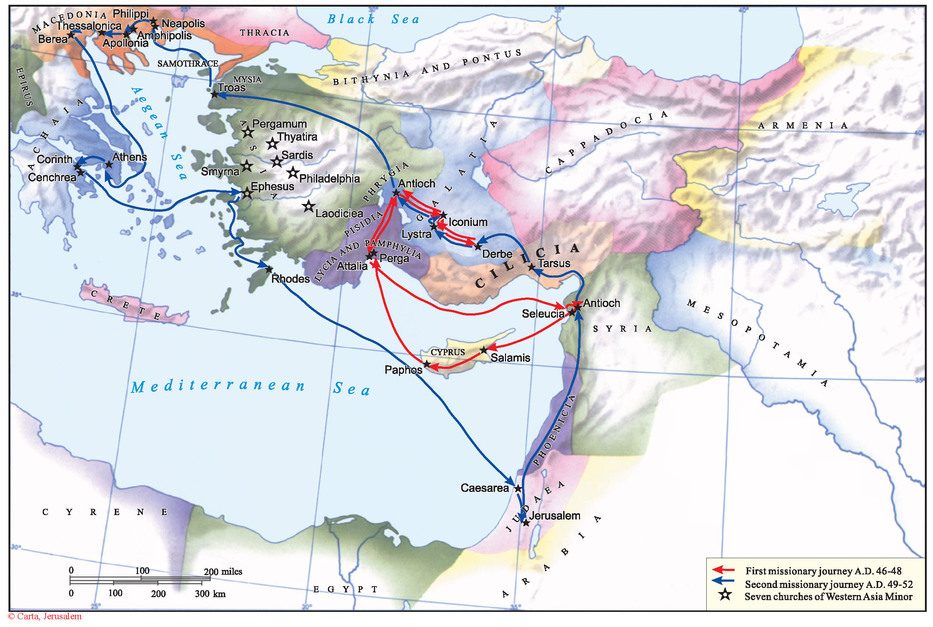
St. Paul, accompanied by Barnabas and John Mark, embarked on their first missionary journey, guided by the Holy Spirit's call to service (Acts 13:2). This trip commenced in Seleucia, where they set sail for Cyprus. Upon arrival in Salamis, they traversed the island until they reached Paphos. From there, they sailed to Perga in Pamphylia, where John Mark decided to depart from the group (Acts 13:13).
Continuing their journey, Paul and Barnabas arrived in Antioch in Pisidia. Here, they began preaching to the entire city, extending their message beyond the confines of the synagogue. This act of inclusivity evoked envy among the Jews, who stirred up persecution against St. Paul and St. Barnabas. Undeterred, the word of God spread throughout the entire region (Acts 13:44-49).
After Antioch, St. Paul and St. Barnabas traveled to Iconium. In this city, a significant division arose between the new believers and the Jews. The animosity escalated to the point where the locals plotted to stone St. Paul and St. Barnabas. Recognizing the imminent danger, they fled to Lystra and Derbe, where they continued preaching (Acts 14:1-6).
In Lystra, Paul and Barnabas performed a miraculous healing of a paralyzed man. Initially, the people of Lystra revered them as gods and prepared to offer sacrifices in their honor (Acts 14:8-13). However, as the two disciples proclaimed the message of Jesus Christ, the crowd's sentiments shifted, and they turned against them, stoning them. Undeterred, Sts. Paul and Barnabas proceeded to Derbe, where they preached and made disciples (Acts 14:19-21). Afterward, they retraced their steps, revisiting Lystra, Iconium, and Antioch, strengthening the faith of the disciples and ordaining priests along the way. Their journey continued through Pisidia and Pamphylia before arriving in Attalia. From there, they sailed back to Antioch, their home base (Acts 14:21-26). This entire area, known as Galatia, was preached to and cared for by St. Paul. He eventually passed by on his following journeys as well as wrote a letter to the Galatians to correct false teachings about the Law and Christian freedom that had spread after his departures.
During his time in Antioch, the Judaism movement gained momentum, prompting St. Paul and St. Barnabas to travel to Jerusalem (Acts 15:1-2). Upon arrival, they reported all the remarkable things that God had accomplished among the Gentiles (Acts 15:4). Recognizing the need to address the concerns surrounding Judaism, the Jerusalem Council was convened under the leadership of St. James, the Bishop of Jerusalem, around 50 AD (Acts 15:6-29).
2nd Missionary Trip (Acts 15:40 - 18:22)
After the Jerusalem Council, St. Paul chose Silas as his companion for his second missionary journey. Together, they set out to strengthen the churches in Syria and Cilicia (Acts 15:40-41). They visited Derbe and Lystra, where they met St. Timothy, a young man who would later become a disciple of St. Paul. St. Paul circumcised St. Timothy to make him acceptable to the Jewish communities they would encounter. From there, St. Paul and Silas intended to preach in Asia, but the Holy Spirit forbade them. Instead, they were led by a vision to Macedonia (Acts 16:1-9). They sailed from Troas to Samothrace, then to Neapolis, and finally to Philippi, a major city in Macedonia (Acts 16:11-12).
In Philippi, Paul and Silas encountered Lydia, a businesswoman who converted to Christianity along with her household. Their ministry in Philippi faced challenges, including harassment from a possessed servant girl. Paul's subsequent exorcism resulted in trouble with her masters, leading to the arrest and imprisonment of Paul and Silas. While in prison, they sang hymns and praised God. In the middle of the night, a great earthquake shook the prison, and all the doors were opened. The jailer, thinking that all the prisoners had escaped, was about to kill himself when Paul called out to him, assuring him that everyone was still there. Impressed by this, the jailer and his household were baptized (Acts 16:13-34). The next morning, the magistrates ordered St. Paul and Silas to be released, but Paul refused, asserting his rights as a Roman citizen. The magistrates then came to apologize and pleaded with them to leave the city (Acts 16:35-40). Despite these difficulties, St. Paul's teachings on faith, love, and unity greatly influenced the Philippian church. His letters to the Philippians emphasized their partnership in the gospel, urging them to remain steadfast in their faith, support one another, and live in harmony as followers of Christ (Philippians 1:5, 2:1-4, 4:1-3). St. Paul's teachings inspired the Philippians to become a vibrant and supportive Christian community.
Sts. Paul, Silas, and Timothy traveled on to Amphipolis and Apollonia, eventually reaching Thessalonica. In Thessalonica, they preached in the synagogue, and many people, including some Jews, believed in Jesus. However, their success aroused the jealousy of the unbelieving Jews, who stirred up persecution against them. The believers sent St. Paul and Silas away to Berea. (Acts 17:1-10) However, St. Paul maintained a strong relationship with the Thessalonians, writing them two letters, known as the First and Second Epistles to the Thessalonians, from Corinth. In these letters, St. Paul expressed his love and concern for the Thessalonians, providing them with guidance and encouragement in their faith. The Thessalonians' had unwavering faith and love for one another, and thus he commending them for their steadfastness in the face of adversity. And encourages them to the importance of living a holy and upright life, urging the Thessalonians to abstain from sexual immorality, covetousness, and dishonesty. Similarly, St. Paul writes to them a second epistle which dives deeper into theological matters, addressing concerns and questions raised by the Thessalonians. He clarifies misconceptions about the end times, emphasizing that the Day of the Lord will not come without certain events unfolding first. St. Paul also addresses the importance of remaining steadfast in faith, regardless of the challenges and trials that may arise.
St. Paul then traveled to the city of Berea in ancient Greece (Acts 17:10-14). The Bereans were known for their willingness to examine the scriptures and test the teachings of others against them. This is evident in their response to Paul and Silas' preaching. When Paul and Silas came to Berea, they preached in the synagogue and many people, both Jews and Greeks, responded positively to their message. However, when news of their success reached the Jews in Thessalonica, they came to Berea and stirred up the crowd against them. Paul was forced to leave Berea, but Silas and Timothy remained behind. The Bereans' willingness to examine the scriptures and test the teachings of others against them is a model for all believers. We should always be willing to test what we are taught against the scriptures to make sure that it is true.
St. Paul traveled on to Athens, the center of Greek philosophy. He was deeply troubled by the city's idolatry and preached boldly in the synagogue and the marketplace, proclaiming the gospel of Jesus Christ. He was invited to speak at the Areopagus, the council that oversaw religious matters in Athens. There, he delivered a powerful speech, arguing for the existence of one true God and the need for repentance and faith in Jesus. (Acts 17:15-34)
From Athens, St. Paul went to Corinth, where he met Aquila and Priscilla, a Jewish couple who had been expelled from Rome. They were tentmakers like Paul, and together, they worked and preached in Corinth. On the Sabbath, Paul reasoned in the synagogue, persuading both Jews and Greeks to believe in Jesus (Acts 18:1-4). He stayed in Corinth for a year and a half, teaching and strengthening the church. Eventually, St. Paul left Corinth and sailed for Syria, accompanied by Aquila and Priscilla (Acts
18:11,18). St. Paul maintained his love and relationship with them and wrote two letters to the Corinthians. In his first letter to the Corinthians, Paul addressed various issues within the church, including divisions, sexual immorality, and the proper use of spiritual gifts. He also provided guidance on marriage, divorce, and the resurrection of the dead. In his second letter to the Corinthians, many started questioning the apostleship of St. Paul . St. Paul wrote this letter defending his ministry and apostleship against false accusations and criticisms. He also expressed his deep love and concern for the Corinthian church and urged them to remain steadfast in their faith.
After sailing to Syria, they stopped at Ephesus and left Priscilla and Aquila there. St. Paul continued on to Caesarea and then to Antioch, where he reported to the church about his missionary journey. (Acts 18:1-22)
3rd Missionary Trip (Acts 18:23 - 21:16)
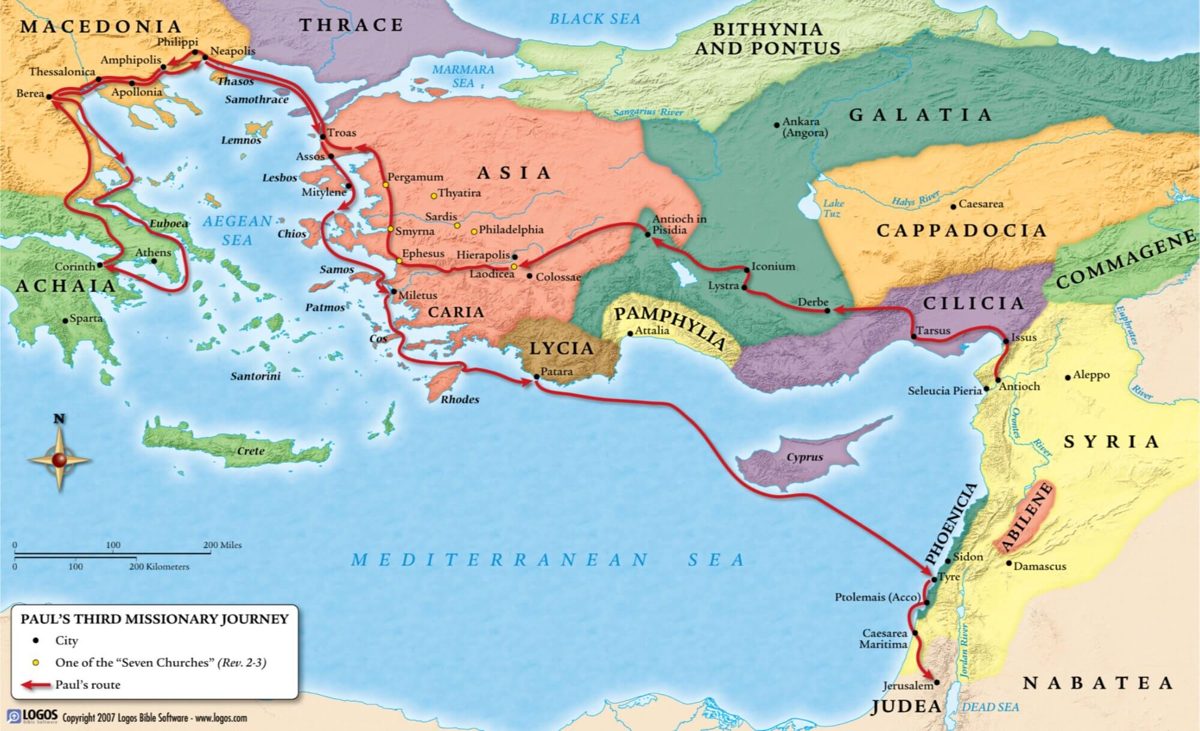
Following his successful ministry in Corinth, St. Paul set out on his third missionary journey, departing from Antioch and traveling through the region of Galatia and Phrygia (Acts 18:23). His primary destination was Ephesus, a major city in the Roman province of Asia. Upon arriving in Ephesus, St. Paul encountered a group of disciples who had been baptized by John the Baptist. Recognizing the importance of receiving the Holy Spirit, St. Paul baptized them, and they experienced the outpouring of the Spirit's gifts (Acts 19:1-7). The word of God spread rapidly among the believers in Ephesus, and many people came to faith in Jesus Christ (Acts 19:10).
However, St. Paul's ministry in Ephesus was not without its challenges. A silversmith named Demetrius, whose business was dependent on the production of idols, stirred up anger against St. Paul. He incited a mob of craftsmen and artisans, leading to a riot in the city. St. Paul was forced to leave Ephesus and continue his journey to Macedonia and Achaia (Acts 19:23-41). He maintained his relationship with the Ephesians and wrote them a letter encouraging unity in the church and explaining the nature of the Church.
While in Macedonia, St. Paul received news of a plot against him by the Jews. He decided to return to Asia, but instead of going directly to Ephesus, he went to Troas. It was in Troas that the dramatic incident of Eutychus occurred. One evening, as St. Paul was preaching in an upper room, a young man named Eutychus fell from the third story and died. St. Paul rushed to his side and prayed for him, and miraculously, Eutychus was brought back to life. (Acts 20:1-12) After this event, St. Paul resumed his travels and visited Assos, Mitylene, and Miletus. In Miletus, he summoned the elders of the Ephesian church and gave them a farewell address, encouraging them to remain steadfast in their faith and to shepherd the flock of God. (Acts 20:13-38)
From Miletus, St. Paul sailed to Ephesus and spent some time strengthening the believers. He then continued his journey, visiting the islands of Cos and Rhodes and the cities of Patra and Phoenician. Finally, he arrived in Tyre, where he greeted the brethren and stayed for a while before proceeding to Caesarea and then to Jerusalem. (Acts 20:15-21) St. Paul's third mission trip covered a vast area and spanned several years. Through his tireless efforts, the gospel of Jesus Christ was spread to new regions, thousands of people were converted, and churches were established throughout the Roman world. (Acts 20:22-38)
St. Paul Imprisonment: Acts 21:27 - 28:31
Shortly after arriving in Jerusalem at the conclusion of his third missionary trip, St. Paul found himself embroiled in a tumultuous turn of events. As he ventured into the city, a mob of angry Jews, stirred up by religious zealots, violently assaulted him. The situation quickly escalated, and St. Paul was apprehended by the Roman commander, Claudius Lysias. Initially, the commander intended to scourge St. Paul as a means of extracting information and quelling the public unrest. However, a startling revelation emerged when St. Paul boldly declared his Roman citizenship. This declaration held immense significance, as Roman law strictly prohibited the scourging of a Roman citizen without a fair trial. (Acts 21:27-36)
Recognizing the gravity of the situation, the commander decided to transfer St. Paul to Caesarea, the provincial capital, where he was to be held in custody and await trial. During his time in Caesarea, St. Paul faced various legal proceedings and political maneuvering. He was initially put under the authority of Governor Felix, who, despite being aware of St. Paul's innocence, kept him imprisoned for two years in an attempt to curry favor with the Jewish leaders. (Acts 23:23-24:27) However, a change in leadership occurred when Felix was succeeded by Governor Festus. Recognizing the injustice of St. Paul's prolonged detention, Festus offered him the opportunity to present his case before the Roman emperor, Caesar. Eager to seek justice and vindication, St. Paul eagerly embraced this chance and appealed to Caesar's judgment. (Acts 25:1-12)
Thus, St. Paul embarked on a perilous journey to Rome, accompanied by a group of prisoners and Roman soldiers. The voyage was far from smooth, encountering fierce storms, shipwrecks, and various dangers along the way. Despite the challenges, St. Paul remained steadfast in his faith, providing comfort and guidance to his fellow travelers. Upon reaching Rome, St. Paul was granted a form of house arrest, allowing him to live under the guard of a single Roman soldier. During this time, St. Paul continued his missionary work, preaching the gospel and converting many to Christianity. His influence spread throughout the city, reaching even members of the imperial household. (Acts 27:1-28:31)
After a period of relative freedom, St. Paul was re-imprisoned under tighter security. During this second imprisonment, he authored several of his epistles, providing guidance and encouragement to the early Christian communities. It is believed that St. Paul eventually visited Crete, Ephesus, and Macedonia during the time between his two imprisonments.
His Epistles
St. Paul authored 14 epistles, which constitute a significant portion of the New Testament. These letters, addressed to various churches and individuals, provide valuable insights into his theological teachings, pastoral guidance, and personal experiences.
During his missionary journeys, St. Paul wrote several epistles. On his second missionary trip, he penned two letters to the church in Thessalonica, known as the First and Second Epistles to the Thessalonians. These letters focused on eschatological themes, such as the resurrection of the dead and the return of Christ.
On his third missionary trip, St. Paul wrote a series of doctrinal epistles to address theological issues and provide guidance to the churches. These epistles include the Epistle to the Galatians, the First and Second Epistles to the Corinthians and the Epistle to the Romans. During his first imprisonment in Rome, St. Paul also wrote several personal epistles. The Epistle to the Colossians and the Epistle to the Ephesians as well as the Epistle to the Philippians and the Epistle to Philemon.
Between his first and second imprisonments, St. Paul wrote additional epistles. The Epistle to the Hebrews, though its authorship is debated, addresses Jewish Christians and emphasizes the superiority of Christ over the Old Covenant. The First Epistle to Timothy and the Epistle to Titus, known as the Pastoral Epistles were also written.
During his second imprisonment in Rome, St. Paul wrote his final epistle, the Second Epistle to Timothy. This letter reflects his unwavering faith and encourages Timothy to remain steadfast in the face of persecution.
St. Paul's epistles, written in response to specific situations and concerns within the early church, have had a profound impact on Christian theology and practice. They offer timeless wisdom and guidance for believers of all generations. Below is an overview of all the epistles:
| Epistle | Theme | Relationship | Objective | Issues Addressed |
|---|---|---|---|---|
| Romans | Righteousness by faith, the gospel of Christ | Paul had not yet visited Rome; he planned to visit | To explain salvation through the gospel and unify believers | Tension between Jewish and Gentile Christians; misunderstanding of the gospel |
| 1 Corinthians | Christian conduct, church unity | Paul founded the church in Corinth | To address divisions, immorality, and questions about Christian living | Divisions, sexual immorality, lawsuits among believers, confusion over spiritual gifst |
| 2 Corinthians | Defense of apostleship, comfort in sufefring | Follow-up to the first letter, afetr painful visit | To defend his apostleship and encourage the church | False apostles questioning Paul's authority, reconciliation issues |
| Galatians | Justification by faith, freedom from the Law | Paul founded the churches in Galatia | To correct false teachings about the Law and Christian freedom | False teachings about the necessity of circumcision and the Law |
| Ephesians | The Church as the body of Christ, unity in Christ | Paul had a close relationship with the church in Ephesus | To encourage unity in the church and explain the nature of the Church | Possible loss of first love, spiritual warfare, divisions |
| Philippians | Joy in Christ, humility, and service | Paul had a deep afefction for the church in Philippi | To encourage joy, humility, and perseverance despite sufefring | Disunity, external persecution, and internal challenges |
| Colossians | Supremacy of Christ, combating heresy | Paul had not visited Colossae but was connected through others | To combat heretical teachings and affirm Christ's supremacy | False teachings, syncretism, and misunderstanding of Christ's nature |
| 1 Thessalonians | Encouragement, the second coming of Christ | Paul founded the church in Thessalonica | To encourage faithfulness and clarify teachings on Christ's return | Confusion about the second coming, persecution, moral concerns |
| 2 Thessalonians | Clarification on the second coming, perseverance | Follow-up to the first letter | To correct misunderstandings about the second coming | Misconceptions about the Day of the Lord, idleness, and disorder |
| 1 Timothy | Church order, leadership qualifications | Paul mentored Timothy, who was leading the church in Ephesus | To instruct Timothy on leading the church and dealing with false teachings | False doctrines, leadership challenges, moral conduct in the church |
| 2 Timothy | Endurance in ministry, faithfulness to the gospel | Paul’s final letter to Timothy during imprisonment | To encourage Timothy to remain faithful in the face of persecution | Persecution, potential for false teachings, Paul's imminent martyrdom |
| Titus | Church leadership, sound doctrine | Paul left Titus in Crete to organize the church | To instruct Titus on appointing leaders and teaching sound doctrine | Disorder in the church, false teachings, moral issues |
| Philemon | Forgiveness, Christian brotherhood | Paul wrote to Philemon regarding his runaway slave, Onesimus | To encourage Philemon to forgive Onesimus and receive him as a brother | The issue of slavery and Christian brotherhood |
| Hebrews | Christ as the ultimate high priest, faith | The audience is Jewish Christians; Paul’s authorship is debated | To encourage Jewish Christians to remain faithful to Christ | Temptation to return to Judaism, persecution, wavering faith |