
- 1 Introduction & Organization
How Will They Apply the Lesson in Their Lives?
Indeed, the objective of Sunday School goes beyond spreading historical information about Christianity. Its primary focus should be to foster an engaging and dynamic learning environment that enables children to establish a personal connection with God. As servants, it is crucial to reflect on how each lesson contributes to helping children not only acquire knowledge about God but also develop a genuine and meaningful relationship with Him.
To illustrate the distinction, consider the difference between knowing about someone and truly knowing them. For instance, you may be well-informed about the President of the United States—his name, family, achievements, and so on—but this does not necessarily mean that you have a personal relationship with him. In contrast, you may have a friend named John whom you genuinely know because you engage in conversations, understand his preferences and dislikes, care about his well-being, and have the freedom to communicate and spend time together.
Similarly, the goal of Sunday School is to cultivate a relationship with God that resembles the latter example. We want our children to develop a deep and personal connection with the Lord, one that is characterized by open communication, genuine care, and a desire to follow His guidance. Rather than merely imparting knowledge about God, our lessons should aim to foster a living, breathing relationship that will guide and sustain them throughout their lives.
Ultimately, our overarching goal is to guide our children toward the heavenly kingdom, a destination of eternal peace, love, and happiness. To accomplish this, we must provide them with a clear roadmap, a spiritual compass that they can rely on throughout their lives. This involves nurturing their spiritual growth and deepening their understanding of the loving, caring, and compassionate nature of God.
By fostering a strong spiritual foundation, we empower our children to develop meaningful connections with God and to align their hearts and minds with His divine teachings. This includes instilling in them a profound understanding of what brings joy to God and what causes Him concern.
Learnings
In the Gospel of John, Chapter 4, we encounter the profound biblical tale of a Samaritan woman's encounter with Jesus, the Messiah. It unfolds in the ancient city of Sychar, where Jesus, weary from his travels, rests at a well. The Samaritan woman's encounter with Jesus becomes a pivotal moment in her life. Many learning can be extracted from the narrative.
“so He came to a city of Samaria which is called Sychar, near the plot of ground that Jacob gave to his son Joseph. Now Jacob’s well was there. Jesus therefore, being wearied from His journey, sat thus by the well. It was about the sixth hour.
A woman from Samaria came to draw water. Jesus said to her, “Give Me a drink.” For His disciples had gone away into the city to buy food. Then the woman of Samaria said to Him, “How is it that You, being a Jew, ask a drink from me, a Samaritan woman?” For Jews have no dealings with Samaritans. Jesus answered and said to her, “If you knew the gift of God, and who it is who says to you, ‘Give Me a drink,’ you would have asked Him, and He would have given you living water.” The woman said to Him, “Sir, You have nothing to draw with, and the well is deep. Where, then, do You get that living water? Are You greater than our father Jacob, who gave us the well, and drank from it himself, as well as his sons and his livestock?” Jesus answered and said to her, “Whoever drinks of this water will thirst again, but whoever drinks of the water that I shall give him will never thirst. But the water that I shall give him will become in him a fountain of water springing up into everlasting life.” The woman said to Him, “Sir, give me this water, that I may not thirst, nor come here to draw.” Jesus said to her, “Go, call your husband, and come here.” The woman answered and said, “I have no husband.” Jesus said to her, “You have well said, ‘I have no husband,’ for you have had five husbands, and the one whom you now have is not your husband; in that you spoke truly.”... The woman then left her waterpot, went her way into the city, and said to the men, “Come, see a Man who told me all things that I ever did. Could this be the Christ?” Then they went out of the city and came to Him.” (John 4:5-18,28-30)
In order to break down a lesson, thereby allowing others to apply it to their lives, one must have a manner by which to dissect the information presented. Below, there is a formulaic route to understanding each lesson and attempting to apply it to one’s own life, through the examples seen in the final step of the flow chart. The passage above from John 4 can be divided into these categories, to allow for a deeper understanding of the lesson and its roots in Christianity.
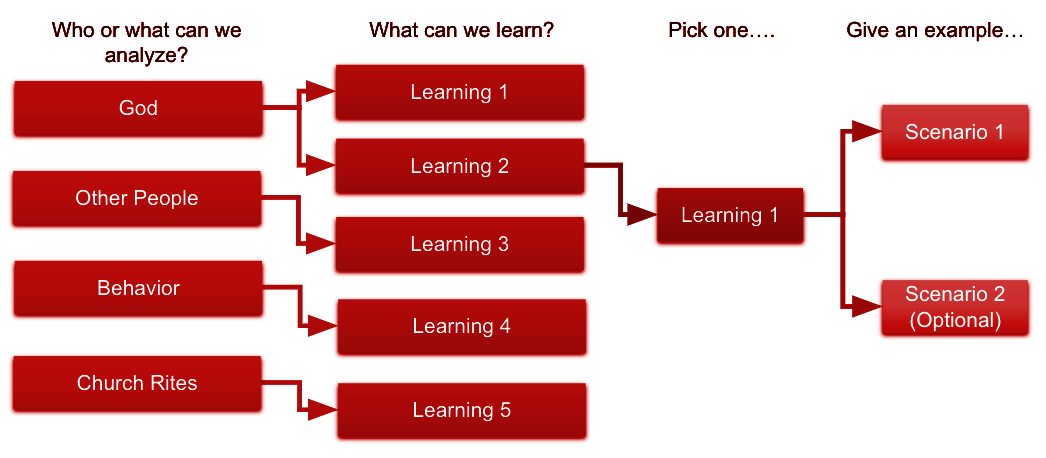
First, we must analyze, which may mean we have to re-read it several times. Next, a comprehensive examination of each component of the flowchart should be conducted. God – what did He do? How did He react to certain behaviors; we need to evaluate this because this reveals to us about the characteristics of God, so that we may feel closer to Him. Following this, an examination of the other individuals in the story should be undertaken. Are they rich, poor, greedy, selfish, kind, giving, etc.? Consider the potential lessons that can be learned from their experiences. The next step involves analyzing behaviors, particularly instances of anger, lack of faith, and disobedience, as these provide insights into how individuals respond in various situations. Lastly, attention should be paid to any Church Rites present in the story, which can be less obvious in stories as these may offer valuable lessons regarding appropriate conduct within the church and its community.
Then once we have evaluated all the different story components, one can think about the learnings themselves. Analyze your initial thoughts, and come up with a few learnings. As a very important note: do not make up interpretations! Pick one that you feel is the most appropriate, as well as is unique to this story. Lastly, try to give an example; start thinking how can this apply in their lives? This is where the role of application comes in, as they may feel the lesson’s presence in their lives moving forward, as well as feel much closer to God.
What Makes a Good Lesson Application?
A good lesson application should follow the acronym S-A-U-L-S:
S - It is specific
A - It is age appropriate
U - It is unique
L - It is linked to the story
S - It has a modern day scenario
- S - Specific:
- Define abstract concepts: Break down abstract concepts into tangible and age-appropriate examples. For instance, explain the concept of courage by sharing stories of heroes from everyday life or from children's favorite books.
- Real-life examples: Use real-life stories, situations, or characters to illustrate the concept, making it relatable and meaningful to the children. For example, discuss how a child in the class demonstrated kindness by helping a friend in need. It is very common to tell the kids, “you have to be humble,” however the reality is, they probably do not know what that means.
- A - Age-appropriate:
- Consider mental capacity: Tailor the lesson application to the children's mental capabilities, attention span, and cognitive development. For younger children, use simple and straightforward examples, while older children can handle more complex concepts.
- Avoid advanced concepts: Steer clear of concepts that are too advanced or complex for the age group, as they may lead to confusion and disinterest. For most children in younger grades, and even some older grades, talking about the living water can is too difficult for their age group. In general, keep in mind their mental capacity, attention span, etc.
- U - Unique:
- Choose uncommon applications: Select an application that is not commonly found in other lessons to increase its memorability. For example, instead of a traditional worksheet, create a role-playing activity or a hands-on experiment to reinforce the lesson.
- Capture the essence: Ensure the application is unique to the story and captures its essence, providing a fresh perspective on the lesson. For instance, if the story is about friendship, design a collaborative project that requires children to work together and learn the value of teamwork. Or, for instance, St. Mary of Egypt talks about purity but also talks about how God loves us. Pick the one that is unique, as this keeps the children interested and makes for a memorable lesson.
- L - Linked:
- Direct connection to the story: Make sure the lesson application is directly linked to a specific part of the story, rather than being a general or vague concept. For example, if the story is about a character overcoming a challenge, create an application that allows children to reflect on their own experiences of overcoming difficulties. A lesson application from the story of Jonah cannot be to a life of purity.
- Provide concrete examples: Offer concrete examples that demonstrate how the application relates to the story, helping children grasp the connection. Link to a specific part of the story, not too generally or vaguely. For example….”just like the Samaritan woman did this…..we should do the same…” What did she do? Always remember the first “S” and be specific.
- S - Modern-day scenario:
- Relatable examples: Use modern-day examples, situations, or scenarios that children can easily relate to and encounter in their daily lives.
- Avoid distant or irrelevant examples: Steer clear of examples that are too distant or irrelevant to the children's experiences, as they may not resonate with them. Do not give an example of something that could happen at work or financial issues that do not really apply to them, as this will increase difficulty when it comes to them applying the lesson back to their own lives.
By incorporating the S-A-U-L-S acronym in lesson applications, educators can ensure that their lessons are specific, age-appropriate, unique, linked to the story, and have modern-day scenarios. This approach fosters deeper understanding, retention, and personal growth, creating a lasting impact on children's learning journey.
Analyzing Lesson Applications
If a lesson application comes back from a student and reads “never lose hope and know that God is always with us.” Although this is a kindhearted message, once we go through ‘SAULS,’ we will see that it is far from the ideal lesson application model. Concerning “specific,” it is very vague and therefore does not match the criteria needed; next comes age appropriate, which is achieved. The “U,” is disregarded altogether, as this sentiment is well known and not necessarily unique. It is so vague that it is not linked to the story either, and lastly there is no scenario given for the final ”S” in ‘SAULS.’ Therefore, objectively, this lesson application needed a lot of improvement, however true their statement might be.
On the other extreme, if the learning looks like this: “be friendly to everyone, seek the living water, be honest and say the truth when asked, praise others when they do well, or tell others about Jesus and spread the word”, then they have checked off most of the boxes of ‘SAULS,’ as these are the actual learnings of the Samaritan woman lesson. However, by keeping them altogether, the learning is no longer unique and specific. Only one should be chosen.
Further analyzing, provided we are choosing an application for 3rd graders, being friendly is common in many topics, seeking the living water is not age fitting honesty is good and unique, praising others is good as well, preaching and telling others about Jesus seems unlikely for that age. First part is picking the learning. Say we pick Honesty. Link it back to the story. Don’t tell them, “just like we learned today…” Be specific, tell them which part of the lesson are we learning from? We learned from what the Samaritan woman did. For example, honesty plays a big role, as just like the Samaritan woman was honest and said the truth that she had no husband, Jesus praised her for that. We should do the same, meaning we should always say the truth when asked, even if it may be embarrassing or get us in trouble.
The second part of the lesson is the scenario, which is where you need to get creative. You need to think of a scenario that will help them behave appropriately in their everyday life. Again, do not talk about a scenario where you are driving and something happens, as they likely do not drive. It must be something that they can go through or relate to at the very least. This is the type of scenario logic that is expected of the servant, particularly toward the younger age groups: if you are playing at home and while hitting the ball you accidently broke that really nice flower vase in the living room, but no one saw you, would you tell your parents about it? What would you do, tell her it was your little brother or sister, or tell her that it just fell all on its own? No, today we learned to always say the truth as Jesus will be very very happy with us. You should apologize and tell her that you broke it even if you’ll get in trouble for doing that.