- 1 Introduction & Organization
Lesson Preparation – The Three Components
Throughout service, the servant will hear the following 3 terms: Lessons plan, Lesson Preparation and Lesson Application. It is essential to differentiate among these concepts, especially distinguishing lesson plans from lesson preparation. While related, they represent distinct aspects of the teaching process.
Lesson preparation refers to the complete list of activities that needs to be undertaken in order to ensure they are adequately equipped to deliver a specific lesson on a given day. It encompasses a wide range of tasks that go beyond simply gathering materials and writing a lesson plan. Lesson preparation involves a holistic approach that integrates prayer, practice, and planning.
Effective lesson preparation is essential for quality teaching and student learning. It enables servants to be well-equipped, organized, and confident in their ability to deliver engaging and impactful lessons. By incorporating prayer, practice, and planning into their lesson preparation routine, servants can create a conducive learning environment for the Holy Spirit to work. We will go through them one by one:
Prayer
The first component is prayer. This allows God’s guidance in preparation of the lesson and classroom. Secondly, it allows for God to help the attendees open their hearts. The servants can ask the Lord for more support through prayer, as well as can ask for spiritual growth, as the students are not the only ones hoping to learn.
Before you start working on your lesson, pray everyday for God’s guidance in what you are going to say. Pray for Him to open the hearts of the kids. You can prepare the most amazing lesson and really cool games and activities for them but they do not benefit from it. Perhaps they will not show up at all. Only God can work in their hearts, we can solely do our part only. Pray for the servants in your class to be able to support the service. Next, pray for God to teach you through the lesson as well. Serving in Sunday school is not about teaching, as we are not teachers, but this service is a blessing and a way for me to grow in my own spiritual life. Ask God, what do you want me to learn? What is the message that you are sending me, personally?
Prayer is a vital aspect of lesson preparation, as it provides servants with spiritual guidance, wisdom, and strength. Through prayer, servants seek God’s assistance in understanding the needs of their students and in delivering lessons that are aligned with their spiritual growth.
Practice
The second component is practice. Practice is another crucial component of lesson preparation. It involves servants rehearsing the lesson content, practicing teaching methods, and anticipating potential questions or challenges they may encounter during the lesson. By engaging in practice, educators can refine their delivery, address potential roadblocks, and ensure a smooth and effective teaching experience.
Yet, though practice is an essential component of lesson preparation, it goes beyond simply rehearsing the material. It involves servants actively engaging with the content, reflecting on their own understanding, and applying it to their personal lives. By practicing what they teach, servants not only reinforce their own knowledge and skills but also become more authentic and relatable role models for their students. Additionally, practicing the material helps servants identify potential challenges or areas of confusion that students may encounter, allowing them to anticipate and address these issues effectively.
For example, practice is not just in the literal sense, but also in virtues taught, such as thankfulness. The servant that teaches it, must practice it. Similarly, when it comes to the liturgy, importance of communion, coming early, etc. – the servant is to be their example. This cannot be stressed enough; the kids watch servants more than they listen to them, such as during liturgy and other times. When a servant tells them to come early to liturgy but then they see them walking half-way, what kind of message is that giving them? Or, perhaps, they are told they need to speak softly and not shout but they are yelled at during class. What message is that giving them?
Lesson Plan
The final aspect of a lesson is planning. You must have a lesson plan document. As previously mentioned, ”lesson preparation” and ”lesson plan” are two distinct concepts. Both are related but are not the same thing. Lesson preparation means all the things that you have to do in order to be prepared to teach the lesson that day.
Planning is the foundation of lesson preparation. It involves developing a structured and coherent lesson plan that outlines the learning objectives, materials, activities, and assessment strategies for the lesson. The lesson plan serves as a guide for servants, ensuring that they cover the intended content and engage students in meaningful learning experiences.
When forming a lesson plan, there are two questions that must be asked: what will I teach them? And, how will I teach it? This is what you will be explaining in your lesson plan. We will try to answer both of these questions throughout the remainder of this section.
What will I teach them? The Curriculum
Below, there is a sample curriculum lesson plan, particularly for grade three, to use as a template for future lessons the reader must plan. Note the neat order of each section, as well as how concise it is, allowing the speaker to elaborate on their own time, should they be presenting. Additionally, there are many commendable Bible verses listed, which is good for those who wish to search them up during the lesson, save them on their phone, write them down, etc.
Recall the first of the two key questions to ask oneself: what I will teach them? This is somewhat easy because there is a diocese curriculum for the whole southern diocese and all the churches follow this curriculum. You can find this curriculum on the diocese website: www.suscopts.com/ssc . Pick your grade, and download the Sunday School Curriculum.
Just as is shown above, the outline should contain the following items:
- Objective – What are we trying to get them to learn about today?
- Memory verse - This is the verse that the kids will memorize for that day.
- References - These are typically a
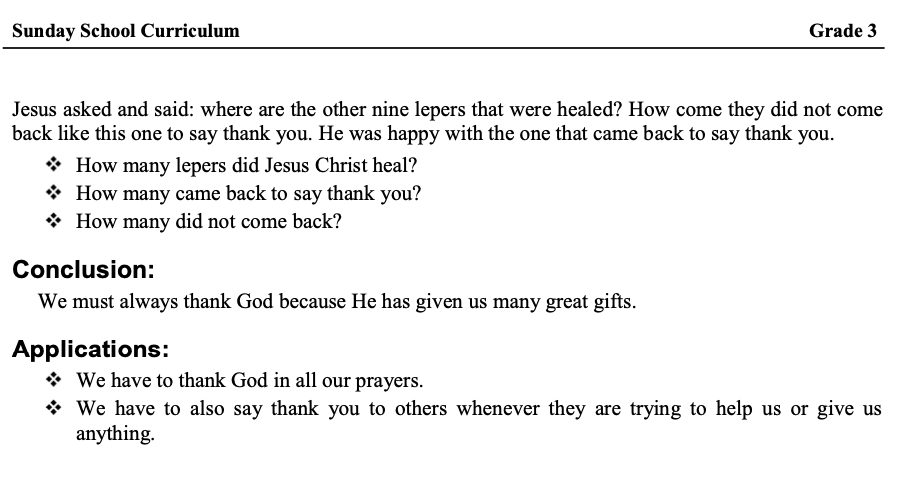
reference to the Holy Bible, (where is this story located within,) or could be references to other books that talk about this subject.
- Introduction – This is meant to get the
kids excited about this subject, or try to bring it down to their level. - Lesson outline – This is the actual story
or lesson that we need to teach them. - Conclusion and lesson application – These components summarize what is said, as well as provide a practical application.
Recall, once again, the second key question to ask: what will I teach them? Below it will be broken down into sections, allowing for a good flow, as to not overwhelm both the servant and the students.
Part A: Basic Information
In an effective lesson plan, the initial phase plays a pivotal role, setting the stage for a captivating learning experience. During this crucial stage, the teacher's responsibility is to create a conducive environment, capture the students' attention, and provide a solid foundation for the lesson to unfold.
In the “Children of Light” curriculum, each lesson is part of a building block which is itself part of a theme for the year. By reviewing the building block at the start of each lesson, the servant ensures the student is up to date and sees the vision of the year and lesson. The underlying principles of the lesson plan to be presented for an effective lesson can be encapsulated as follows:
- Building Block Review:
- The lesson begins by clearly stating the date and providing a sense of time and continuity for the students within the building block. Connecting the lesson to the students' prior knowledge and experiences can help make the learning process more
meaningful. This helps them situate the lesson in their minds and understand its position within the broader curriculum.
- Next, the teacher introduces the lesson title, which serves as a captivating hook. A well-crafted title piques the students' curiosity, generates anticipation, and hints at the main theme of the session.
- Memory Verse:
- To set a spiritual tone and reinforce the lesson's message, the teacher introduces a memory verse related to the theme and the lesson.
- The students are encouraged to repeat the verse after the teacher, fostering active participation and creating a sense of shared purpose. This practice also helps the students develop their memory skills and strengthens their understanding of the lesson's central message.
- Creating a Comfortable Atmosphere:
- Recognizing the importance of a conducive learning environment, the teacher takes a moment to ensure that the physical setting is comfortable and conducive to learning. This includes arranging comfortable seating, ensuring appropriate lighting, and maintaining a clean and organized classroom.
- To establish rapport with the students, the teacher greets them warmly and creates a sense of community. This can involve a friendly smile, a personalized greeting, or a brief exchange about their day. By doing so, the teacher demonstrates care and sets the tone for a positive and respectful learning experience.
- Grabbing Attention:
- The initial phase presents an opportunity for the teacher to captivate the students' attention and set the tone for the lesson.
- The teacher engages the students with an intriguing question, a thought-provoking quote, or a captivating story that relates to the lesson's objective. This approach stimulates the students' curiosity, ignites their imagination, and makes them eager to explore the lesson further.
- Establishing Objectives:
- To provide clarity and direction, the teacher briefly outlines the learning objectives for the session. This helps the students understand the intended outcomes of the lesson and what they are expected to gain from the experience.
- Clearly stated objectives serve as a roadmap for the learning journey, guiding the students' focus and enabling them to measure their progress throughout the lesson.
- Transition to the Next Phase:
- Once the introduction has been successfully delivered, the teacher smoothly transitions to the next phase of the lesson.
- This transition is vital to maintain the flow of the lesson and prevent abrupt shifts. The teacher provides a natural segue that connects the introduction to the main content, ensuring a cohesive and engaging learning experience.
By meticulously planning and executing this introductory stage, the teacher lays the foundation for a productive and enjoyable learning experience. A well-crafted introduction establishes the context, grabs attention, sets clear expectations, and creates a positive learning environment, all of which contribute to the success of the overall lesson.
Part B: The Lesson
In the previous discussion, we highlighted the comprehensive structure of a lesson plan, which consists of several key sections. The first section focuses on the objective, addressing the spiritual growth of the participants. This is followed by the introduction, which serves as the initial engagement with the topic. The core lesson constitutes the central content of the lesson, delving deeper into the subject matter.
After the core lesson, the practical application section is crucial, as it enables the participants to connect the lesson's teachings with their daily lives. Visual aids play a significant role in enhancing learning and retention, so it is recommended to incorporate relevant visual materials into the lesson. Depending on the age group, there can be additional elements such as take-home activities or simple crafts. These creative aspects actively involve the participants and provide a hands-on experience that reinforces the lesson's message.
By thoughtfully incorporating these sections, we create a structured and engaging learning environment that caters to different learning styles and age groups. This approach aims to foster spiritual growth, promote understanding, and facilitate the practical application of the lesson's teachings in the lives of the participants.
Part C: Take Home Component
This may be in the form of homework or Bible study, once again, depending on the age group. Now, the lesson plan template is complete. However, remember we said as part of preparation….what are the three things we need to put into preparation? Prayer, practice, and planning. Therefore, if it is your turn to teach, you will go to the curriculum to see what you will teach, read it, and then you will start preparing a lesson plan, filled with a multitude of prayer, practice, and planning.
Visual Aids
The human brain processes images 60,000 times faster than text. Visual aids have been found to improve learning by up to 400%. This is why visual aids are so effective in learning, as they can help students to retain more information and understand concepts more easily. There are many different types of visual aids that can be used in Sunday school, including pictures, movies, role play, and 3D models. Each type of visual aid has its own advantages and disadvantages, so it is important to choose the right one for the particular lesson being taught.
If I showed you the picture of the circle, then in one second, you would have known exactly what I was referring to, whereas trying to describe a circle is much more difficult, especially to those who have no prior knowledge of one. Here is another scenario: I describe something in words and you picture said image in your mind; ‘I was on vacation last year with my family, we went to this beautiful beach! It was filled with soft sand, sparkling water, and beautiful palm trees! It is a place I would definitely visit in the future!’ As you can imagine, it was no trouble to develop that mental picture. However, if I asked you to tell me about such a place following my description of it, it is likely it will be much more challenging.
Thus, once again, this emphasizes the importance of visual aids. It is easier to show the children a photo, etc. than to spend so much time and so many words to describe it. And in the end, they might not even get what you are trying to describe or have a completely different picture in their mind. For instance, a few weeks ago, a servant spoke to us about incense and about the censer. If we were to words things to the kids, they probably would not even know what a censer is. Consequently, there are two choices: the servant can try to tell them that it is this round thing with long chains that Abouna holds during the holy liturgy, while smoke comes out of it, or he can show them a picture and they will know exactly what is being referred to. Which one do you think will be easier, as well as more effectively retained in long term memory?
Another visual aid format is movies: children are typically presented with a film depicting the lesson being taught. It is important to note that this is not an excuse to refrain from providing children with direct instruction. While it is beneficial to incorporate videos or other forms of media, these resources should not supersede storytelling and practical hands-on activities, which are considerably more effective for educational purposes.
As mentioned previously, pictures are a simple but effective way to illustrate concepts and provide students with a concrete image to remember. They can be used to show objects, people, places, or events. Movies can be used to tell a story or to provide a more immersive experience. They can be especially effective for engaging students who are struggling to read or who have difficulty paying attention.
If deemed appropriate, role-playing can also be incorporated into a lesson. This entails enacting the story in class. The teacher can either assume the role of the characters or have the students act out the story based on the teacher's narration. Either way, it will serve as a visual aid, and a core memory that will become much easier for them to retrieve later on, leading to more effective learning.
One can also build 3D models, use puppets, or begin other competitions/ activities that will keep the children engaged and more eager to learn what is being taught to them. No matter what type of visual aid is used, it is important to make sure that it is relevant to the lesson being taught and that it is presented in a way that is engaging and easy to understand. Visual aids should be used to supplement the lesson, not to replace it. Servants should also make sure to give students time to process the information and to ask questions. When used effectively, visual aids can be a powerful tool for teaching and learning. They can help students to retain more information, understand concepts more easily, and develop a deeper appreciation for the subject matter.
Gentle Reminders
Always write lessons, games, etc. in your own words, and read the tips in the template, if provided online. Furthermore, make sure that what is being taught is accurate, as well as capable of getting the kids engaged. Finally, remember to add a lesson application: what did we learn from that lesson, and how can we use it each day?