
- 2 Relationships
Complexity of Discipline
Discipline is a broad and complex subject. Although it is not possible to cover every aspect exhaustively, this chapter aims to provide foundational guidelines for understanding and implementing discipline effectively. It encompasses guiding individuals towards self-control, responsibility, and respect for others. We will explore the nature of discipline, its theological underpinnings, and practical approaches for its application.
Discipline vs Punishment vs Abuse
Understanding the distinctions between discipline, punishment, and abuse is crucial for effective service and teaching. These terms, though often used interchangeably, represent fundamentally different approaches with distinct outcomes on the individuals involved. Can you tell the difference?
Discipline
Discipline is inherently constructive and goal-oriented, aiming to teach and guide individuals towards better behavior and self-control. It is not merely about correcting mistakes but about fostering growth and instilling values that will benefit the individual in the long term. Its purpose extends beyond mere rule enforcement; it encompasses guiding individuals towards self-control, responsibility, and respect for others. Discipline serves an educational role by teaching responsibility and self-control.
The key characteristic of discipline is that it is done with love. This approach is rooted in a desire to nurture and support, ensuring that the individual understands the reasons behind the rules and the importance of adhering to them. For instance, saying no to a child who wants another toy, despite already having many, is a form of discipline. It teaches the child moderation and prevents them from becoming spoiled. This act is not a punishment but a way to guide the child towards responsible behavior and self-control.
Punishment
Punishment, on the other hand, often stems from a place of anger and frustration. Unlike discipline, punishment is less about teaching and more about expressing dissatisfaction or anger towards the individual’s behavior. It is typically a reactive measure, focusing on penalizing the wrongdoings rather than guiding the individual towards better behavior. Punishment can be destructive, leading to fear, resentment, and a breakdown in the relationship between the servant and the individual. When punishment is administered, it often lacks the constructive, goal-oriented nature of discipline and instead serves to vent the anger of the person administering it. This can result in negative emotional outcomes, such as fear and resentment, rather than positive behavioral change.
Abuse
Abuse is a severe form of mistreatment that involves actions which result in belittling, humiliating, or degrading the individual. Unlike discipline, which is done with love, and punishment, which is often an expression of anger, abuse is characterized by harming the individual's self-esteem and well-being. Abuse can take many forms, including spiritual, physical, emotional, and financial. Spiritual abuse occurs when religious teachings or scripture are misused to manipulate, control, or shame individuals. For example, using biblical verses to guilt or demean someone, even though the intent might seem to be for correction, it is a form of spiritual abuse. Such actions can cause deep emotional and psychological harm and are fundamentally opposed to the nurturing intent of true discipline. Even Satan, during the temptation of Jesus on the mountain, used a verse from Psalm 19 to attempt to mislead. Therefore, it is crucial to be vigilant against the temptation to wield scripture as a tool for manipulation or harm.
If someone of great authority and respect asks you to go hit an individual, will you do it? In 2-3 words – why not?
- Because I’m a Christian?
- Because I’m raised well?
- Because we are in church?
- Because I have to lead by example?
All good answers but the correct answer is….”because I don’t want to hurt them.”
In a Sunday School context, it is imperative to refrain from disciplining students if one is experiencing internal anger. Effective discipline requires a foundation of peace and calmness; it must emanate from a serene and composed heart rather than one agitated by anger. This ensures that the disciplinary actions are constructive and nurturing rather than punitive and harmful. The focus, thus, should be on discipline, which is conducted with love, patience, and a genuine desire to guide and support the child's development.
Theology of Discipline
Discipline, from a theological perspective, is deeply rooted in love and care. Theologically, discipline is viewed as a means of guiding individuals toward becoming who they are meant to be. This concept reflects God’s discipline, which is based on His love for us. For instance, in Hebrews 12:6 and Proverbs 3:12, it is stated that God disciplines those He loves, emphasizing that divine discipline is intended for growth and betterment, not for retribution. “My son, do not despise the chastening of the Lord, nor be discouraged when you are rebuked by Him; for whom the Lord loves He chastens, and scourges every son whom He receives.” (Hebrews 12:6) “For whom the Lord loves He corrects, Just as a father the son in whom he delights.” (Proverbs 3:12)
Divine Love and Discipline
God’s discipline is motivated by His love. It is not for every minor mistake but aims to correct and guide us towards fulfilling our potential. If I allow the child to do whatever they want, is this love? Actually, it's a lack of love! For example, if a child insists on having car keys without knowing how to drive, allowing this would be irresponsible and potentially harmful, reflecting a lack of genuine care. By allowing him to have the keys, this would not be love.
This mirrors how God’s discipline is not arbitrary but aimed at guiding us towards safety and growth. God in his love does not want us to die in our sin, thus the discipline is aimed to protect us from the death that is ensued by sin.
God's Presence and Involvement
God's involvement is intimate and personal. He's not detached from us. He's not in heaven and we're on earth and we're disconnected. Yes, we say Our Father who art in heaven, but God in heaven became Emmanuel (God is with us). He sent His Holy Spirit to live "in" us. This involvement implies that while authority is maintained, God is actively engaged in our lives. He's above us, yet not far from us, because He's in heaven and we're His creation but He came to us and now abides in us through the Holy Spirit. Let us dive into each element of God’s authority and involvement with us using the following table:
| Relation | Application |
|---|---|
| Above – Our Father who art in heaven | If you love your children, keep this hierarchy in the class. If the authority is reversed you cannot discipline them. You are the authority figure, you are the decision maker. In some houses the authority is reversed, the child decides and the parents execute. God does not allow this in our relationship with Him. If He allows that we decide and He executes then it won't work for our benefit. God reminds us "our father who art in heaven" He's above us. |
| With – Became Emmanuel (God is with us) | But at the same time, you are with them, you are involved with them. God's not far from us, He's with us. Although you're the authority figure, you're not disconnected. The kids should not be scared of you or not know how to talk to you. They should not be so scared to come and bring an issue to you. Yes, there is a hierarchy, but the kids feel like you're with them, you sit and play with them on the floor, you go out with them, carry them. |
| In – Sent us the Holy Spirit to live ”in” us | Through love, you are inside their hearts. Same time you're in their heart. |
Sovereignty and Free Will
God’s respect for human free will, even when individuals make poor choices, illustrates a key aspect of divine discipline. Although God is sovereign, He gave us the freedom to make choices and He respects our free will. Even with our freewill when we make wrong choices. Many times God makes us reap the consequences of our choices but He respects our choices, even the wrong ones.
This principle is evident in the parable of the Prodigal Son, where the son’s experiences of consequence are part of his journey back to reconciliation. “But when he had spent all, there arose a severe famine in that land, and he began to be in want. Then he went and joined himself as a citizen of that country, and he sent him into his fields to feed swine. And he would gladly have filled his stomach with the pods that the swine ate, and no one gave him anything. (Luke 15: 14-16) No one gave him anything when he was in need! The father was very rich. Imagine if the father said, "I'll send him some money and some food and so he will see my love and come back to me." Would the prodigal son have come back? Unlikely. That kind of love hurts our children.
For example, a child is speeding, gets a ticket, the parent pays their ticket, speeds again, pays again, speeds again, pays again and then their driving license is revoked so the parents find a lawyer and pay the fees of that lawyer,etc. What are they doing? They are stopping him from reaping the consequences of his wrong behavior. Actually, it can even be considered challenging God's plan. God has a law of sowing and reaping - what we sow we reap. But now we tell God, I will let my son sow, but I will reap.
Practical Implementation of Discipline
Effective discipline in a Sunday school setting requires a thoughtful and structured approach to manage and guide behavior. Addressing common disruptive behaviors involves employing a variety of strategies tailored to the specific context and needs of the children involved. Setting clear rules and expectations at the beginning of the year or class is a foundational aspect of effective discipline. It is important to communicate these rules clearly to students and explain the reasons behind them. This can be achieved through discussions, visual aids, and role-playing scenarios, which help students understand the importance of adhering to these guidelines.
Part 1: Be ready
Know the common disruptive behaviors of each age group. Before beginning the year, speak to previous servants who have served the same kids and seek their insight. Why restart from scratch and come to the same conclusion as another servant 6 months later only to have them go to another class 6 months after! Regardless, have an outright plan to the very least to common disruptive behaviors such as:
- Talking, laughing, or joking during a lesson or activity
- Answering when not being called upon
- Excessive movement during a lesson
- Talking back to servants
- Using inappropriate words
- Sleeping in class
- Playing with their toy/phone, etc.
Part 2: Educate
Education about behavior involves not only setting rules but also discussing the rationale behind them. Explaining how certain behaviors impact themselves and others can help students internalize expectations. This educational approach fosters an understanding of why specific behaviors are encouraged or discouraged. God gave us the commandments, taught us what’s right and wrong. Similarly, do they know what is wrong? Do we set these rules at the beginning of the year/class? Again, train them and explain – take time to sit with the kids, talk to them about their behavior, and try to rationalize the positive impact of why proper behavior has positive impacts.
Part 3 : Chasten
Chastening, as part of discipline, should be tailored to each child and the specific situation. Many different techniques are used but in order to truly be effective, always offer a prayer that God may guide and direct you to the proper method of intervention. Below are a variet of methods than can be used:
Low-profile interventions, such as incorporating a student's name into a lesson example, can redirect behavior without disrupting the entire class. Positive reinforcement, such as acknowledging and rewarding good behavior, is also effective in encouraging desired actions. Additionally, involving students in tasks, such as distributing materials or leading activities, can help redirect disruptive energy into productive activities.
| Intervention | Example |
|---|---|
| Low-profile intervention | Use the student's name in part of your presentation. “As an example, let's measure Michael's height in centimeters.” Michael, who has been whispering to his neighbor, hears his name and is drawn back into the lesson with no disruption of the class. |
| Involve them | Have a child distribute coloring pages or take notes of questions |
| Education | Take the time one on one to help guide the child to be educated on the error separately. Similar to taking a defensive driving course if you get a ticket. Child gets angry and shouts and breaks something. So you ask him to go do a research about anger and get verses from the bible about anger |
| Positive reinforcement | If you don't do this for a certain period of time, I will give you this thing (which he wants). So he will earn what he wants. Not an ideal method since it can be used for manipulation in the long run, but a method nonetheless. |
| Withdrawal of privileges | If you do this or that then a certain privilege will be taken away |
| Beware!! |
- Pick your battles - God doesn't discipline us for every little mistake we do. You’re not going to go through all the stages every time someone does something wrong. Is this something that really needs to be stopped? E.g. a kid that didn’t raise their hand before answering. Must be in proportion to what they did.
- Follow through: Say something and do it. Otherwise they won’t take you seriously, you lose credibility.
- Consistency in my behavior: Kids see inconsistency between your words and your behavior. Who you are and what you want your children to be. That's why we have to be disciplined ourselves.
- Consistent message (word vs action): don’t give contradicting messages. You tell them I love you, but all your actions don't show this love. So the kid gets confused on how to reconcile those two contradicting messages. Do you love him or not? A study of Schizophrenic (skit·suh·freh·nuhk) children - 80% of them show due to receiving contradicting messages from their parents in their early childhood. The kid wants to resolve it but cannot, they start saying I'm confused. I don't know if my dad loves me or not, he says so but his behavior does not.
- Unacceptable Consequences: more on this in the following section.
Acceptable vs. Unacceptable Consequences
When it comes to consequences, it is essential to differentiate between acceptable and unacceptable measures. Acceptable consequences might include withdrawing dojo points, removing candy or other small rewards, or providing assisted time outside of the classroom. Such consequences are intended to be constructive and help students reflect on their behavior without causing undue harm.
Conversely, unacceptable consequences involve punitive actions that can be harmful or excessive. These might include barring students from essential activities like attending liturgy or dressing as deacon,denying outings or crafts, giving timeouts, denying basic needs like restroom access, leaving a child alone outside. Such measures can be counterproductive and do not contribute to the child's development in a positive manner.
Escalation Process
In cases where in-class strategies are insufficient, it is important to follow an escalation process. Initially, address issues through discipline, education, and chastening within the classroom setting. If these measures do not resolve the issues, involve the Coordinator for additional support. The Coordinator can offer further resources and strategies for managing persistent problems.
Should the situation require more extensive intervention, seeking guidance from the priest of your church may be necessary. Abouna's involvement can provide additional support and perspective. As a final step, involving parents may be appropriate, but it is crucial to handle such discussions delicately. Avoid discussing specific behaviors in front of the child to prevent embarrassment, and focus on finding collaborative solutions to support the child's development.
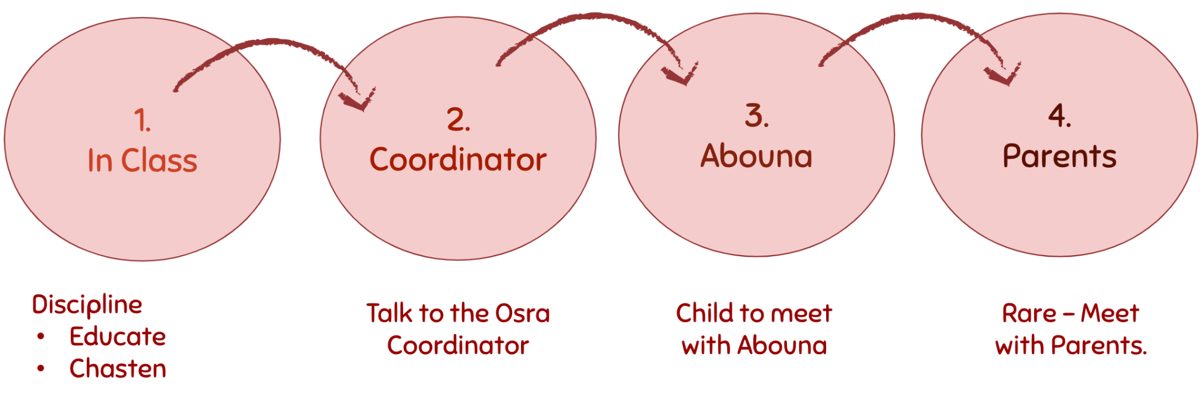
It is recommended not to jump and skip through steps but respect the escalation process. This helps relieve the load as well as enables additional disciplinary measures. By skipping too quickly through steps, the child may, in due time, no longer feel accountable to any of these stages as the most extreme measures were abused and endured.
Help Needed!
Discipline should be approached with love and aim to foster growth and development. Implementing effective discipline requires a combination of thoughtful effort, spiritual support, and consistency. While discipline and dealing with kids requires effort, our efforts are not enough. It needs support from God and direction from the Holy Spirit. Continuously strengthen your relationship with God in order for the Holy Spirit to direct you and guide you with the best way to deal with your children. When we discipline them, they become a light to the world and salt to the earth. Discipline needs our effort, support from God, direction from the Holy Spirit.