Orthodox iconography is not illustration. It does not seek to represent history as a camera would capture it — fixing a moment in its outward appearance and preserving it behind glass. The icon is a window, not a portrait. Through the particular figures, colours, and gestures of a painted surface, the icon mediates the theological reality it depicts — inviting not observation but encounter. The Fathers of the Seventh Ecumenical Council declared that what the Gospel proclaims in words, the icon proclaims in colours. The two are not separate channels of truth but one teaching in two registers. The servant who meditates before an icon is not studying art. They are standing before a witness.
The icons presented in this section are companions for the day and for the weeks that follow it. They are offered not to be glanced at but to be sat with — in the way that the Coptic servant sits before an icon in the midnight praise, returning again and again to the same face until the face begins to speak. Each icon in this series has been selected because it illuminates, from a particular angle, the theological heart of what it means to be wounded and to be found by God within the wound.
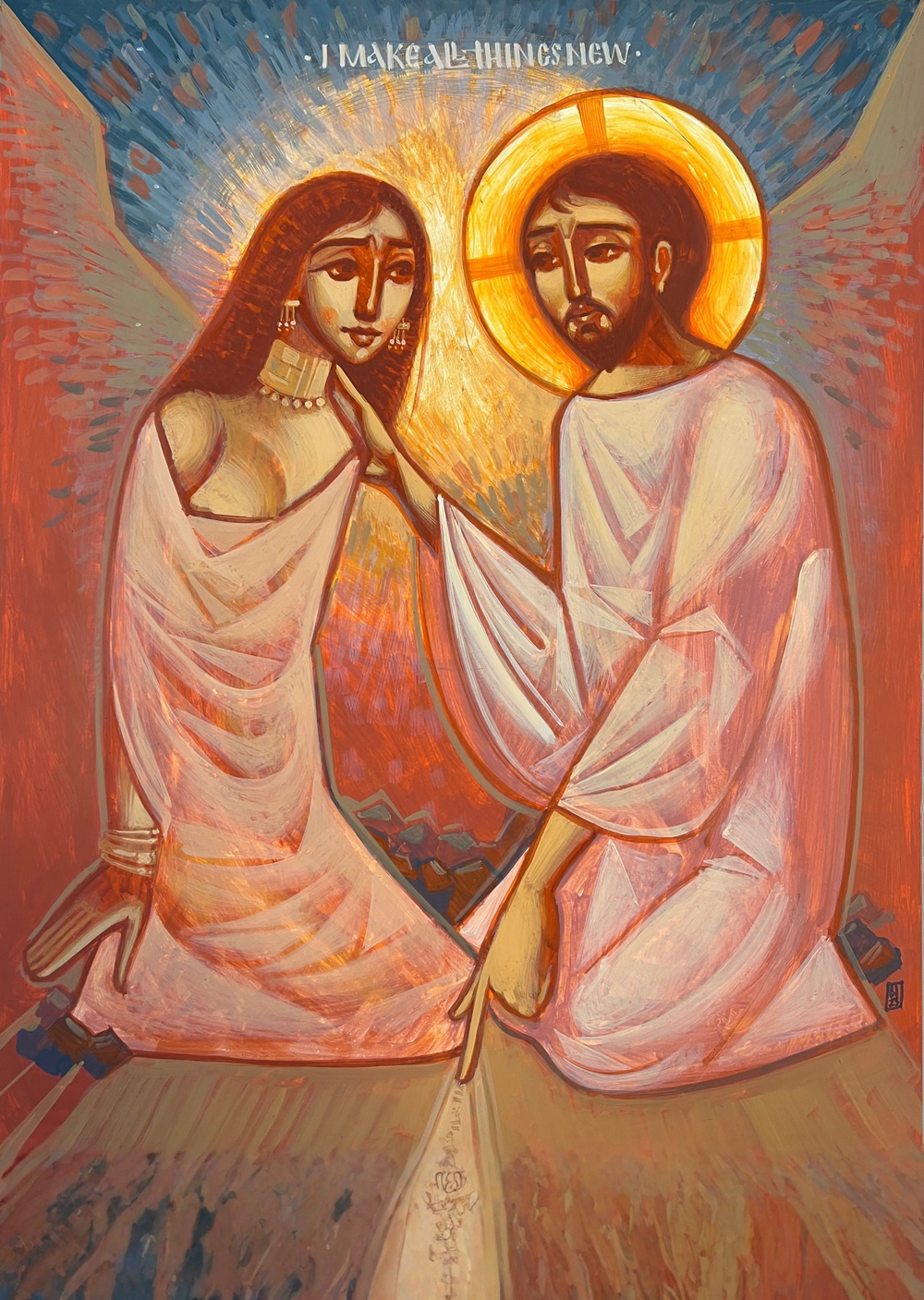
Christ the Bridegroom — Nymphios
"I Make All Things New" · Revelation 21:5
Icon sourced from copticicon.com
“I Make All Things New”
The Woman Caught in Adultery
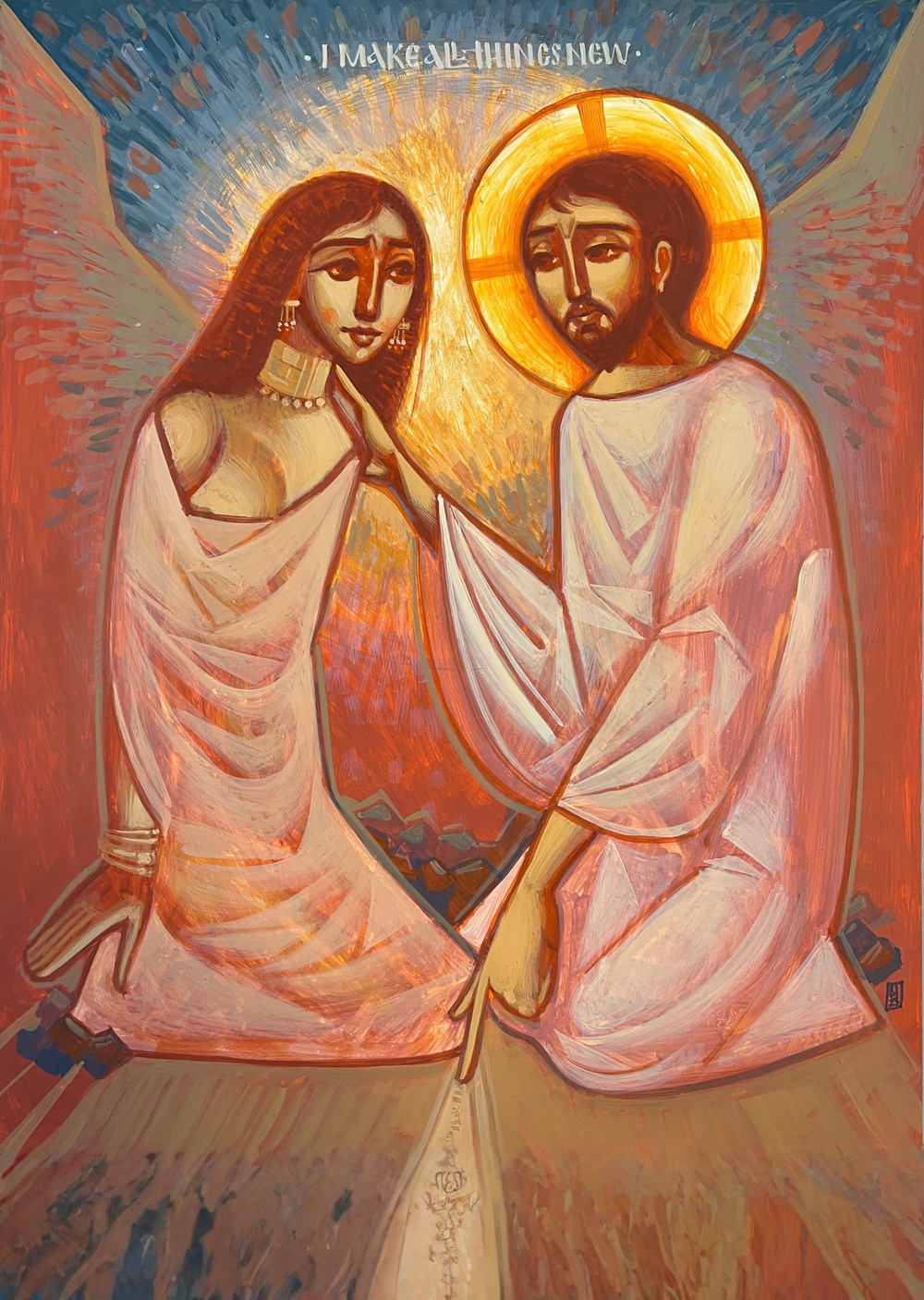
“I Make All Things New” · Revelation 21:5
copticicon.com
“Behold, I make all things new.”
The Artist’s Vision
“Christ in this icon is the Redeeming Groom. He stoops down to His Bride, descends to her Hell, and much like Eve, restores her from the shame and guilt of her nakedness. The early morning of her trial became the dawn of her new life, revealed by the Light Himself.”
The icon holds two figures close enough to touch. A man in white robes, his head encircled by a golden halo from which light radiates in every direction — blue and gold and red, filling the space behind them both. A woman in the same light, her face turned toward His, His hand reaching to touch her cheek. The inscription at the top: I MAKE ALL THINGS NEW. There is nothing in the image that speaks of a courtroom, of accusers, of the crowd that surrounded her that morning. All of that has already happened. What remains is two figures in the light, one reaching toward the other’s face.
The scene is John 8. Early morning in Jerusalem. The scribes and Pharisees bring her in and set her into the middle — exposed on every side. The Law is cited. The question: What do You say? He does not answer. He stoops and writes on the ground with His finger. St Cyril of Alexandria and St Augustine both observe what the crowd does not: that the same finger tracing in the dust of a Temple floor is the finger that once traced the Law in stone on Sinai. The Lawgiver has returned to the dust. He bends. He writes. He descends. When they press, He speaks the one sentence that empties the courtyard. And what St Augustine names in what remains when they are gone is this: two were left, misery and mercy. The woman in her wound. And the One who is incapable of condemnation.
“No one, Lord.”
“Neither do I condemn you; go and sin no more.”
He does not ask about the sin. He asks about the accusers. He receives her at the precise point of her wound — not before it, not after it has been managed, but in the exact moment of it, when the dust has not yet settled and her shame is still raw. He asks only what remains. And when the answer is no one, He confirms it: neither do I.
The Theological Vision
The artist names what the Fathers have always seen in this scene: Christ is the Redeeming Groom — stooping not only in this courtyard but across the whole arc of the Incarnation, from the throne of heaven to the womb of a woman, from Gethsemane to the depths of death. It is the theology of the Anastasis: the same Christ who descends to grasp Adam and Eve by the wrist and draw them from the pit descends here into a woman’s worst morning. He descended to her Hell, and much like Eve, restores her from the shame and guilt of her nakedness. She cannot raise herself. She cannot undo what has been done. What she can do is what the icon shows: she remains. She stays before the One who stayed when all the accusers left. And His hand reaches toward her face.
The love of God does not wait for the Bride to be presentable. It seeks her in the worst morning of her life. This woman does not even cry out. She is simply there, at the bottom of everything — exposed, silent, alone. And He comes.
The Artist on the Inscription
“The early morning of her trial became the dawn of her new life, revealed by the Light Himself. Then Jesus spoke to them again, saying, ‘I am the light of the world. He who follows Me shall not walk in darkness, but have the light of life.’ — John 8:12”
Behold, I make all things new (Revelation 21:5). He does not make new things to replace the old. He makes all things — the broken things, the exposed and ashamed things — new. The wounds are not removed. They are remade. The woman does not leave the courtyard as though the morning had not happened. She leaves carrying a morning that has been transfigured. What had been the worst dawn of her life has become, in the moment He says neither do I condemn you, the first dawn of another one entirely.
For the Servant
The servant who has been in the middle — surrounded, exposed, carrying something that has been seen and cannot be unseen — is the one this icon speaks to most directly. She did not arrive in the courtyard intending to meet Him. She was brought. In her worst moment, in the most exposed place, with no preparation and no opportunity to present herself well, she found that only two remained: her own misery, and a mercy she had not asked for and could not have anticipated.
He asked about her accusers. He confirmed there were none. He sent her forward, not backward. He did not give her back her past — He gave her a morning. Not with consolation in the sense of being told it does not matter. But with the word that is harder and better than consolation: neither do I. And then: go. And then: I am the light of the world.
He makes all things new. Including the wound. Including this morning. Including you.
Icon Source
The icons used throughout this day are sourced from copticicon.com. We commend this resource to any servant who wishes to sit with these images in their own prayer and reflection. Additional icons for this day will be added to this section as the Trilogy of Love develops.