Wounded with Love
Fr Emmanuel Iskander
What does it mean to be struck by the arrow of Christ — and how does the wound He gives become healing?
Delivered by Fr Emmanuel Iskander · Recorded live · June 20, 2026 · Download MP3 ↓ · Jump to Transcript ↓
"I am wounded with love."
The Arrow of the Word
The Septuagint renders Song of Songs as "I am wounded with love" — not the softer "lovesick" of modern translations. St Augustine reads this as the soul struck by the arrow of the Word, Christ Himself. St Ambrose agrees: the Word of God inflicts the wound — but, remarkably, it is a wound that does not produce a sore. It remains a wound only as long as we desire and do not yet have what God is forming in us through it.
The talk traces this wound through Scripture and the lives of the saints — through St Augustine's own burning heart, through the Bishop of Jerusalem who was struck blind in one eye until he learned charity, through St Paul's litany of suffering in 2 Corinthians 11 and his vision of Paradise in 2 Corinthians 12, and through the prophet Ezekiel, who lost his altar in exile and was given, in its place, a vision of the Incarnation itself.
Every servant carries their own arrows. The question the talk leaves us with is simple and demanding: will we work with Christ in the wound He has given, so that it can heal — or will we reject it, and let it remain a wound all our lives?
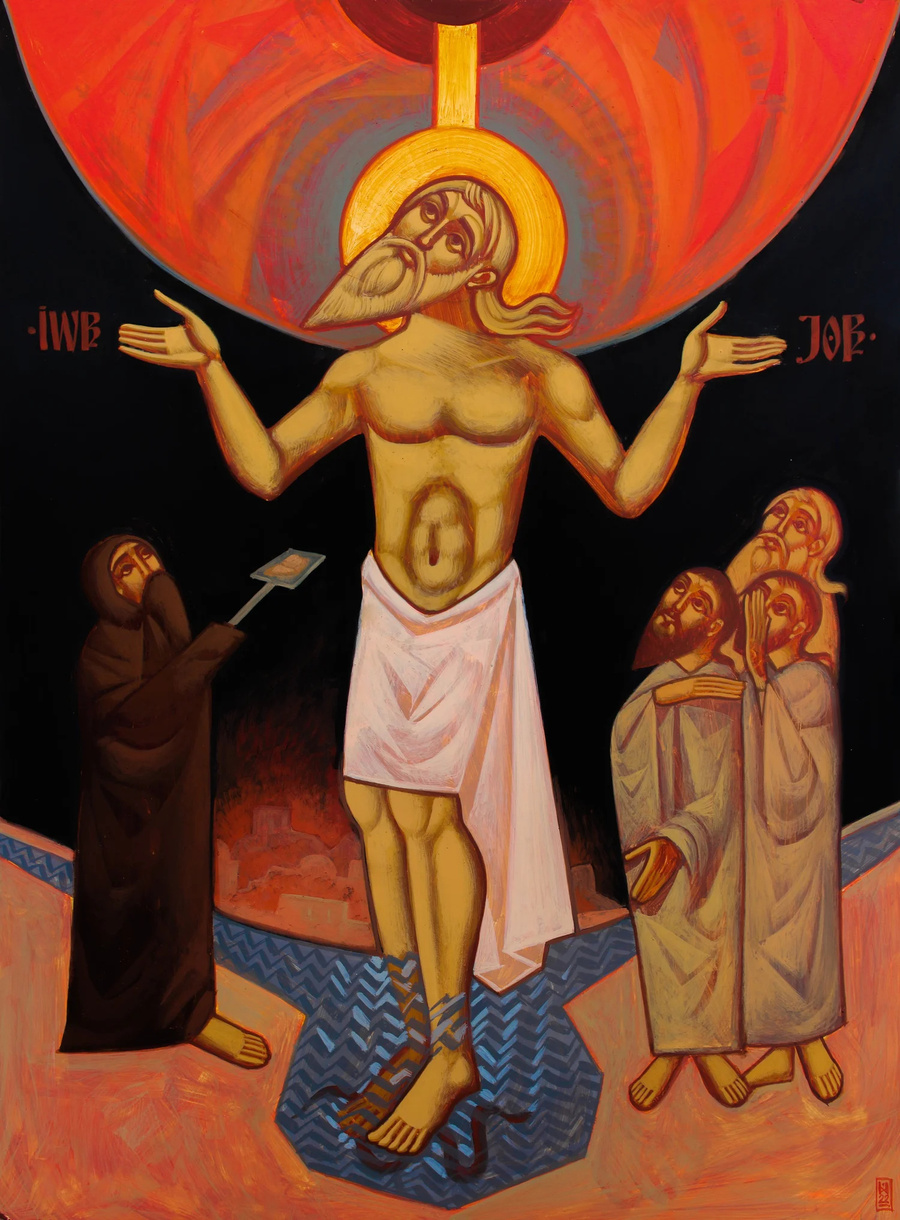
Job · Glory to God for All Things
Full Transcript
Lightly edited for readability from the live recording, June 20, 2026.
In the name of the Father, and the Son, and the Holy Spirit, one God, amen.
It’s lovely to be with you today, to see such beautiful faces, and to pray the Divine Liturgy with you. If you think of the perfect way we can have fellowship in Christ, it’s always the Divine Liturgy — because when we eat His Body and drink His Blood, we have His Body and Blood in us, and we become His Body in His Body, and He is the Head. So we become united in Him. And this is the state of perfection for us: to be in the Body of Christ, and to share in fellowship with each other as we go into eternal life together.
Now, we speak a lot about being “wounded with His love” — we’ve even read beautiful books about it — but there might be some confusion as to what wounded actually means. So I think it’s important to define it: what do the Fathers and the Bible say about being wounded with Christ, or struck by Christ? What does it mean, and how do we proceed?
It appears in the Bible twice — “wounded with love,” in the Song of Songs. It comes from Song of Songs chapter 2, verse 5, and chapter 5, verse 8. If you look at the New King James Version, it says, “I am lovesick.” But if you look at the Septuagint, it says, “I am wounded with love.”
It’s important that you keep something like the Orthodox Study Bible with you, and the Septuagint, because the Septuagint is the Greek translation our Fathers used. They didn’t use the New King James Version — that’s only been around for a few hundred years. It’s a good translation, don’t get me wrong, and it was approved by the Church. But the Septuagint also contains all the books that the Protestants threw out. So it’s good to have that, because sometimes when you look at a word, what’s the first thing you think of when you hear “I am lovesick”? Teenagers with their first crush. That’s what you hear with the kids these days. But when you hear “wounded by love,” it has a certain depth to it.
So don’t be afraid to keep a few Bibles on your desk — and definitely the Septuagint — because the books contained in the Septuagint translation are the ones our Fathers and the early Church used. The Book of Tobit, for instance — isn’t that a beautiful book? They threw it out. The chapter of Susanna — usually the last chapter of the Book of Daniel — they threw it out. So let’s get into the habit, as servants, of looking at those stories again and reading them. Maccabees, and all of it — beautiful things happened there. We’ve just accepted the translation we’re going to use.
So, Song of Songs 2:5: “Sustain me with cakes of raisins, refresh me with apples, for I am wounded with love.” That’s the first time it appears in the Bible. And then a few chapters later: “I implore you, O daughters of Jerusalem, by the gazelles or the does of the field, if you find my Beloved” — that’s Christ — “what will you tell Him? That I am wounded with love.”
So let’s define it. How are we wounded with love?
Our father St Augustine says: “I am wounded with love” — that is, of being in love, of being inflamed with passion, of sighing for the Bridegroom, for she has received the arrow of the Word. You can see — like in the Song of Songs — there’s a lot of emotion, a lot of love directed toward the Bridegroom, and St Augustine has those same feelings. He’s inflamed with the love of Christ; it burns in his heart. Someone once asked one of the Fathers, “What is in your heart?” And the father said, “I wish I could cut my heart into a million pieces and give it to everyone around the world.” Why? Because he loved God so much, he had learned that to love his neighbour is to love God Himself. He wants to cut his heart into a million pieces. And I think it was St Ignatius who said something similar — if you were to cut his heart into many, many pieces, each piece would cry out for the love of God.
So it’s the love of God — but St Augustine says, at the end, “for she has received the arrow of the Word.” Maybe you start picturing in your mind the Roman god Cupid, who shoots an arrow and that person falls in love with someone else. St Augustine is using a similar kind of image, but he says “the arrow of the Word.” So it’s not Cupid, the Roman god of love — it’s the Word Himself. Who is the Word? Christ.
Can you imagine, in the mind of St Augustine, Christ shooting an arrow into the very soul of a man or a woman — into their very soul? This arrow flies and strikes the soul. Now what happens when the arrow strikes the soul? Another father tells us — this is St Ambrose. He says: “The Word of God inflicts our wound.” So he agrees with St Augustine: the Word of God inflicts the wound. But, he says, it does not produce a sore. That’s a bit strange to us. When you fall over, the first thing that happens is you get a wound — it bleeds, and then it can turn into a sore, it might get infected, and you need to treat it until it fully heals. But the wound of love from Christ is a wound that does not produce a sore.
So if the wound doesn’t produce a sore, what does it do? St Augustine again tells us: the wound of love is health-giving. It heals — it heals without producing a sore. We’ll give some examples soon so you can understand, but first, the definition. The arrow shot by the Word of God, Christ, flies, strikes the soul, produces the wound — but not a sore. And this wound heals.
So can the wound just remain a wound forever? When will this wound — that doesn’t produce a sore — heal? Again, St Augustine tells us: it is called a wound as long as we desire and do not yet have. So until the purpose of God, of Christ, is fulfilled in your soul, it remains a wound.
What does this mean? He gives an example, so we can understand. “I am wounded with charity.” So Christ fires an arrow of charity into the soul — and Christ can fire many arrows. This particular arrow that St Augustine is talking about is the arrow of charity. When is this wound healed? When our desire is satisfied with good things. He’s telling us: when Christ wants to teach a soul how to be charitable, He fires the arrow, and it creates a wound. And that person will continue to carry this wound until he learns how to be charitable.
Let me give you an example — one we actually heard about in today’s reading from the Synaxarium. There was a bishop, a monk named John, and another, his friend, named Epiphanius. They both excelled in their spiritual lives. John was chosen as Bishop of Jerusalem, and Epiphanius — from memory — Bishop of Cyprus. They excelled in their spiritual life. But then the love of money entered into the heart of John, Bishop of Jerusalem. When he began to receive money — donations from the churches and the people — instead of giving it to the poor, he thought, “Maybe I can upgrade my residence a little.” So he had silverware specially made for his table. Whenever anyone came to dine, instead of eating from common dishes, they ate from silverware.
His friend Epiphanius, Bishop of Cyprus, heard of this, and he was troubled. “This can’t be the same John — the one I was with in the monastery. It can’t be him.” So, out of love, as a deed of charity, he went to see if it was true. He arrived at the residence, and John had prepared a meal for him, and out came the magnificent silverware — to the shock of Bishop Epiphanius. He held his tongue and said nothing, but he left the meal thinking, “What has happened to this great man? The rank of bishop has destroyed him.”
So he prayed, and he came up with a course of action. After a few days, he sent a messenger to Bishop John, saying, “Would you mind if I borrowed your silverware? I have some friends coming.” Bishop John said, “Yes, of course — you’re my friend, you can borrow it.” Epiphanius took the silverware, but he had no guests coming. Instead, he sold it and gave the money to the poor — where it should have gone in the first place.
After a few days, Bishop John sent word to Epiphanius: “Could you please return my silverware? I need it.” And Epiphanius said to him, “I’m sorry — forgive me. I sold it and gave it to the poor.” This enraged John. He became enraged and began to fight him — physically struck him. The Bishop of Jerusalem, striking the Bishop of Cyprus. It became a great commotion. Epiphanius began to pray to God for help, and God struck John of Jerusalem with blindness.
When John was struck blind, he came to himself, and Epiphanius said to him: “How could you? How could you leave the poor? How could you forget your flock, forget your beginnings, and indulge in gold and silver that will one day melt away and perish?” And John realised his mistake, and he wept, and he confessed everything. Then he said to Epiphanius, “What about my eyesight — I am blind.” So Epiphanius prayed for him, and God opened one eye but left the other closed. So he remained blind in one eye, with the other able to see. And Epiphanius said to him, “It seems God wants you to remember this, so that you never fall into that sin again.”
What happened then? John became the most charitable man — he gave everything to the poor, to the Church, to those in need — to the extent that the Synaxarium tells us he didn’t even have a single coin to his name when he died. Nothing. He went from gold and silver to having nothing at all.
Do you see now? This is a good example. Christ sees our soul in trouble — a soul that would otherwise be lost — a man who was good but had fallen into the devil’s trap. So Christ, in His love, fires the arrow of charity. It strikes him, and it wounds him. And we said it doesn’t create a sore — you might say, well, he was blinded in one eye — but it did not create a sore in his spiritual life. The wound healed his eternal life. And once healed, he was able to give everything to the poor, so that he didn’t have a single coin to himself when he died. Was he healed? Yes. The wound healed.
This is what Christ does. He shoots the arrow, it wounds the person, and then it heals — if they accept it, if they let God work in them. And that is the important thing: do you let God work?
I had an experience like this myself, going to Egypt — as many of you went with me to serve, in January. Last year I had thoughts — because I was taking my family — do I take my kids? Do I need a holiday? There was no way I myself could take leave, because the Church needed me back to serve, for the masses. So I had a thought: “When will I take a break? When will the kids take a break?” Just a thought. I said, “Okay, well, we’ll leave, and we’ll go.” And we went.
What we experienced there was quite amazing. We experienced the service, the poor, the disabled, the blind, the children, the sick, those with cancer. And I can tell you — I wanted to be nowhere else. I thought to myself, while I was there: did I want to go to Queensland during this time, to the theme parks, buying show bags and overpriced food you can’t even bring inside, lying on a beach, lying on a couch doing nothing? No. I found rest in a third-world country — not in streets where you have to close your eyes because sin surrounds you everywhere. I came back, and I didn’t feel like I needed a holiday. We came back, and the kids were happy.
So what did Christ do? I had a thought: “I need bodily rest, God — it’s not fair, I need a holiday.” And He shot the arrow, and He taught me — not only me, but many of us serving in Egypt — He says, “You will find here rest for your souls.” We came back refreshed, with no need of a holiday. And I discovered that the rest of the soul is so much more important than the rest of the body. When the spirit is at rest, when the spirit is flying with God, believe me, that is the only rest you need — the body will catch up on its sleep later. If the spirit is troubled, the body is troubled too. But ask me now: would I rather be in an orphanage, or on a chair in Queensland? The orphanage, for sure — because I found rest there.
At the end of this year, I do plan to take the kids on a holiday — but before that, because of what I’ve learned, I want to go to Africa, and some of you are coming with me. Why? Because I need to rest my spirit, my soul, before I take some bodily rest. This is what I’ve learned. This is what Christ has shot into my heart — saying, “You didn’t believe Me. You thought you needed extra rest, you thought you needed a couch, you thought you needed SeaWorld, you thought you needed the plane, the theme parks. But I have shown you: when you are with the little children with no one else, when you are with the cancer patients, that is where you find true rest.” Because as we visit Christ — do you see the arrow He shoots? And when you accept it, when you realise, “What I was doing was wrong, what I was thinking was wrong,” He says, “You’re healed.”
What does Christ do? We speak of one arrow — but He shoots many. Wanting charity, wanting love, wanting service. Are you healed? What’s happening with you?
Now, everything we’ve just said is for when we accept it and say, “Yes, Lord, I accept, I understand, I’ve changed, I’ve been healed.” The problem comes when we are wounded, and we sulk, we cry, we complain — “Why is God doing this to me?” — and we don’t understand the lesson. If Bishop John, when struck with blindness, had instead said, “Get out of here — you’re the one who made me blind,” and used his money to hire servants to nurse him, to serve himself even in his riches — then his soul would have died, and the wound would have remained, with no effect, because he rejected it. But that wasn’t the case. He accepted the lesson. He accepted the arrow from Christ. He accepted the wound, and he came to know that this wound would not become a sore but would instead show the love of Christ — and that one day this wound would be healed.
And St Augustine finally says: “Love, you see, in that case, is the same if we were paying — when we get there, we then have what we desire, the pain disappears, and the love does not cease.” Beautiful. When you arrive at the point of healing, when the arrow has done its work, the pain ceases, but the love remains. He’s speaking now of the arrow of love. The love stays — but the pain ends, because the wound is now fully healed. Christ has done His work in your soul.
Does this make sense? Do we have a better understanding of what it means to be wounded with love, wounded by Christ? Because we say this often, without understanding what it means. So I always think of it this way — rather than Cupid firing his arrow, it is Christ firing the arrow, into your heart, into your soul, for what He wants you to be healed from.
Now, everyone has their own arrows. Will you work with Christ, so that you can be healed? Or will the wound simply remain there, continuously, continuously? That is something you need to discover. You have quiet time today, you have workshops — maybe it’s time to think: what arrows has Christ fired into my heart? Let me give a few biblical examples, to help you along the way.
We know Saul — St Paul — was a great persecutor of the Church, dragging Christians from their homes to prison and to their death. He was a great Pharisee of the time, someone the Church feared. And then — you know what happened on the road. Christ meets him and says, “Saul, Saul, why are you persecuting Me?” Notice — He says “Me,” even though Saul had not yet met Christ. Because when you persecute His children, you persecute Him. And then you know the story — Christ tells him to go, that he will find someone, Ananias, who will pray for him. The Lord appears to Ananias and says, “Someone named Saul is coming to you, and you are to lay your hand on him and heal him.” And Ananias says, in effect, “You mean the one who has been killing Your children, the one who has caused havoc in the Church — You want me to heal him?” And the Lord says yes. And then He says something remarkable, in Acts 9:16 — “For I will show him how many things he must suffer for My name’s sake.”
Can you imagine, at that moment, Christ with His arrow — striking the Pharisee in the heart, not a small wound, but a huge one? What is Paul going to go through?
Thankfully, St Paul summarises a great deal of it himself, in 2 Corinthians 11. Think carefully about what these words mean — how much you would have suffered, in his shoes. “Are they ministers of Christ? I speak as a fool — I am more. In labours more abundant, in stripes above measure, in prisons more frequently, in deaths often.” He was whipped — people whipping him — imprisoned many times. “From the Jews five times I received forty stripes minus one” — thirty-nine lashes, on his back, five separate times. We read this quickly and think, “Oh, he got whipped.” No — think of that. Think of the Passion of Christ, where they whipped Him; now imagine St Paul receiving something similar, thirty-nine times, five times in his life.
“Three times I was beaten with rods” — can you imagine men taking sticks and beating an apostle? “Once I was stoned” — and at that time, they thought he was dead. They dragged him out, believing he had died — they did the same to St Stephen, and he did die. “Three times I was shipwrecked; a night and a day I have been in the deep.” Three times shipwrecked — if it happened to us once, that alone would be the ordeal of our lifetime. Can we picture St Paul floating on a piece of wood, hoping the sharks wouldn’t reach him, signalling to passing boats, “Save me”? This is the Apostle Paul — we depict him in gold leaf, we honour him so greatly, we have beautiful icons of him. Can you imagine an icon of him shipwrecked in the water, a day and a night, trying to be saved?
“In journeys often” — he travelled constantly to preach the Gospel — “in perils of waters, in perils of robbers, in perils of my own countrymen” — the Jews persecuted him and sought to kill him — “in perils of the Gentiles” — when he preached to the Gentiles, he was stoned; remember the viper that bit him, which isn’t mentioned here but also happened — “in perils in the city, in perils in the wilderness, in perils in the sea” — it seems even more happened at sea than the three shipwrecks already mentioned — “in perils among false brethren” — remember when he says they had forsaken him? He would preach and appoint people, and sometimes those very people turned against him. Even within the Church, there was struggle. “In weariness and toil, in sleeplessness often, in hunger and thirst, in fastings often, in cold and nakedness” — not enough clothing to keep warm. “Besides the other things, what comes upon me daily: my deep concern for all the churches.” He added even this to his sufferings — his constant worry for the people he had left behind, which is why he travelled from city to city, preaching and then returning to check on them, sending Timothy ahead — “Go, see if they are well.”
St Paul’s wound was deep — especially deep. God wanted him to learn enormous lessons, and not only that — He wanted him to be the one who would write fourteen epistles, the great apostle “born out of due time,” the one who would preach the Christian faith to the Gentiles. And it’s striking that what I just read to you was 2 Corinthians chapter 11. Chapter 12 has a very different flavour. Because he is still on the way — still being wounded, still on the road to complete healing — but Christ gives him a vision.
Right after all this persecution, in 2 Corinthians 12, we read: “I know a man in Christ” — he is speaking of himself — “who fourteen years ago, whether in the body I do not know, or whether out of the body I do not know, God knows — such a man was caught up to the third heaven.” The third heaven is Paradise. “And I know such a man — whether in the body or out of the body I do not know, God knows — how he was caught up into Paradise and heard inexpressible words, which it is not lawful for a man to utter.” What does this mean? In the midst of all his suffering, lest he lose hope, and to encourage him to continue writing the epistles and doing all that he was doing, God showed him a vision of Paradise. He says, “I cannot even tell you what I saw or heard — it is not lawful.” We cannot know what he saw in that Paradise of joy.
You might think — is that the healing? Is it finished? No — it goes on. This was just an encouragement, a boost, so that he would not lose hope. Because what happens directly after? “A thorn was given to me in the flesh” — a messenger of Satan — meaning some sickness, some illness that troubled him continually. And he tells us exactly why he received it: “lest I should be exalted above measure.” He knew precisely why Christ shot that arrow: Yes, you have seen visions of heaven; yes, you can work amazing things, people are being healed, you are on the way to being fully healed — but lest you become proud, you will be given this thorn. That sickness would keep him humble, so that he would not be proud of all that was happening to him, or of the vision he had seen. He tells us this directly after describing the vision — so the process was still ongoing.
St Paul eventually continues his journey and is martyred at Rome, along with St Peter — they were executed together and became martyrs. But look at St Paul’s own words, as he drew closer to his death — there is such beauty in them; I’ll choose just two verses. He says: “For me to live is Christ, and to die is gain... having a desire to depart and be with Christ, which is far better.” To live with Christ is better than to live on this earth — he had learned that being with Christ is far better than remaining here. Then he says: “For I am already being poured out as a drink offering.” What is he saying? “I am giving everything I have” — like an offering. The drink offering was one of the offerings of the Jews — poured out completely. Imagine a kettle of water, being poured out — “I am giving you everything from inside, everything that I have.” “For the time of my departure is at hand.” And look what he says at the end: “I have fought the good fight, I have finished the race, I have kept the faith. Finally, there is laid up for me a crown of righteousness.”
St Paul knew, by the end, that his wound was healed. Why? Because he had a desire for the life to come — and not only that. Look at what happened: the one who dragged Christians out to be killed, the Pharisee, is now giving his own life for Christ and for the very Church he once persecuted. I read a contemplation once — I think last year — that said something beautiful: St Paul was welcomed into heaven by the very people he had helped kill. Can you imagine that? The first example: Stephen. Paul watched and approved while the people stoned him — he was part of that killing. Can you imagine St Stephen and St Paul, side by side, in Paradise? The murderer and the murdered — and Stephen rejoiced to see him. Why? Because Christ fired His arrow, and told him, “You will suffer — you will see how much you must suffer for My name’s sake. And through you, St Paul, you will go from being a Pharisee and a murderer to someone who gives his life for the very people you hated.” He laid not the foundation — that was Christ — but he gave the early Church a great boost, helping to establish and continue the preaching of the Christian faith, especially to the Gentiles; giving us the epistles we read every day; solidifying the Christian faith at a time when people were unsure what to do after Christ’s Resurrection, because Christ had appointed him for this. He is healed. The wound has been healed.
Now imagine if St Paul had said no — imagine if he had refused. You can’t even picture it — no epistles, no Paul. It’s almost impossible to imagine. But in our own lives, when the arrow is shot and we carry a wound — whatever that wound may be — do we accept it, work with it, and say, “God, I know this is from You, and I know it is for my healing”? Or do we reject it — refuse to work with God — so the wound continues and continues, with no healing?
Let me give you one more example very quickly — Ezekiel. You know that when the Babylonians came and the people were exiled, Ezekiel was among those taken to Babylon, and he lived near the river Chebar in exile. He writes from there, beside the river — and this should remind you of the Psalm, “By the rivers of Babylon, there we sat down, yea, we wept, when we remembered Zion.” That is Psalm 137, written four hundred years before Ezekiel, and yet it describes exactly the weeping of Ezekiel and all who were with him, weeping over Jerusalem by the rivers of Babylon. He actually mentions the river by name — David, four hundred years earlier, foresaw what was going to happen and wrote of it. I mention this so that when you pray at home and come to that psalm, “by the rivers of Babylon,” you know what it is speaking of — exile. And Ezekiel was there.
There is a great deal one could say about Ezekiel. It wasn’t only his own wound — he seems to have carried the wound of the whole people of Israel too, because God placed it upon him as though he personified Israel or Judah. He had to do strange things to demonstrate what Israel was doing to God — lying on his side for hundreds of days, eating bread prepared in a particular, deliberately degrading way. It’s even called “Ezekiel bread” — I’m not sure if you’ve heard of it; he gives the recipe in his book, and people still make it today. I’ve actually bought some — it tastes quite nice, a dense bread, popular now among people focused on protein and muscle. The recipe comes straight from the Bible. So there were many arrows flying — for him and for the people, because he was a prophet bearing, in some sense, the iniquity of the people, not in the same way as Christ, but as one trying to call them to repentance, with God laying these images upon him as a living sermon. In this way, the Fathers say Ezekiel in some sense represents Christ, bearing in his own body what Israel was doing.
But there’s one detail I picked up that I thought was particularly beautiful. In the very first verses of the book, Ezekiel says it was “in the thirtieth year,” on such-and-such a day and month. He specifies the thirtieth year. Some of the Fathers take this to mean the thirtieth year of a king’s reign, but others say no — he is speaking of his own age. The thirtieth year of his life. Why is that significant? He was exiled at the age of twenty-five — so the book opens five years into his captivity, at the age of thirty.
We know Ezekiel was a prophet, and also a priest. Where did priests and their families live, before the exile? Around the Temple in Jerusalem — there was a quarter for the priests. So he would have grown up there, around the Temple, helping his father, learning the liturgy, learning the sacrifices, preparing for his own service — because he was of the tribe of Levi, and that is why he was a priest. Do you know the age at which a Levite was to begin his temple service? Thirty. And the book begins precisely the day he turned thirty. Why does he specify it? Because he is agonising over it. He has lost the altar.
Can you imagine a priest who has lost the altar — who cannot stand before it? Imagine the joy of a child of the tribe of Levi, growing up around the priests, helping his father, watching, learning — and then, when it is finally his turn, his initiation, to step forward and serve at the altar — he will likely never see it again. Would that hurt? Yes, it would hurt terribly. Do you know what would crush a priest more than almost anything? To take the altar away from him. Even Abouna, when he closes the curtains of the church, says a quiet prayer: “Keep the doors of the church open, O Lord, to the faithful.” When you first learn it, you think, “Oh, that’s just another prayer.” But over time, you come to beg God in it: “Please never deprive me, and never deprive Your people, of Your altar.”
Can it happen? Yes. On Wednesday, if you read the Synaxarium, it commemorates the day the letter came from the emperor to reopen all the churches in Alexandria — meaning the churches had been closed. The Church still celebrates the day that decree was received, as a feast. So poor Ezekiel — a priest with no altar. As I said, this is what crushes a priest. I remember hearing of a saint, a priest, who was mocked and mistreated a great deal, and he bore it without complaint. But then a bishop excommunicated him for no good reason — and this is what broke him. Being taken from his altar, unable to pray the Liturgy — this is what broke him. He was so distressed, even though he was a saintly man, that when the bishop came to celebrate the Liturgy, Christ appeared to the bishop and said, “I will not accept this sacrifice unless it is offered by him.” The bishop understood immediately and said, “You are not excommunicated — you will pray with me today.” This is what it means for a priest to be taken from his altar — because a priest learns to love his altar, and to pray for his people there.
So Christ sends Ezekiel an arrow of despair — the wound that brings the loss of hope. But what does God do? The book of Ezekiel opens with a vision of God. He sees the four living creatures in great detail — the face of a man, of a lion, of an ox, of an eagle — and he sees the throne of God. But more than the throne — God appears upon it in the form of a man. What is this telling us? He is seeing a vision of the Incarnation. The throne — who do we call the throne of God in the New Testament? St Mary. So he is seeing St Mary as the throne, and God appearing as a man, seated upon her — a vision of the Incarnation. And of course, the four incorporeal creatures, which we also read of in Revelation, and which we depict in our icons of the bosom of the Father — around the throne of our Lord Jesus Christ. Where do we receive this imagery from? Ezekiel, and Revelation. He sees the cherubim, the fire, the wheels within wheels — it’s worth reading in full; it’s a beautiful description.
So what was Ezekiel’s healing? While Christ is firing this arrow of despair into him, what is the healing? “Ezekiel, you are longing for the restoration of your people, to return to Jerusalem. You are grieved over your lost priesthood. Let me show you something far greater. Christ will come, through St Mary. He will be incarnate, made man. He will save not only your people, but the whole world — and they will not merely return to the earthly Jerusalem, but to the heavenly Jerusalem.” And he saw this. Is he healed? He had many arrows yet to be healed from — but yes. He is no longer seeing simply a priest; he is seeing the great, eternal High Priest, Christ Himself. He is no longer seeing the daily sacrifice that had to be offered again and again; he is seeing the eternal sacrifice — the one that forgives sin forever. He is seeing salvation. He is seeing eternal life. He is seeing what is to come in the New Testament. In the midst of exile, by the rivers of Babylon, “there we sat down, yea, we wept” — Zion, the mountain on which Jerusalem was built. This was just one wound among many he carried — but it was healed.
So, in conclusion — we should ask ourselves, and take time to think. Don’t be afraid to sit with yourself, to let your mind settle and contemplate and meditate. So often we are too afraid to sit with our own thoughts, because we might come to a clearer understanding of what’s inside, and that frightens us. So what does the enemy give us instead? “Here, have your phone — scroll” — so that we don’t have to remember the pain we’re in, or what we need to face.
No. Sit with yourself, and think: what arrows has Christ given me? What wounds do I carry? Wounds in service? Wounds at home? Wounds in our health? Wounds from other people — mistreatment, words spoken by people at church, by people outside the church? What wounds do we carry — and how will we respond to them? What are we going to do? How are we going to go within, and accept that this is what Christ has given us, and ask how we work with it?
As we said — can you imagine if St Paul had said, “No, I’m not working on this”? And isn’t it just as outrageous for us to say to Christ, “Thank You for the wound — but it’s too much, You shouldn’t have, I’m not interested”? Then we will not grow. We will carry the wound all our lives — but when it heals, miraculous things happen. We become one with Christ, and we remain with Him, in eternal life and glory, forever and ever.
Glory be to God forever and ever. Amen.