"I am wounded by love."
St Gregory of Nyssa · Commentary on the Song of Songs
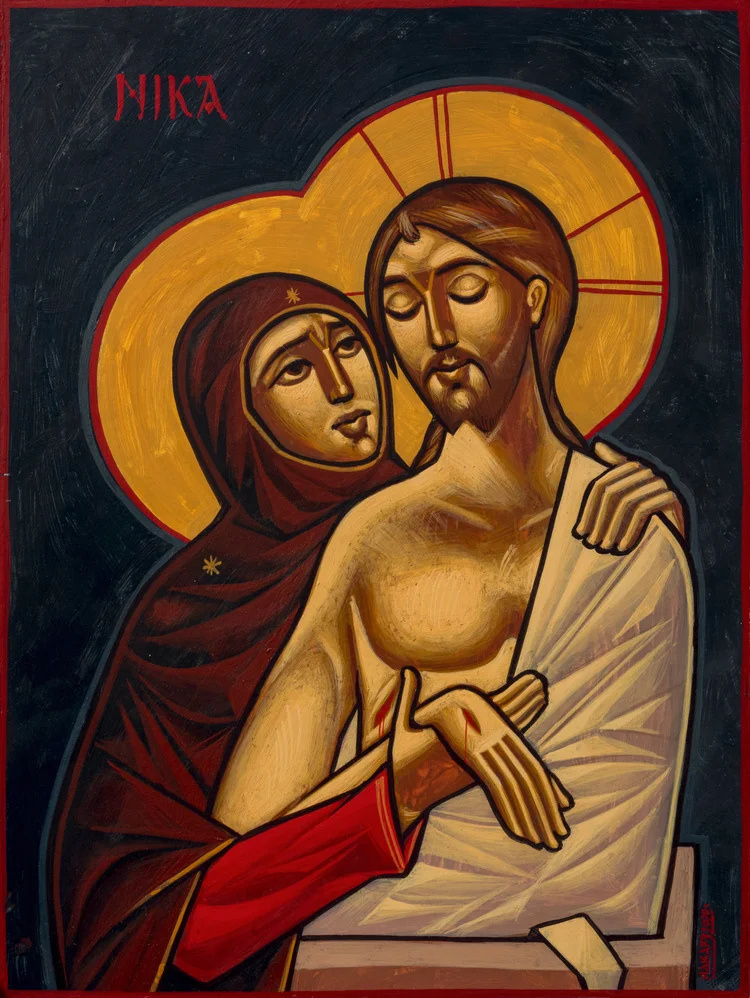
Christ the Bridegroom · I Make All Things New
The Hebrew of the Song of Songs says she is faint with love — overcome, overwhelmed, laid low by a longing she cannot contain. The Septuagint, the Greek translation beloved by the Fathers, renders the word differently: she is wounded — struck open — by love. It is a small difference in translation and an enormous difference in theology. The Septuagint's Bride is not merely overcome. She has been struck. Something has entered her. A mark has been made that was not there before.
St Gregory of Nyssa hears this and does not flinch from the image. In his magnificent Commentary on the Song of Songs — fifteen homilies of sustained, soaring theological poetry — he develops what becomes one of the most remarkable ideas in all of patristic literature: the divine Archer, striking the soul with the arrow of love. The arrow is the Logos Himself, writes St Gregory. Its point is the Spirit. Its feathers are Scripture. And the wound it makes is not damage. It is opening.
His great insight, extending across his theology of the spiritual life, is the concept of the eternal stretching-forward of the soul toward an infinite God. The soul that truly encounters God does not reach satiation — it reaches a deeper hunger. It does not arrive at a point from which no further movement is possible — it discovers that every horizon opens onto another. The wound opened by divine love creates a new space in the soul that only God can fill. And He fills it — and the filling opens the soul further, and the further opening creates more space, and the space draws Him deeper still.
The soul that truly encounters God does not reach satiation — it reaches a deeper hunger.
This is one of the most liberating insights the Fathers offer the servant who is struggling with the wound of unfulfilled spiritual longing: the ache for deeper prayer, the hunger for a fuller sense of God's presence, the longing to serve from a place of genuine love rather than habit or obligation. St Gregory's word is this: that ache is not evidence of something wrong. It is evidence that this holy stretching-forward is alive. The soul is still stretching. Still being struck. The wound is open — and the wound that is open is the wound that is being filled.
The Bride in the Song of Songs does not lament her wound. She announces it. She is not embarrassed by the mark the divine Archer has left in her. She speaks of it as her most intimate boast: I have been struck by a love I cannot contain. The inability to contain it is not a defect of her spiritual capacity. It is the nature of finite creatures encountering an infinite love. The wound is the sign that something utterly real has happened. The mark left by a love that is not theoretical, not merely doctrinal, not merely liturgical — but personal, piercing, present.
For the Coptic servant, there is an additional resonance. The tradition of the Desert Fathers, the monastic heartbeat of the Coptic Church, is saturated with this understanding of holy desire. Abba Isaac, speaking to the young monks at Scetis, describes the life of prayer as a life of perpetual reaching — not a life of arrival but of movement, of the soul always being drawn further into the mystery of the God who is inexhaustible. The servant who serves in the spirit of the desert tradition serves from this inexhaustible desire — and finds that the inexhaustibility is not exhaustion. It is the wound of love, kept open by the love itself, and filled, constantly and overflowingly, by the same.
Of all the wounds this day names, the wound of holy longing is the one servants are least likely to speak aloud. It feels presumptuous. The servant who admits they ache for more of God fears sounding arrogant, or theatrical, or spiritually inflated. But the Fathers are unanimous: this ache is not arrogance. It is the most honest thing a servant can say. The heart that is not yet aching toward God has not yet been struck. The heart that aches has been found.