“Glory to God for all things.”
St John Chrysostom · Letters from Exile
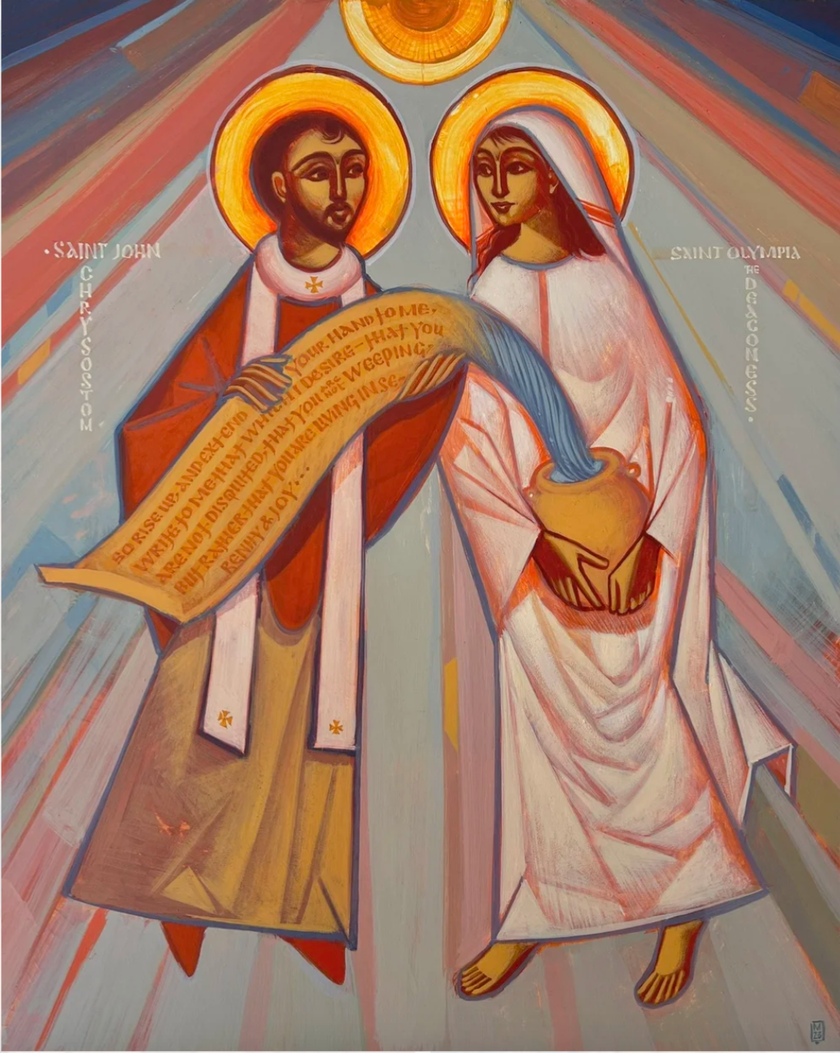
Ss John Chrysostom & Olympia the Deaconess
He is remembered as the Golden-Mouthed: the greatest preacher of the ancient Church, the Patriarch of Constantinople, the man whose homilies on the Gospels shook entire cities and drove the powerful to repentance. When he spoke, the crowd was silent with a silence that felt like listening for one’s own name. But it is not his eloquence that speaks most powerfully to the wounded servant. It is his end.
St John Chrysostom was deposed twice. The first deposition lasted only days before popular pressure and a convenient earthquake brought him back. The second was permanent. The Empress Eudoxia, whom he had challenged publicly for her vanity and indulgence of the rich at the expense of the poor, secured his exile with the support of a synod he would not have called legitimate. He was sent first to Cucusus in Armenia — a city he described as exposed to every wind and every hostility — and then, when it became clear he was still drawing visitors and influence, the order was given to march him further, to Pityus on the eastern shore of the Black Sea. He did not survive the march. Forced to walk in the rain regardless of his age and illness, forbidden to shelter, he died in September of 407 AD at the small town of Comana in Pontus.
Those with him recorded that his final words were these:
Glory to God for all things.
Not for the good things. Not for the homilies that shook Antioch, or the thousands baptised under his episcopate, or the moments of unmistakable grace that had marked his ministry across three decades. For all things — including the exile, including the cold, including the abandonment by those he had formed and loved, including the end that looked from the outside like the defeat of everything he had worked for.
This is not stoicism. Stoicism is the refusal of pain through an act of will — the determination to remain unmoved by what happens. St Chrysostom was moved. His letters from Cucusus describe real loneliness, real cold, real grief at being separated from his people. He felt the wound fully. He did not manage it from a distance. What he did — what the long formation in prayer and the Liturgy and the honest offering of repeated wounds to God had made possible in him — was to take the wound and offer it. To say, from inside the exile: You are here. And You are good. And therefore: Glory.
The doxology is not what St Chrysostom achieved through spiritual willpower. It is what God had been building in him across a lifetime of smaller offerings — through the wounds of misunderstanding in Antioch, of political machination in Constantinople, of watching those he loved fall away, of serving a people who were sometimes ungrateful and sometimes faithless and always, in his eyes, worth every sacrifice. He arrived at the final doxology because he had been practising smaller doxologies all his life.
The servant who meditates on this is not asked to arrive at “Glory to God for all things” today. They are asked a more manageable and more demanding question: Am I on the path that leads there? Is there a wound in my current service from which I am, by God’s grace and my own imperfect cooperation, learning to offer something? Not resignation. Not bitterness swallowed and relabelled. But genuine offering — the wound placed in the hands of the One who permitted it, who is present within it, and who is doing something inside it that is not yet visible but is already real.
St John Chrysostom’s feast day is observed in the Coptic Orthodox Church on the thirteenth of Hatour. When we commemorate him, we commemorate not only the Golden-Mouthed preacher. We commemorate the man who stood in the rain on the road to Pityus and found, at the very last, that he had nothing left to offer but everything — and that everything was enough.