“Present your bodies a living sacrifice, holy, acceptable to God, which is your reasonable service.”
St Ignatius of Antioch · Epistle to the Ephesians
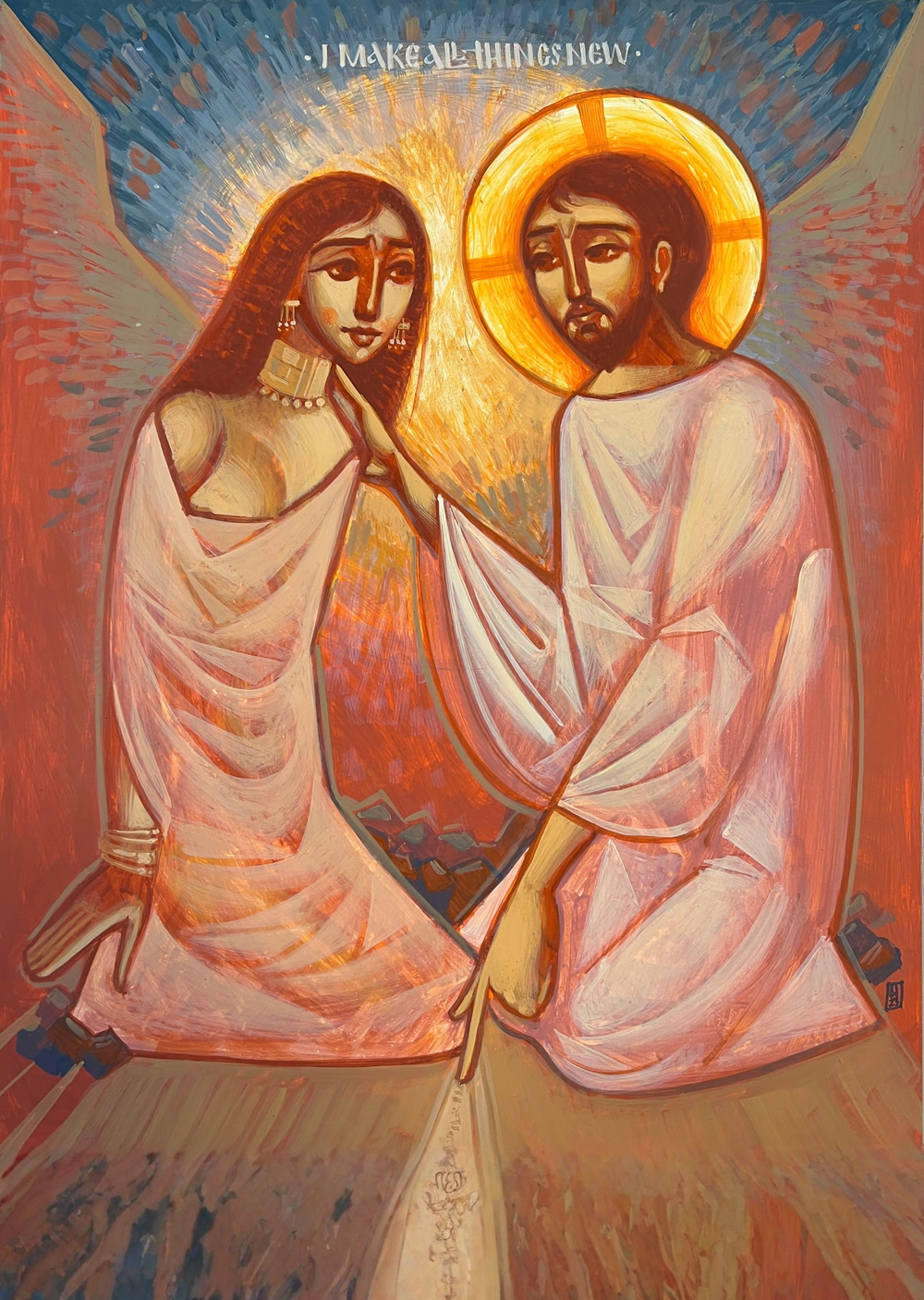
The Theotokos · Standing at the Cross
St Ignatius of Antioch, writing to the Ephesians on his way to martyrdom in Rome, describes the Eucharist as the medicine of immortality (pharmakon athanasias). He is not speaking metaphorically. He is speaking as a man who knows he is about to be torn apart by wild beasts, who has already received the wounds of the journey, and who testifies from inside that knowledge: the Body and Blood of the Lord is the medicine. Not the reward for having recovered. Not the celebration of having managed the wound. The medicine. For the sick. For the broken. For the wounded servant who comes to the altar carrying what they could not leave at the door.
The Coptic servant lives liturgically in a way that much of the Christian world does not. The Divine Liturgy is not one activity among others in the Coptic week. It is the event around which the week is oriented — the moment toward which the servant moves all through the week and from which they depart strengthened, or consoled, or at least accompanied. The preparatory prayers, the prayer of thanksgiving, the prayer of reconciliation before the anaphora, the Great Entrance, the fraction, the communion — each of these is a moment in which the wound the servant carries can be deliberately offered.
The prayer of reconciliation is particularly important for the wounded servant. Before the anaphora begins, the deacon calls: “Salute one another with a holy kiss.” This is not a formality. It is the Church requiring of every person present that they not approach the mystery of the Cross while nursing an unresolved wound against their brother or sister. The Liturgy is not a space the servant enters with their wound managed. It is a space they enter with their wound present — and the Liturgy itself does what the servant cannot do alone.
St John Chrysostom, in his homilies on the priesthood, speaks with awe about what happens at the altar. He does not describe the priest as a spiritual professional performing a religious function. He describes him as standing in a place where heaven and earth are not separated, where the sacrifice of Calvary is made present, where the wounds of Christ are not historical but living. The servant who participates in that Liturgy — who brings to the altar the wound of their service and unites it consciously, deliberately, to the wound of the Cross — is not performing an act of spiritual management. They are doing the most fundamentally Orthodox thing available to them: they are placing the wound inside the great offering.
The Coptic Liturgy of St Basil is explicit about this. The anaphora prays: “Remember, O Lord, those who are sick and suffering, those in need, the poor and the needy.” It names the suffering. It brings it in. It does not ask the suffering to wait outside until the holy things are over. The Liturgy was never designed for the well and the strong. It was designed, as St Ignatius knew on the road to the arena, for those who need medicine.
The altar is not a place of arrival. It is a place of offering. And the servant who brings their wound to it discovers, Sunday by Sunday, that the altar receives all things.
The practical invitation for the servant is this: do not leave the wound in the car before entering the church. Bring it in. Name it in the silence of the preparation prayers. Offer it consciously at the Great Entrance. Receive at the communion rail not as a graduate of the week’s spiritual exercises but as one who needs the medicine — and who is receiving, in that moment, the same medicine that sustained St Chrysostom in Cucusus, that held Pope Kyrillos VI in the desert, that accompanied St Pishoy Kamel on the thin mattress.