“Out of the depths I have cried to You, O LORD; Lord, hear my voice!”
Pope Kyrillos VI · The Silent Patriarch
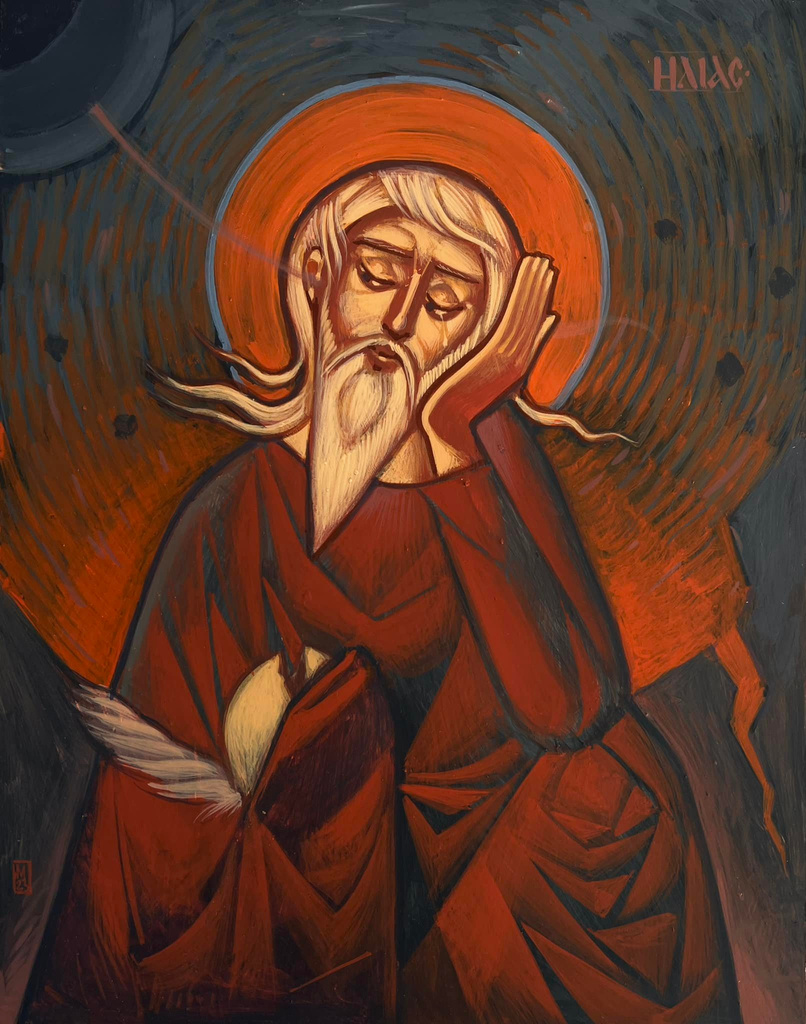
The Prophet Elijah · God Speaks in the Wilderness
There are wounds that announce themselves — that arrive with a recognisable face, that can be named and prayed over and brought, in some form, to a spiritual father. And then there is the wound described by those who have walked furthest into the dark with an honesty that is almost uncomfortable to encounter — the wound that has no face, because it is not the wound of something that happened but the wound of something that has gone: the withdrawal of all spiritual consolation, the complete removal of the experienced sense of God’s presence, the silence where there was warmth, the wall where there was an open door.
The monastic tradition does not call this the absence of God. It calls it — with precision and with the testimony of years — the most hidden form of God’s presence.
Those seasons are described with unflinching honesty — not days, not weeks, but seasons — in which prayer seemed to strike the ceiling and fall back. Seasons in which the Liturgy was celebrated without the felt participation of heaven. Seasons in which one sat before the icon and felt, not the warmth of encounter, but the blankness of interior poverty. The tradition does not explain these seasons away. It does not offer three steps toward restoration. It sits in them. It prays from the void. It waits with the patience of those who have learned that God has not gone. He has gone quiet. And there is a difference.
On the other side of those seasons — after years, not days — comes the testimony of what was happening in the dark. The capacity eventually forged to intercede for others with a depth and an authority that astonished those around them, to carry in prayer the suffering of the world with a weight that was personal rather than notional, to accompany the most desperate souls with a compassion that seemed to come from a place deeper than empathy — that capacity was forged in the desolation. Not despite it. Through it.
The conclusion of those who have passed through such seasons, offered not as theory but as testimony, is one the servant in dryness needs more than almost any other word: the one who has never descended cannot accompany the descent of another. The servant who has known only consolation in prayer — who has never sat in the silence where God seemed absent, never prayed from the void of their own poverty — cannot fully sit with the person who is in that silence now. They can offer advice. They can offer encouragement. But they cannot offer the particular gift of one who has been in the same dark, and was held, and came back with the testimony that the dark was not empty.
The Silent Patriarch, His Holiness Pope Kyrillos VI, was known not for eloquence but for a presence. Those who came to him in crisis often reported that he said very little — sometimes nothing at all. What they received from him was not information but transmission: the quiet of a man who had spent so many hours in the dark before God that he had become, in some way, a living space of God’s presence. His silence was not emptiness. It was the fruit of desolations he had brought to God and been held through. The seed of his intercession for others was planted in the dark seasons of his own poverty.
For the servant who is currently in such a season: this is not abandonment. This is preparation. The seed is being buried. The dying that precedes the grain — the dying that John 12:24 describes as the condition of fruitfulness — is happening in the dark. You cannot see it. You may not feel it.
The dark before the dawn is not evidence against the dawn. It is evidence that the dawn is nearer than it appears.
A question to carry away
Is there a person in your service community — a young person in crisis, a struggling family, a colleague in ministry — whose darkness you have found genuinely difficult to enter? Could it be that the wound of your own desolation or failure is precisely what would equip you to sit with them — not with answers, but with presence?