“Now there stood by the cross of Jesus His mother.”
St Cyril of Alexandria · The Theotokia
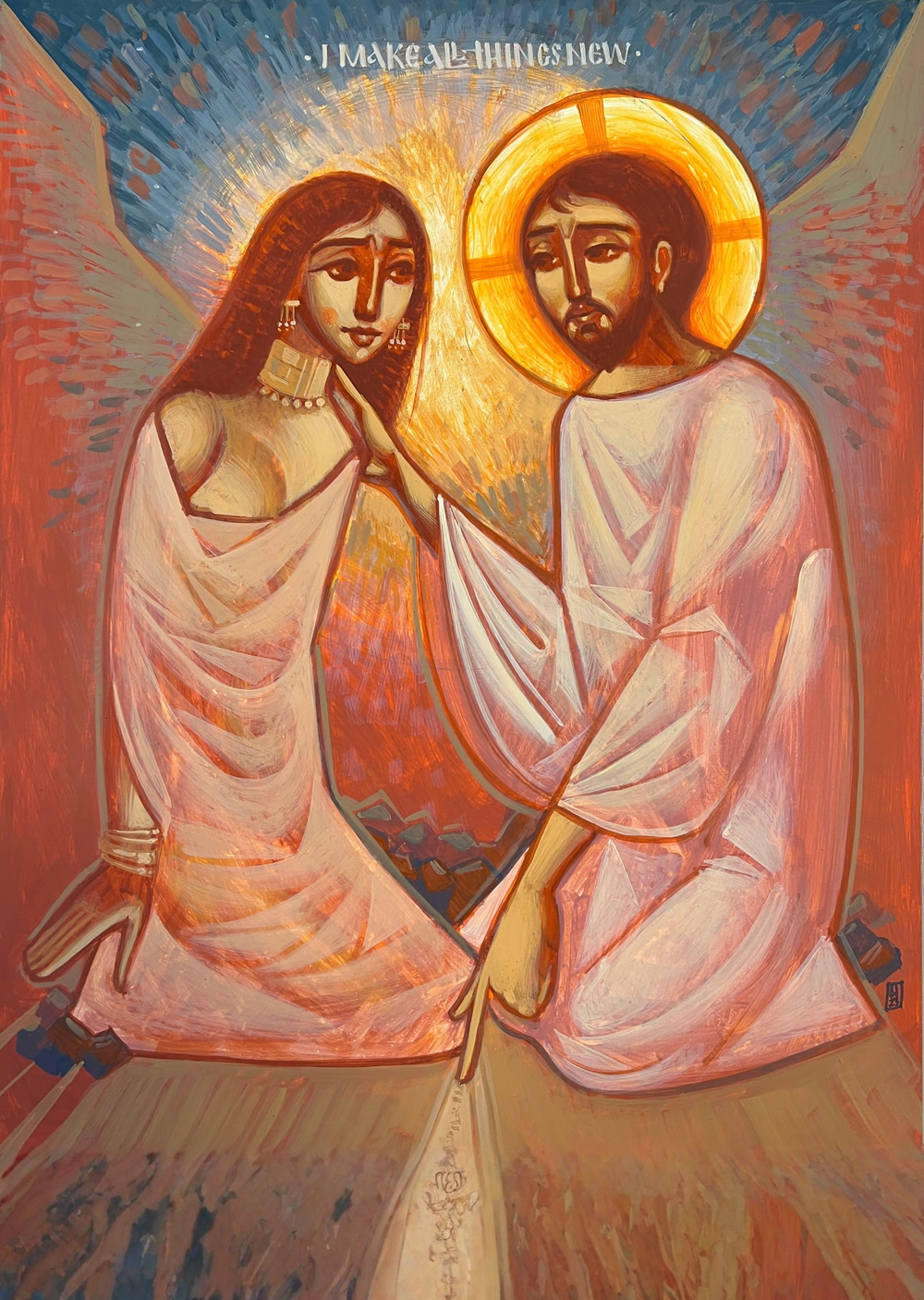
The Theotokos · She Stood
Simeon told her thirty-three years before it happened. He took the infant into his arms in the Temple, blessed God, and then turned to Mary with a word no mother should hear about her child: “A sword will pierce through your own soul also” (Luke 2:35). She received this prophecy on the eighth day of her Son’s life. She carried it for the full length of His earthly ministry — through the hidden years of Nazareth, through the public ministry, through every healing and every confrontation and every moment she watched the world misunderstand, reject, and plot against the One she knew from the inside out. She carried the wound of that prophecy before the wound itself arrived.
And when it arrived, she stood.
The Greek word the Evangelist uses is precise and deliberate: the active word meaning she was standing firm. Not collapsed. Not watching from a distance. Standing at the foot of the Cross, close enough to hear His breathing, close enough to see His face, present in the wound with the full weight of maternal love and the full cost of what that love required her to witness. Every other account of the Crucifixion speaks of the disciples having fled. She did not flee. She stood.
This is not the endurance of someone who has suppressed their pain. The Coptic tradition has never read the Theotokos as emotionally absent from the Passion. The Theotokia hymns — sung at every Hour, woven into the fabric of every liturgical day — describe her grief with an honesty that is sometimes startling: her tears, her cries, the desolation she carried. The tradition does not ask her to perform composure. It asks something harder: to remain present in the wound, to stay at the Cross, to receive into her own soul what Simeon had told her was coming. The sword pierced. And she stood.
In the Coptic midnight praise, the tasbeha, the faithful gather in the dark hours and cry out: Ya Umm al-Nour — O Mother of the Light. They bring to her what they carry: the grief of the day, the wound of the week, the chronic ache of service that costs more than it appears to return. They bring it to her not because she is a solution but because she is a companion — one who has stood in a wound greater than any they will ever carry, and who remains, still, interceding from within it.
The servant who has sat with a suffering person they love and could not help, who has watched a young person they invested years in walk away from the faith, who has carried the grief of another’s darkness into their own prayer and found it almost unbearable — this servant knows something of what it means to stand at the Cross. Not the Cross of personal suffering only, but the Cross of love that suffers in another’s suffering. This is the wound the Theotokos bears, and it is the wound she consecrated by choosing not to look away.
St Cyril of Alexandria, whose theology of the Incarnation insists on the full humanity of the One born of her, also insists on what this means for her: she bore in her body and her soul the full weight of what it cost God to become human and to die. She is not a symbol of passive acceptance. She is the prototype of the servant who loves so completely that they will stand in whatever the love requires them to stand in — and who discovers, standing there, that they are not standing alone. The Beloved Disciple was given to her in that moment. She was given to him. Neither stood in the wound without the other.
She stood at the Cross. She stands still. And she knows how to stand with those who are standing in their own.
The Coptic Church commemorates the Theotokos on the twenty-first of every Coptic month without exception — a liturgical rhythm that ensures no month passes without her name on the lips of the faithful. This is not sentiment. It is the Church’s pastoral wisdom: the servant who forgets to run to her will carry alone what was always meant to be carried together.