“Thou madest us for Thyself, and our heart is restless, until it repose in Thee.”
St Augustine of Hippo · St John Climacus
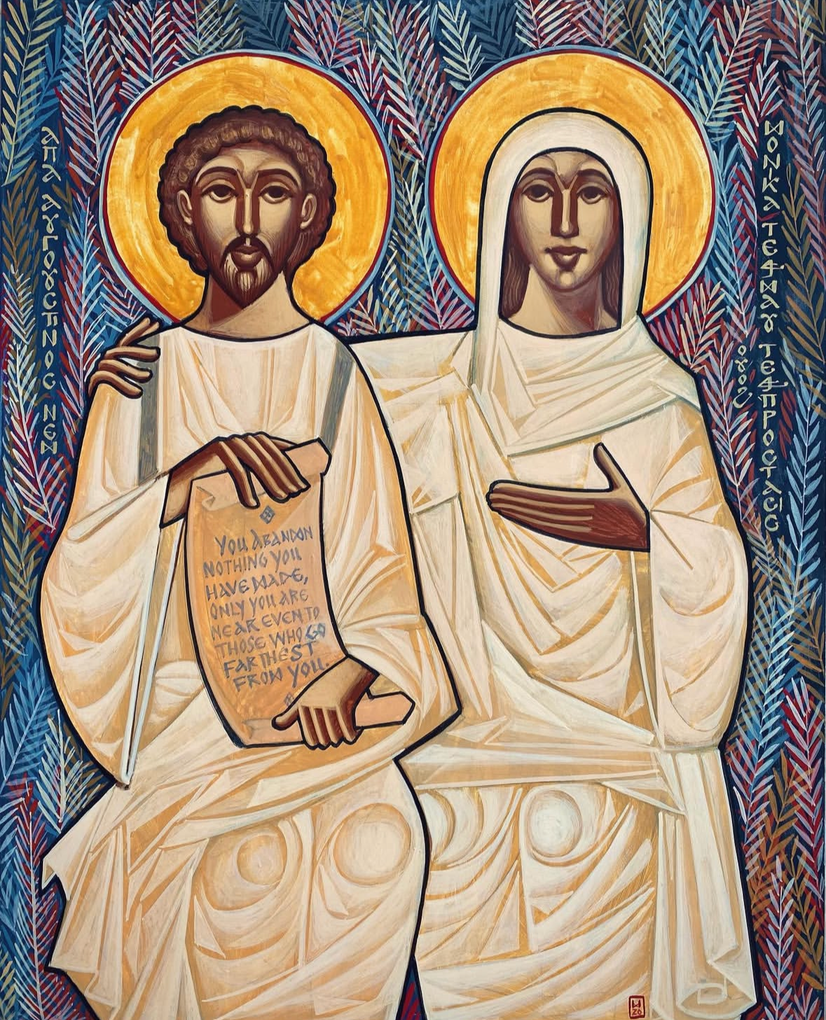
Ss Augustine & Monica · The Restless Heart
St Augustine wrote those words at the beginning of the most honest book ever written about the human soul’s search for God. He wrote them after a decade of seeking in the wrong places — philosophy, pleasure, reputation, a brilliant career, the love of a woman he could not marry, the approval of men who could not give him what he most deeply needed. He wrote them not as a man who had arrived, but as a man who had been found, and who recognised, looking back over the landscape of his wasted years, that the restlessness had been the clue all along. The wound had been doing its work even in the years when he refused to name it. His heart had been reaching toward God even while his hands were reaching toward everything else.
The restlessness St Augustine names is not a character flaw. It is not a spiritual deficiency or a sign of weak faith. It is the structural consequence of being made for an infinite love and living in a finite world. He is describing what it is to be human before God — to be a creature whose deepest capacity cannot be satisfied by anything less than the One who made it. Every servant who has given their best years to a ministry, a community, a vision — and found that even the good fruit was not quite enough, that there was still something they were reaching for that the work itself could not supply — knows this restlessness from the inside.
The wound of holy longing takes a particular form in the servant. It is not the wound of failure. It is the wound of the person who has served well, who has loved genuinely, who has given much — and who finds, in honest moments, that they are still hungry. Still reaching. Still not quite arrived at the thing they most want, which is not a more successful ministry but a fuller encounter with the living God who called them into this ministry in the first place. They wanted more of Him, and the service — however fruitful — gave them more of the work but not always more of the Person.
St John Climacus, standing at the summit of his Ladder of Divine Ascent, describes the soul in love with God as one permanently and happily unfinished. Love, he writes, by its very nature, is a reaching toward God. The one who loves God is always longing for Him — not with the longing of deprivation but with the longing of the one who has tasted and found the taste inexhaustible. Every encounter with God opens a new horizon. Every answered prayer reveals a deeper prayer that was waiting underneath it. The soul that has genuinely met the living God does not reach satisfaction. It reaches a deeper hunger.
The servant who prays the morning prayers and finds their mind elsewhere is not failing at prayer. The servant who celebrates the Liturgy and feels, on some Sundays, that heaven has not come as close as it does on others — is not failing at the Liturgy. The servant who loves their class and gives their best and still drives home with a quiet ache that something more was supposed to happen — is not failing at service. They are living the restlessness St Augustine described. And that restlessness, honestly held, is not the opposite of faith. It is one of its deepest expressions.
There is one dimension of this wound that servants rarely speak aloud, because it feels presumptuous. It is the ache for more of God Himself — not more spiritual experiences, not more fruit in ministry, but more of the Person. The servant who dares to say “I have not found enough of Him yet — I want more” is not being arrogant. They are being honest about a longing that the Fathers consider the mark of genuine spiritual life.
The heart that is not restless toward God is the heart that has not yet been struck. The heart that aches is the heart that knows, however imperfectly, what it was made for.
And the One for whom it aches is not indifferent to that aching. He made the heart that way. He is the one it is reaching toward. And He does not remain at a distance from those who reach.